Your AI data center is experiencing high operating costs due to rising electricity rates. The facility hosts various workloads, including massive deep learning training runs, high-throughput inference services, and intensive data preprocessing. Which power management strategy is most effective at reducing energy consumption without causing permanent performance degradation?
Select an answer to reveal the explanation.
Short Explanation and Infographic
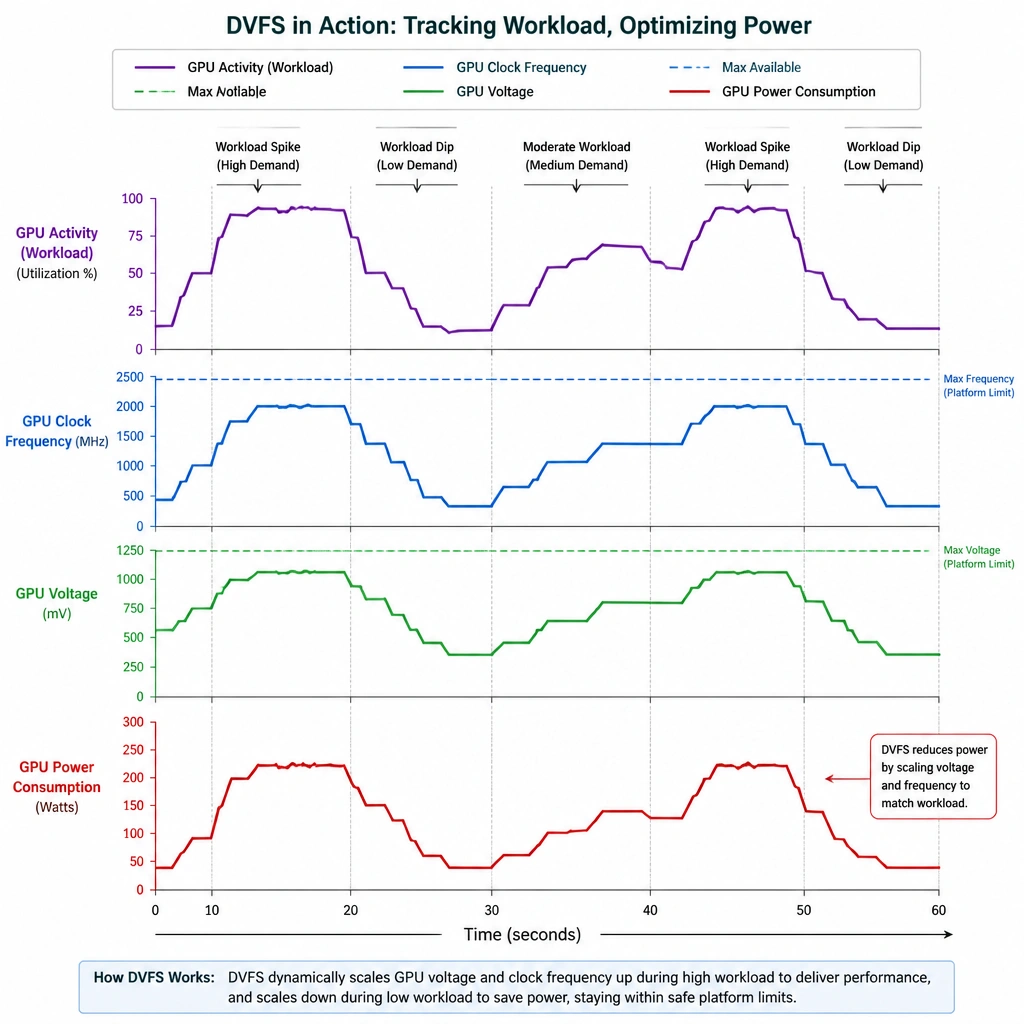
Imagine your boss walks in and says, 'Our electricity bill is through the roof, but don't you dare slow down our training runs!' That's a classic data center challenge. If you just underclock all the GPUs, you'll save power, but your models will take forever to train. Not a good move! Instead, we use Dynamic Voltage and Frequency Scaling (DVFS). Think of it like a smart gas pedal: when the GPU is doing light work, it dials back the power and clock speed. But when a heavy training batch hits, it guns it to full speed. This saves energy during quiet moments without hurting performance when it counts. Nice and clean!
Full explanation below image
Full Explanation
Dynamic Voltage and Frequency Scaling (DVFS) is a highly effective power management technique that adjusts a processor's voltage and clock frequency in real-time according to the current workload demands. When the GPU is waiting for I/O or processing lighter tasks, DVFS automatically lowers the frequency and voltage, reducing dynamic power consumption (which scales quadratically with voltage). When a compute-intensive phase begins, DVFS scales the values back up to deliver maximum performance. This ensures that energy is saved during periods of lower utilization without permanently degrading processing capabilities. - A is incorrect because permanently underclocking GPUs reduces their performance across all workloads, directly violating the requirement to maintain high processing speeds. - B is incorrect because trying to run large-scale AI workloads (which typically require clusters of multiple GPUs) on a single GPU is technically unfeasible and would result in severe memory issues and performance degradation. - C is incorrect because shifting workloads to nighttime hours changes when electricity is consumed (potentially lowering utility costs) but does not actually reduce the total amount of energy consumed by the hardware.