As deep learning models grow to billions of parameters, training them on a single workstation becomes impossible due to time and memory limitations. Why are distributed computing environments the standard infrastructure choice for handling large-scale AI workloads?
Select an answer to reveal the explanation.
Short Explanation and Infographic
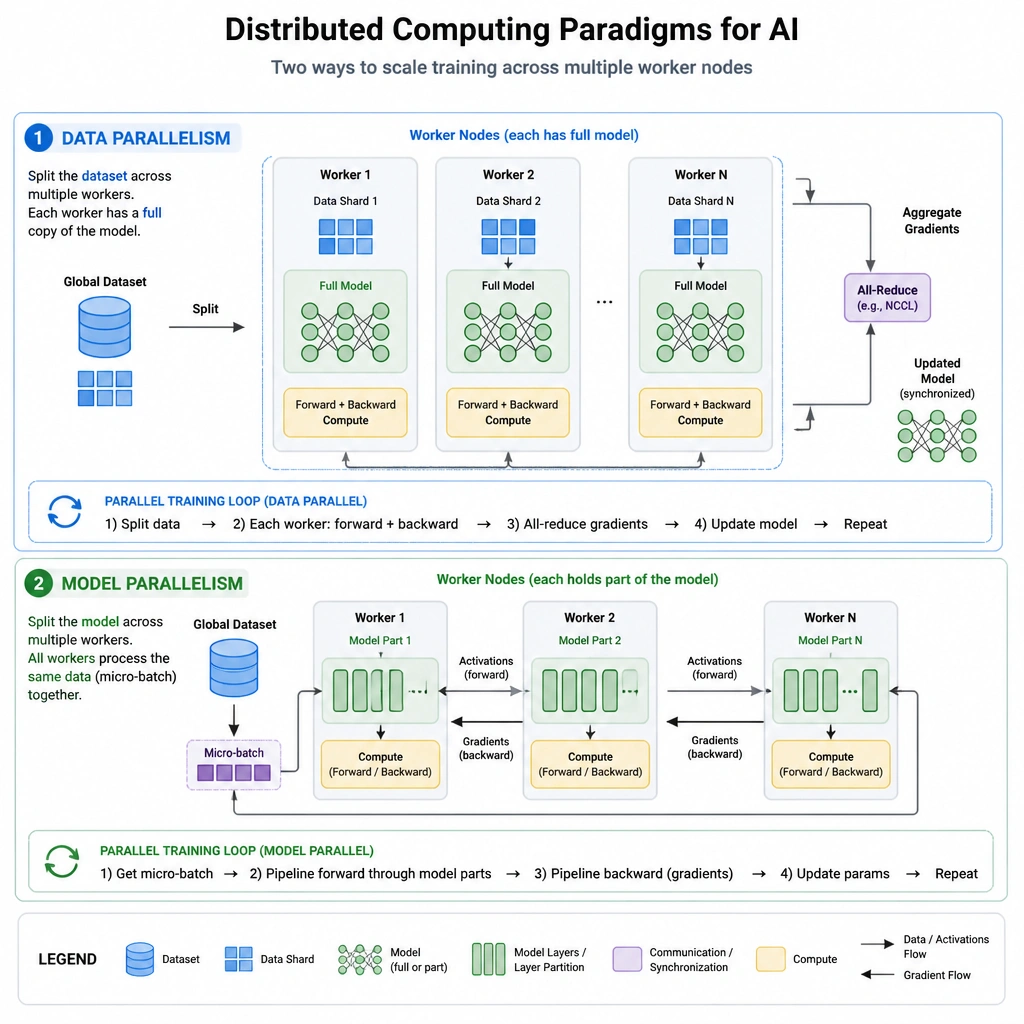
Think of it like this: if you have to build a giant brick wall by yourself, it's going to take weeks. But if you bring in ten of your buddies, you can divide the wall into sections and build it in parallel. That's exactly how distributed computing works for AI. Modern models are massive—we're talking billions of parameters. Running that on one machine will take months, or you'll run out of memory. By using a distributed environment, we split the data and the model parameters across a bunch of nodes, processing the workloads in parallel. It speeds up training and inference, and lets you handle models that wouldn't even fit on a single GPU.
Full explanation below image
Full Explanation
AI workloads, particularly deep learning, are computationally intensive and require processing massive datasets and millions or billions of model parameters. Distributed computing environments facilitate parallel processing through two main paradigms: 1. Data Parallelism: The training dataset is split into smaller batches, and each node trains a local copy of the model on its batch, synchronizing gradients at the end of each step. 2. Model Parallelism: The model itself is too large to fit in the memory of a single GPU, so different layers or parts of layers are distributed across multiple nodes. By dividing the computational load, distributed systems allow these tasks to run concurrently, scaling memory capacity and computational power to drastically reduce training and inference times. - A is incorrect because distributed computing does not eliminate the need for GPUs; in fact, distributed AI systems typically consist of nodes loaded with multiple GPUs or other specialized hardware accelerators. - C is incorrect because AI workloads are notorious for requiring massive amounts of memory, not less memory than traditional workloads. - D is incorrect because AI models are highly complex, non-linear deep neural networks, not simpler architectures.