During the training phase of a large deep learning model on a cloud server equipped with NVIDIA GPUs, the execution process intermittently halts with an Out-of-Memory (OOM) error. Interestingly, real-time monitoring tools report that the total allocated VRAM remains well below the maximum hardware limit when the crash occurs. Which of the following explains this anomaly, and how can it be resolved?
Select an answer to reveal the explanation.
Short Explanation and Infographic
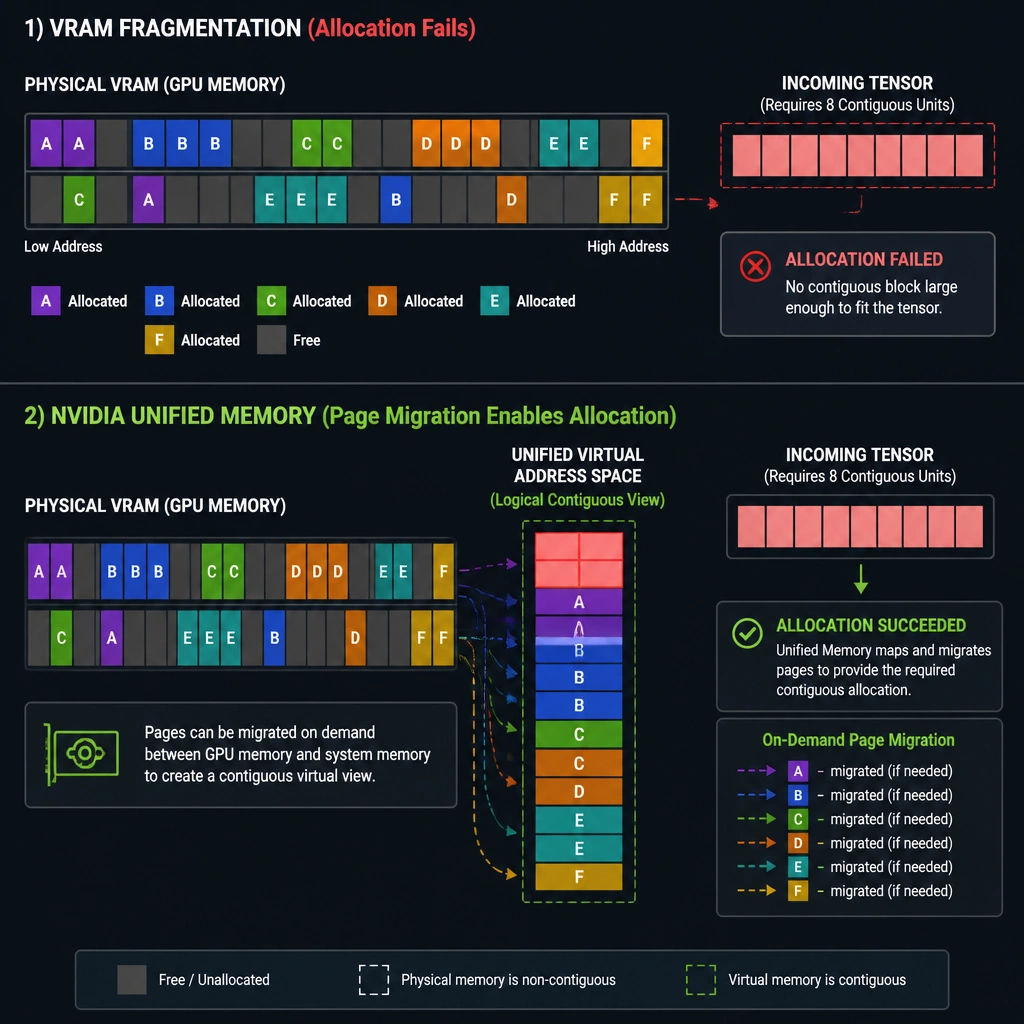
Check this out: this is one of those issues that drives engineers absolutely crazy. Your monitoring tool says you've got 4GB of free memory, but the system throws an Out-of-Memory crash anyway. What gives? Think of it like a parking lot. You have 20 empty spaces, but they are scattered all over the lot. If a massive tour bus pulls up, it needs 5 spaces in a row to park. If it can't find a contiguous block, it can't park! That is memory fragmentation. The GPU allocator needs contiguous blocks of VRAM for large tensors. To fix this, you can enable NVIDIA Unified Memory. This creates a shared memory pool between the CPU and GPU, letting the driver dynamically migrate pages back and forth, effectively giving you a much larger virtual address space and cleaning up those fragmentation issues. Trust me, it's a lifesaver.
Full explanation below image
Full Explanation
GPU memory allocation requires contiguous blocks of physical memory (VRAM) to store tensors. During training, variables are constantly allocated and freed as layers execute their forward and backward passes. Over time, this dynamic allocation causes memory fragmentation: the VRAM becomes peppered with small, non-contiguous free spaces. While the total sum of these free spaces might show as significant in monitoring tools (e.g., nvidia-smi), a request for a large new tensor allocation will fail if there is no single contiguous block large enough to fit it. This triggers an Out-of-Memory (OOM) error.
To mitigate this, enabling NVIDIA Unified Memory (also known as CUDA Unified Memory) provides a bridge. Unified Memory creates a single, managed memory address space shared between the CPU and the GPU. It uses page migration engine technology to automatically move data pages between host system RAM and GPU VRAM on-demand. This allows applications to allocate memory allocations larger than the physical size of VRAM (oversubscription) and significantly reduces the impact of fragmentation by allowing the virtual memory system to map non-contiguous physical pages into a contiguous virtual address space.
Let's address the distractors: Option A (slow data loader) causes GPU starvation (underutilization), which slows down training but does not trigger OOM crashes. Option B (reducing batch size) is a standard way to reduce overall memory footprint, but it doesn't directly solve the issue if the crash is happening when reported memory is well below the maximum capacity. Option D (host CPU over-sub-scribing the queue) might affect host-device synchronization latency, but it does not cause physical VRAM allocation failures on the device.