In an enterprise AI training cluster, GPUs often sit idle, waiting for training data to be read from storage and loaded into memory—a state known as I/O starvation. To maximize GPU utilization and data throughput, which storage hardware strategy should you implement?
Select an answer to reveal the explanation.
Short Explanation and Infographic
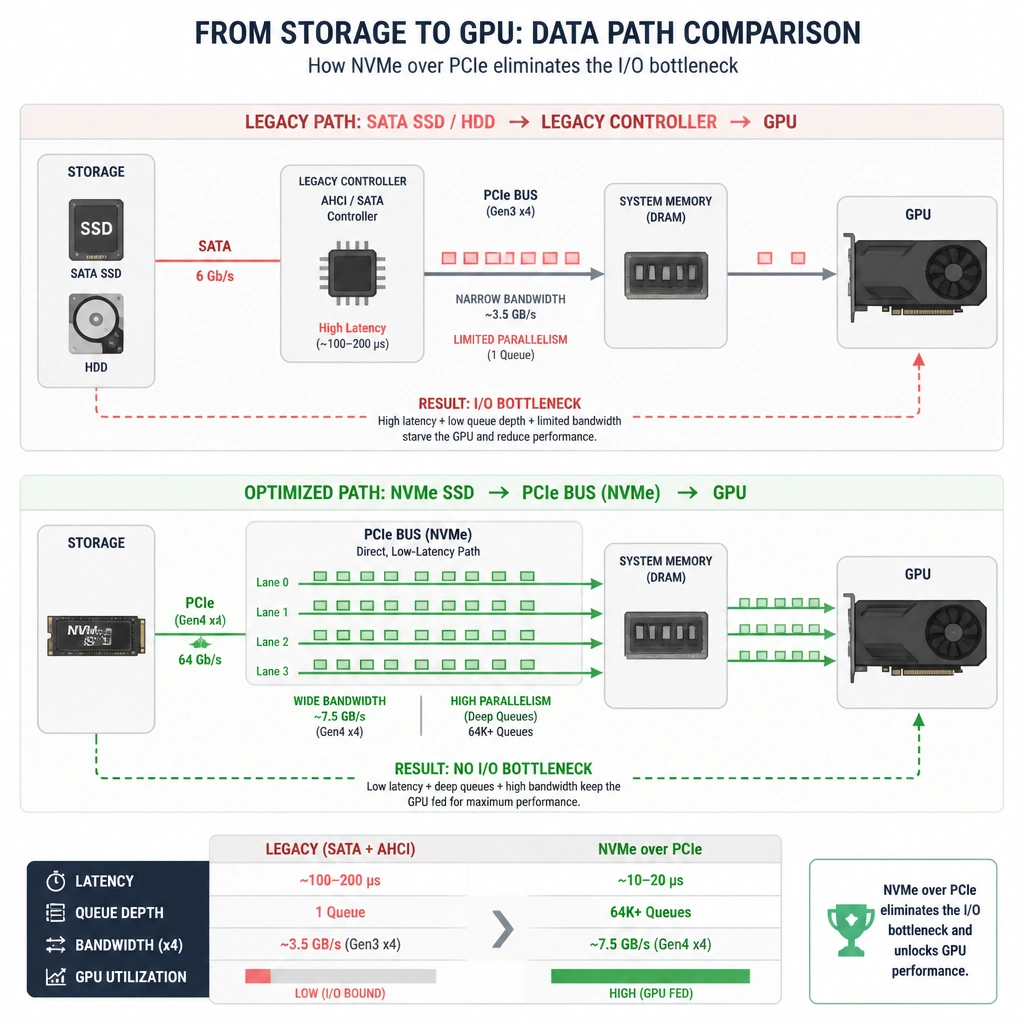
Here's the deal: if you have the fastest GPUs in the world, but your storage is slow, those expensive chips are just going to sit there twiddling their thumbs. We call this I/O starvation, and it's a huge waste of money. Think of it like trying to feed a fire hose with a drinking straw. To fix this, you need to ditch the old spinning disks and even standard SATA drives, and go straight to PCIe-based NVMe SSDs. NVMe speaks directly to the PCIe bus, bypassing the legacy storage protocols that were built for slow mechanical drives. This gives you insane throughput and super-low latency, which is exactly what you need to keep those hungry GPU cores fed with data. Do not let your storage be the bottleneck that kills your AI performance! Got it? Sweet. Let's keep rolling.
Full explanation below image
Full Explanation
In high-performance computing (HPC) and AI training environments, data ingestion is a critical phase. Deep learning models require massive datasets containing millions of files (images, text, or audio) to be continuously loaded into GPU memory during training epochs. If the storage subsystem cannot deliver this data quickly enough, the GPUs experience 'I/O starvation' and stand idle, reducing overall efficiency.
To resolve this bottleneck, the best strategy is to deploy Non-Volatile Memory Express (NVMe) SSDs (Option C). Unlike legacy storage interfaces such as SATA or SAS, which were designed for mechanical hard drives and rely on protocols with high latency and low queue depths, NVMe was built from the ground up for solid-state storage. NVMe SSDs interface directly with the high-speed PCIe bus. This direct connection dramatically reduces latency and enables massive parallel queue depths (up to 64,000 queues with 64,000 commands each), providing the high read throughput and random I/O performance required to feed modern GPUs.
Let's evaluate the incorrect options. Layering a distributed file system over mechanical hard drives (Option A) will not solve the underlying hardware bottleneck; spinning HDDs have physical seek times that are far too slow for AI workloads. Standard SATA SSDs (Option B), while faster than HDDs, are capped by the legacy SATA III interface (around 600 MB/s), which is insufficient for high-density GPU clusters. While RAID configurations can improve throughput, standard SATA-based RAID 5 is still bottlenecked by the controller interface and write performance overhead. Using standard Gigabit Ethernet links for NAS (Option D) introduces severe network bottlenecks, as a 1 Gbps link can only deliver roughly 125 MB/s of throughput, which is vastly inadequate for modern AI training demands.