A cloud-native Kubernetes cluster hosts a mixed set of AI workloads, including long-running, high-priority LLM training jobs and short, latency-sensitive inference services. To prevent resource conflicts and ensure that training jobs do not occupy nodes reserved for real-time inference, which Kubernetes scheduling mechanism should be configured?
Select an answer to reveal the explanation.
Short Explanation and Infographic
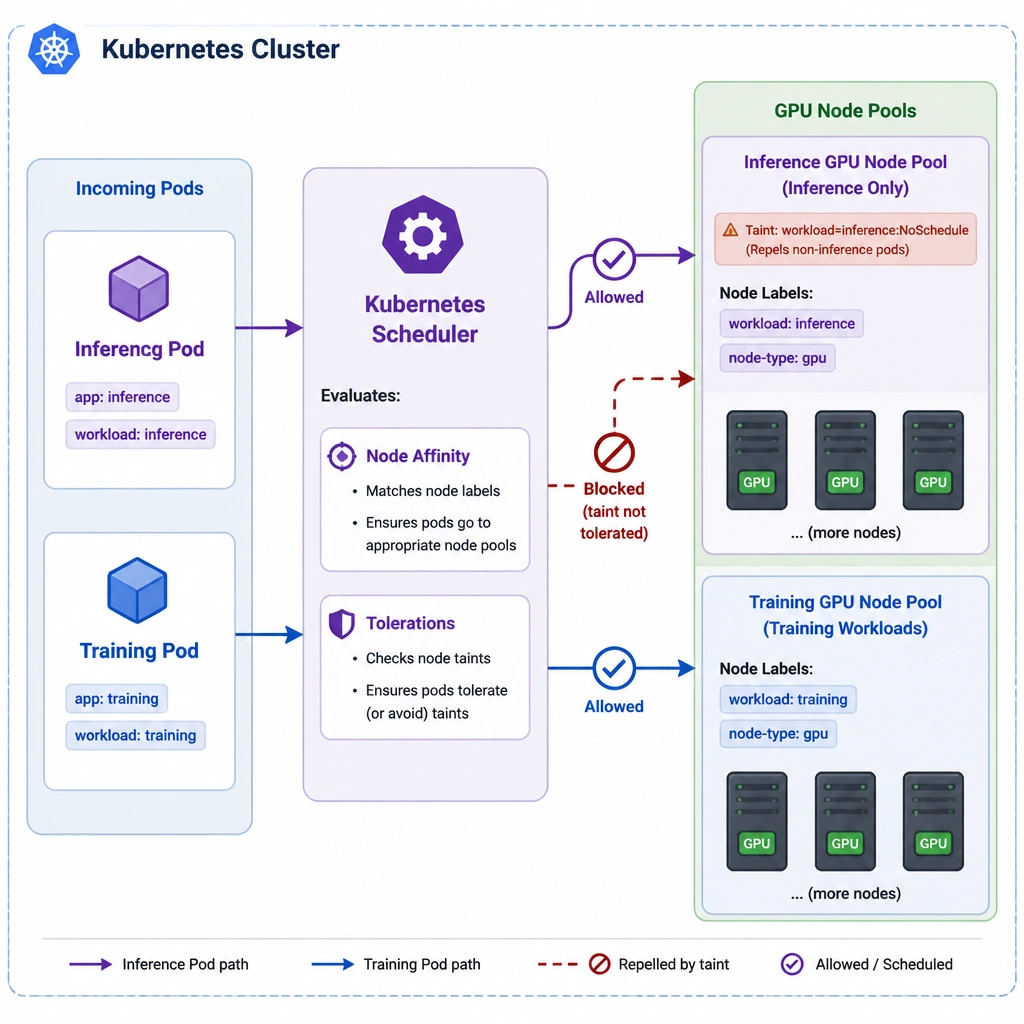
Check this out: in a busy cluster, you've got different workloads competing for the same expensive GPU resources. You might have a massive language model training job that runs for days, and a real-time voice recognition service that needs to answer users in milliseconds. If you don't set up proper boundaries, that training job will hog all the GPUs, and your real-time service will be left stranded. Not good! To keep the peace, you need to use Kubernetes Node Affinity along with Taints and Tolerations. Think of taints like a sign on a VIP room that says 'Authorized workloads only,' and tolerations like the key that lets specific pods in. By combining this with node affinity, you can make sure your training jobs stay on their designated heavy-duty nodes and your latency-sensitive inference runs on its own dedicated pools. It's clean, automatic, and prevents production outages. Got it? Sweet. Let's keep rolling.
Full explanation below image
Full Explanation
Managing a mixed-workload AI environment in Kubernetes requires robust resource scheduling to prevent resource contention, guarantee high availability for latency-sensitive tasks, and maintain high utilization for batch training jobs. The best mechanism to achieve this segregation and optimization is the combination of Kubernetes Node Affinity and Taints and Tolerations (Option B).
Taints are applied to nodes, allowing a node to repel a set of pods. Tolerations are applied to pods, allowing (but not requiring) the pods to schedule on nodes with matching taints. For instance, an administrator can taint a pool of high-end GPU nodes (e.g., NVIDIA H100s) reserved for real-time inference with dedicated=inference:NoSchedule. Only inference pods configured with a matching toleration can run on those nodes, preventing long-running training jobs from accidentally scheduling on and monopolizing those resources. Node Affinity, on the other hand, is a set of rules that defines hard or soft preferences for scheduling pods on specific nodes based on labels (e.g., scheduling training jobs on nodes equipped with NVLink interconnects). Used together, these features allow granular, automated, and dynamic control over workload placement across heterogeneous GPU clusters.
Let's evaluate the incorrect options. FIFO scheduling (Option A) is a simplistic scheduling algorithm that processes jobs in the order they arrive. In a mixed environment, a FIFO queue would allow a massive batch training job to block urgent, real-time inference jobs, leading to unacceptable service delays. Manual static assignments (Option C) do not scale, bypass the Kubernetes scheduler's benefits, and introduce administrative overhead and single points of failure. Increasing GPU memory request limits (Option D) on all workloads does not isolate workloads or prevent scheduling conflicts; instead, it can lead to scheduling failures because nodes will quickly appear fully allocated, leaving pods in a 'Pending' state.