Your team has successfully trained a deep learning model for real-time translation on a distributed cluster using massive datasets. Now, the project is moving into the production deployment phase, where the model will serve live API requests from millions of mobile users. Which of the following architectural requirements becomes the primary focus when designing this inference environment compared to the original training setup?
Select an answer to reveal the explanation.
Short Explanation and Infographic
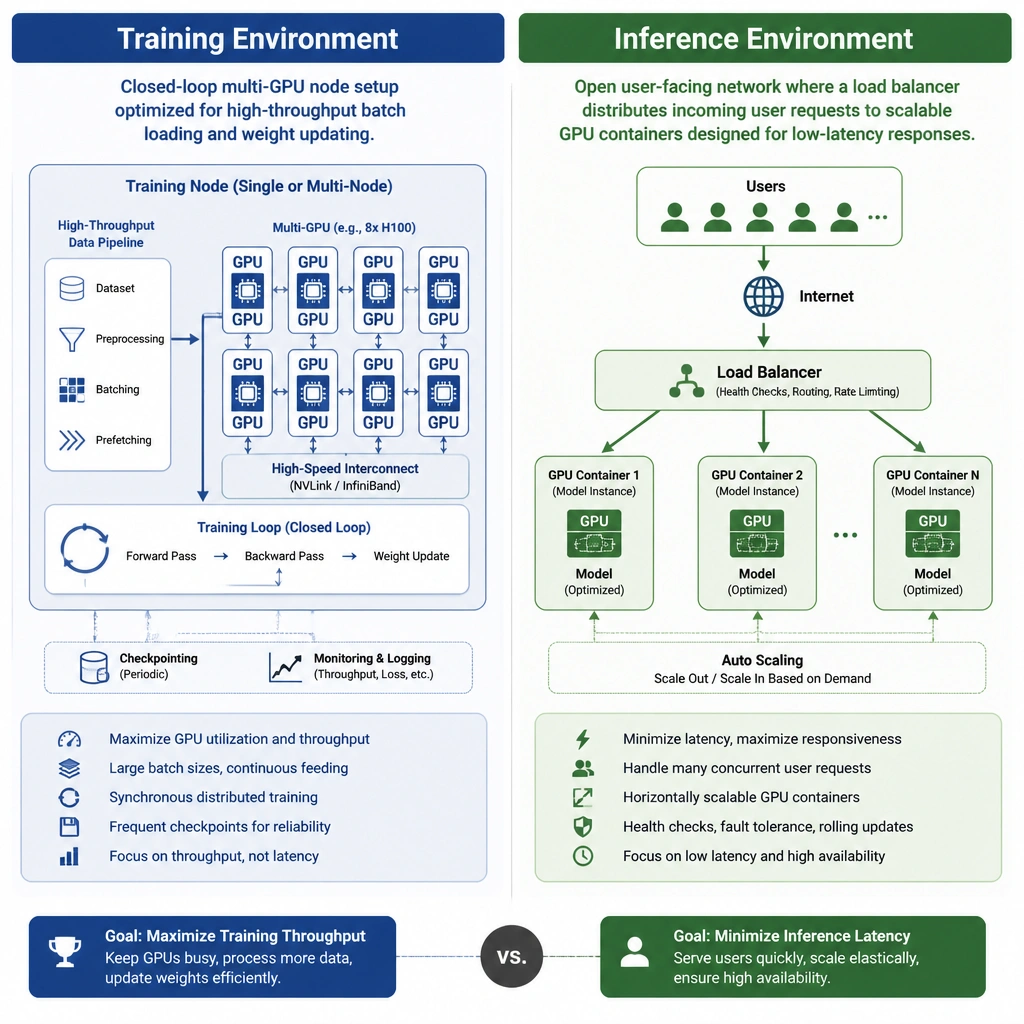
Let's look at this transition because it's where a lot of teams stumble. Training a model is all about throughput—you want to feed massive amounts of data into the GPU to adjust those weights as fast as possible, and you don't mind if it takes hours or days. But once that model is trained and you push it to production to serve real users, the game changes completely. Now, it's all about latency and scale. A user talking to an assistant or typing in a chatbot isn't going to wait ten seconds for a response. They want answers in milliseconds. Plus, you might have ten users at 3 AM and ten thousand users at 3 PM, so your infrastructure has to dynamically scale up and down to handle that traffic without blowing your budget. Remember: training is about throughput; inference is about low-latency and responsiveness.
Full explanation below image
Full Explanation
The transition from deep learning model training to production inference represents a fundamental shift in systems engineering priorities. During training, the primary metric is aggregate throughput: processing massive batches of training samples to update model weights as quickly as possible. Systems are optimized for high memory bandwidth and efficient distributed communication (e.g., using NCCL over InfiniBand). In contrast, the inference phase focuses on serving real-time predictions to end-user requests. The primary architectural goals here are minimizing latency (reducing the time elapsed between an incoming request and the outgoing prediction) and supporting horizontal autoscaling. The infrastructure must dynamically spin up or tear down model serving containers in response to real-time API demand variations to maintain latency SLAs while optimizing operational costs.
Other options focus on training-phase activities. Maximizing distributed training bandwidth (Option B) is essential for synchronizing gradients across multi-GPU setups during backward passes, which is not required when running forward-pass inference. Enabling periodic model checkpointing (Option C) is a recovery mechanism for long training runs to save weights, whereas inference servers run with static, frozen weights. Implementing heavy data augmentation and hyperparameter searches (Option D) are pre-training techniques used to improve generalization and tune architecture parameters, having no role in the active inference path.