Your engineering team has compiled a massive dataset containing millions of multidimensional customer telemetry records. Before feeding this data into an AI model, you need to apply unsupervised data mining techniques to uncover hidden structures and reduce the complexity of the feature space. Which two techniques are most effective for these tasks? (Choose two)
Select all correct answers, then click Submit.
Short Explanation and Infographic
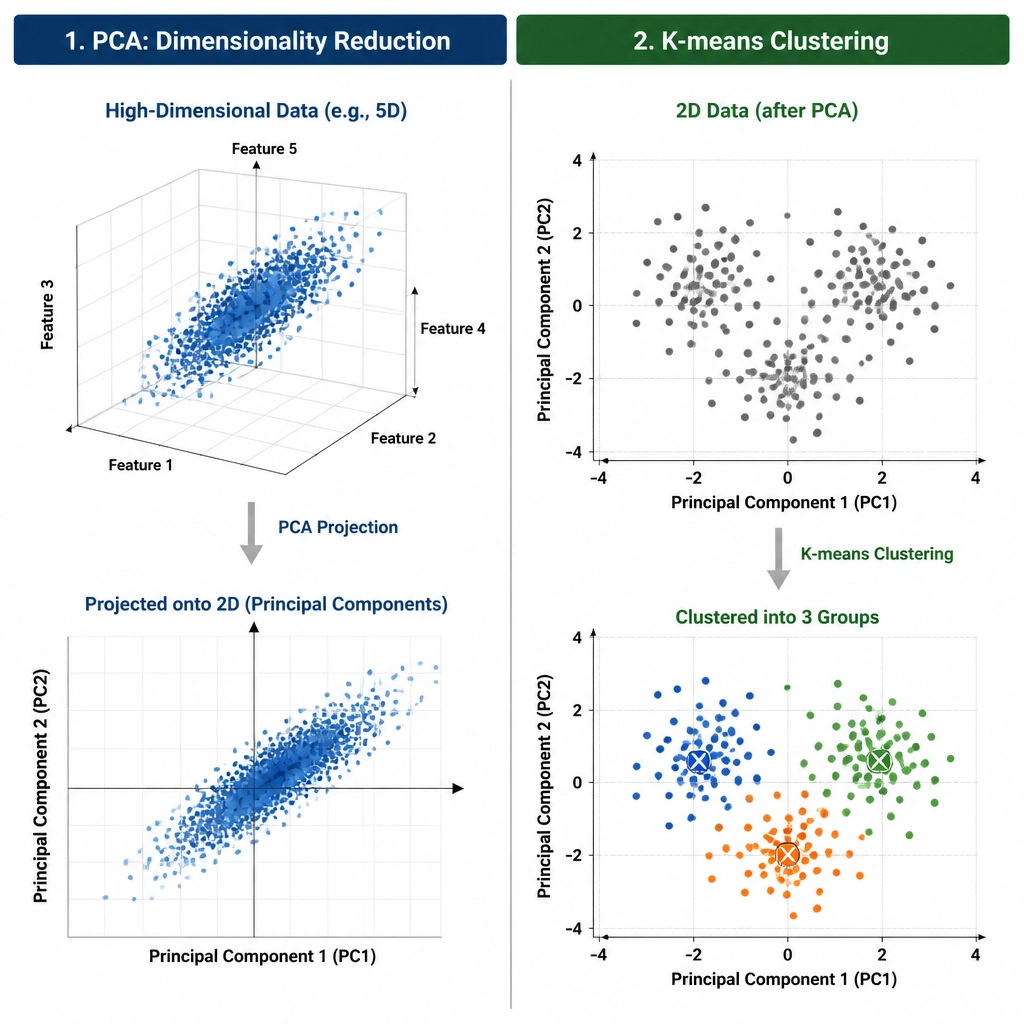
Here's the deal: when you're dumped with a database containing millions of rows and hundreds of columns, it's easy to get overwhelmed. You've got what we call the 'curse of dimensionality.' Too many features make your models slow and confused. Think of Principal Component Analysis, or PCA, as a smart editor. It looks at all those columns, finds the ones that actually contain the most important information, and compresses the rest down without losing the main story. Now, once you've simplified your data, how do you find patterns? You use K-means clustering. Think of K-means like sorting a big pile of laundry into shirts, pants, and socks based on how similar they are. It groups your data points into distinct clusters so you can see the natural patterns in your customer base. Don't fall for distractors like dropout (which is for training neural networks, not data mining) or storing files in flat text files. Got it? Sweet. Let's keep rolling.
Full explanation below image
Full Explanation
Large-scale data mining for AI workloads involves preparing and analyzing massive, high-dimensional datasets to extract meaningful features and discover latent patterns. Two fundamental techniques used in unsupervised learning and exploratory data analysis are Principal Component Analysis (PCA) and K-means clustering. PCA (Option B) is a dimensionality reduction method that transforms a large set of variables into a smaller one that still contains most of the information in the original set. By projecting high-dimensional data onto orthogonal axes (principal components) that maximize variance, PCA simplifies the feature space, reduces noise, mitigates the curse of dimensionality, and improves the training speed of downstream AI models. K-means clustering (Option C) is a partition-based clustering algorithm that groups n observations into k clusters, where each observation belongs to the cluster with the nearest mean (centroid). This grouping helps identify natural segments, patterns, or anomalies within unstructured data. In contrast, dropout (Option A) is a regularization technique used during neural network training to prevent overfitting, not a data mining technique for dataset analysis. Storing data in a flat file (Option D) is a storage format decision that does not uncover patterns or analyze data. Overfitting (Option E) is a modeling failure that hurts generalization and is not a constructive data mining technique.