Your organization is building a computer vision application that processes live, high-resolution feeds from fifty security cameras. The application must perform simultaneous object detection and classification in real time. Which hardware setup should be prioritized to handle the heavy mathematical computations with the lowest possible latency?
Select an answer to reveal the explanation.
Short Explanation and Infographic
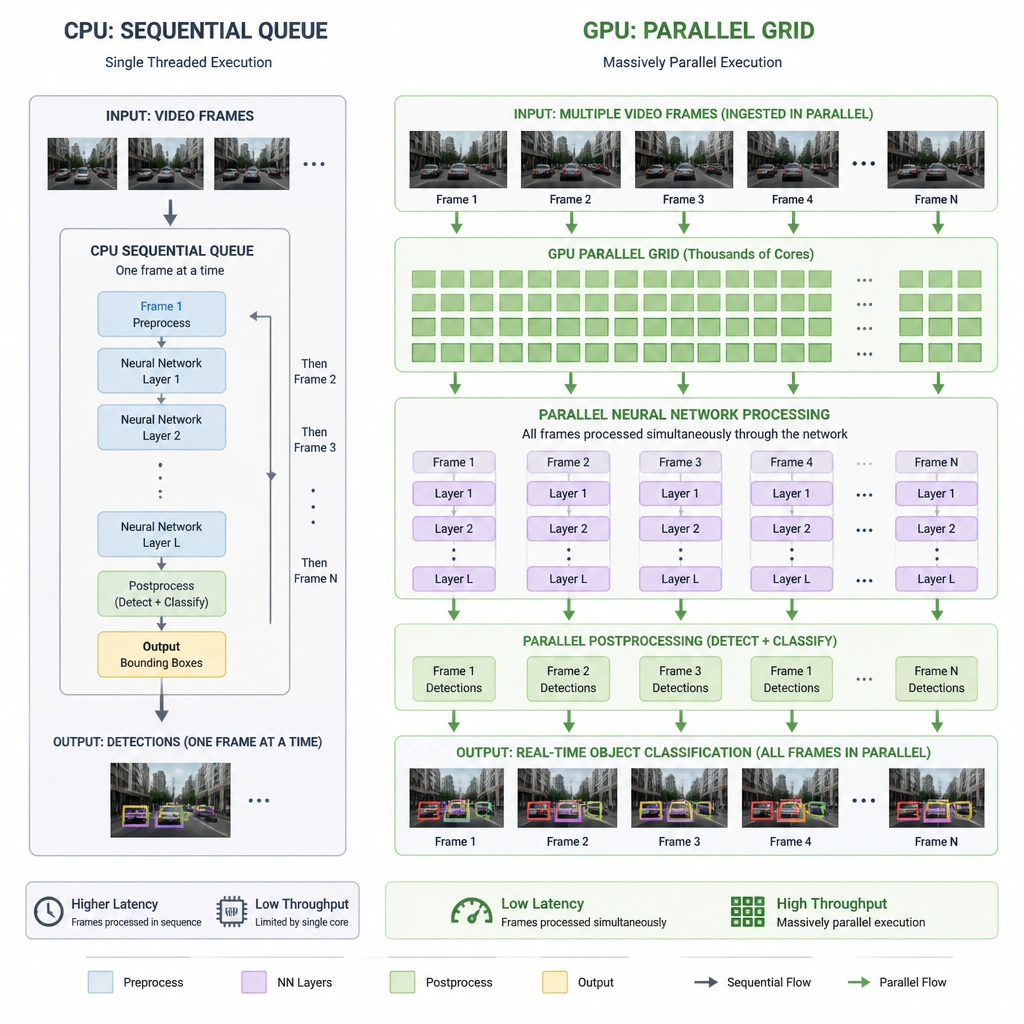
Here's the deal: real-time video processing is incredibly demanding. If you have fifty high-res cameras pumping frames in at 30 frames per second, a CPU is going to choke. Why? Because CPUs are designed for sequential tasks. They have a few powerful cores, but they can't handle the massive parallel matrix math required for neural networks on multiple video feeds at once. GPUs are the heavy lifters here. They pack thousands of smaller cores that can execute thousands of mathematical operations simultaneously. That parallel computing power is exactly what you need to ingest, decode, and run inference on video frames with almost zero latency. Trying to use CPUs or FPGAs for this is like trying to move a mountain of dirt with a teaspoon instead of a dump truck.
Full explanation below image
Full Explanation
Real-time video analytics on multiple high-resolution streams involve massive data throughput and dense computational requirements, specifically matrix multiplication and tensor operations used by deep learning models for inference (e.g., CNNs for object detection). CPUs, designed for low-latency serial processing, lack the parallel compute capabilities needed to process multiple streams simultaneously without incurring significant latency. In contrast, GPUs are designed with highly parallel architectures consisting of thousands of arithmetic logic units (ALUs). This allows them to process thousands of video frames and execute inference operations concurrently, making them the most suitable hardware architecture for real-time, low-latency computer vision applications. FPGAs can perform low-latency operations but are harder to program and typically lack the raw throughput and software ecosystem (such as TensorRT) that GPUs provide.