An operations engineer is configuring a cluster to accelerate the training of a convolutional neural network (CNN) for a high-throughput medical imaging application. The engineer must justify the hardware procurement of NVIDIA GPUs over high-end CPUs for processing the massive dataset. Which of the following statements best describe the architectural advantages that make GPUs far more suitable than CPUs for this deep learning task? (Choose two)
Select all correct answers, then click Submit.
Short Explanation and Infographic
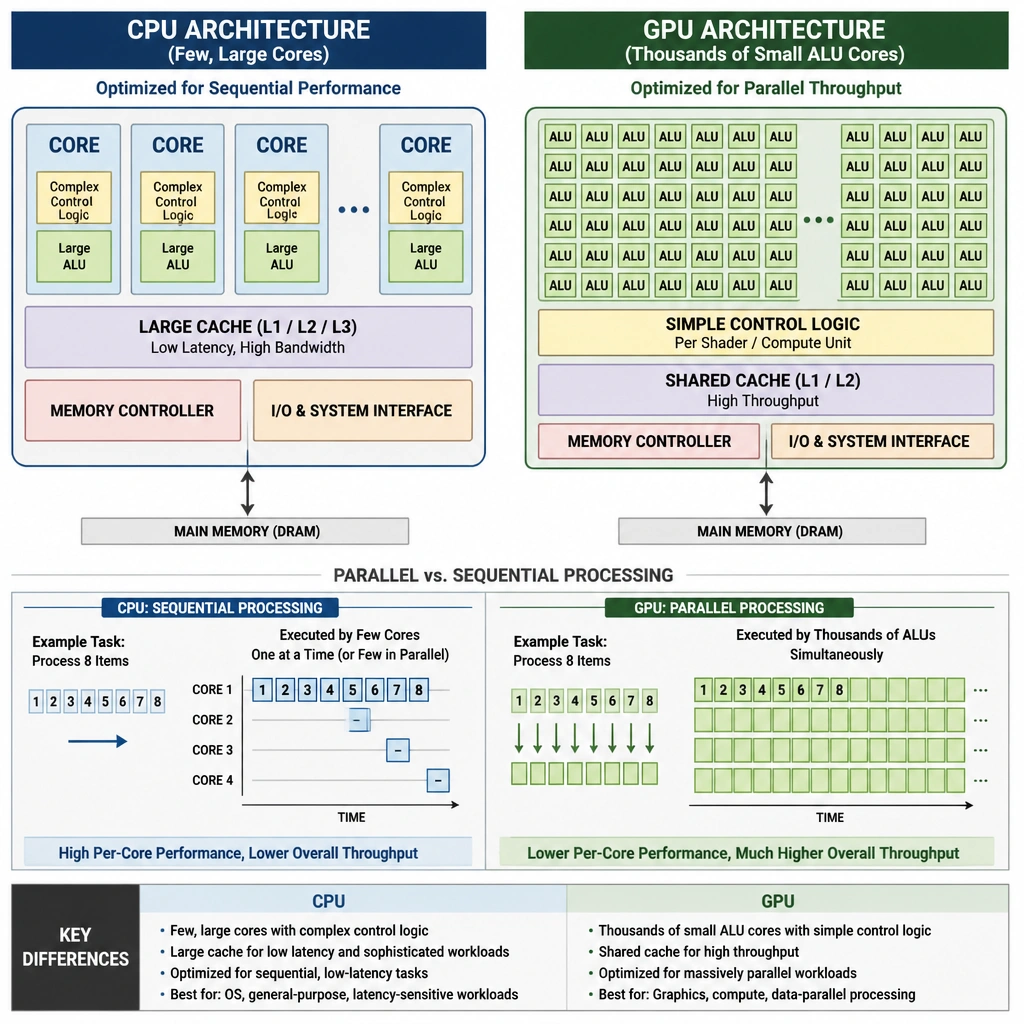
Let's dive in. If you've ever tried to run a deep learning model on a standard CPU, you know it's a great way to watch paint dry. It's incredibly slow! Here's the deal: deep learning is basically just a mountain of matrix math—multiplication and addition over and over. A CPU is like a genius mathematician who can solve any complex logic problem in a fraction of a second, but they can only work on one or two problems at a time because CPUs only have a handful of powerful cores. A GPU is like thousands of junior school kids who can all do basic multiplication at the exact same time. Individually, they aren't as fast or smart as the mathematician, but collectively, they can solve a million multiplication problems in parallel. Since neural networks are built on matrix operations, the GPU's thousands of parallel cores and specialized hardware leave the CPU in the dust. Trust me on this, for deep learning, parallel throughput is king. Got it? Sweet.
Full explanation below image
Full Explanation
Selecting the right compute hardware is critical for deep learning workloads due to the specific mathematical nature of neural network training and inference. - Massive Parallelism (Option B): Central Processing Units (CPUs) are designed for general-purpose computing and low-latency execution of sequential tasks. They feature complex control logic, large caches, and a small number of highly optimized, powerful cores (typically 16 to 128 in enterprise servers). Conversely, Graphics Processing Units (GPUs) are designed for high-throughput parallel execution (SIMD - Single Instruction, Multiple Data). A single enterprise GPU houses thousands of smaller, simpler cores that work in parallel, making them ideal for executing thousands of identical calculations simultaneously. - Matrix Operations Optimization (Option E): The fundamental mathematical operations in deep learning, particularly in convolutional and dense layers, consist of high-dimensional matrix multiplications and additions (linear algebra). GPUs are architecturally optimized for these operations, utilizing high-bandwidth memory (HBM) and specialized hardware blocks like Tensor Cores. Tensor Cores are dedicated execution units designed specifically to perform mixed-precision matrix multiply-accumulate operations in a single clock cycle, providing orders of magnitude higher throughput than general-purpose CPU cores.
Let's examine why the incorrect options are incorrect: - Option A is incorrect because although CPUs may have lower total power consumption than high-end GPUs, this does not make them more suitable for deep learning. The massive execution times on CPUs actually result in much higher total energy consumed for the same training run compared to a fast, efficient GPU. - Option C is incorrect because CPUs actually have lower latency than GPUs for individual, serial calculations. GPUs trade single-task latency for massive parallel throughput. - Option D is incorrect because CPUs are not better suited for large deep learning datasets due to memory bandwidth; enterprise GPUs actually have significantly higher memory bandwidth (using HBM2e/HBM3) to feed their thousands of cores compared to CPU DDR memory channels.
Therefore, Options B and E are correct.