A data center architect integrates NVIDIA Data Processing Units (DPUs) into a high-performance cluster to optimize storage and networking for AI applications. Despite the installation of the DPUs, several distributed training workloads continue to experience high networking latency and high host CPU utilization. What is the most likely cause of this bottleneck?
Select an answer to reveal the explanation.
Short Explanation and Infographic
Okay, let's look at this. You bought these fancy NVIDIA DPUs—Data Processing Units—to speed up your data center. The whole point of a DPU is to act as a "sidecar" processor that offloads infrastructure tasks from your main host CPU. Think of the host CPU like a chef in a busy restaurant. If the chef is constantly running to the door to seat customers, clean tables, and wash dishes (which are like network packet processing, storage overhead, and security encryption), they won't have time to actually cook the food! The DPU's job is to take those chores off the chef's plate. But if you don't actually configure your operating system and network stack to offload those tasks to the DPU, the host CPU keeps doing them, getting overwhelmed and causing latency bottlenecks. Make sure your offloading configuration is active, and let the host CPU focus on what it does best.
Full explanation below image
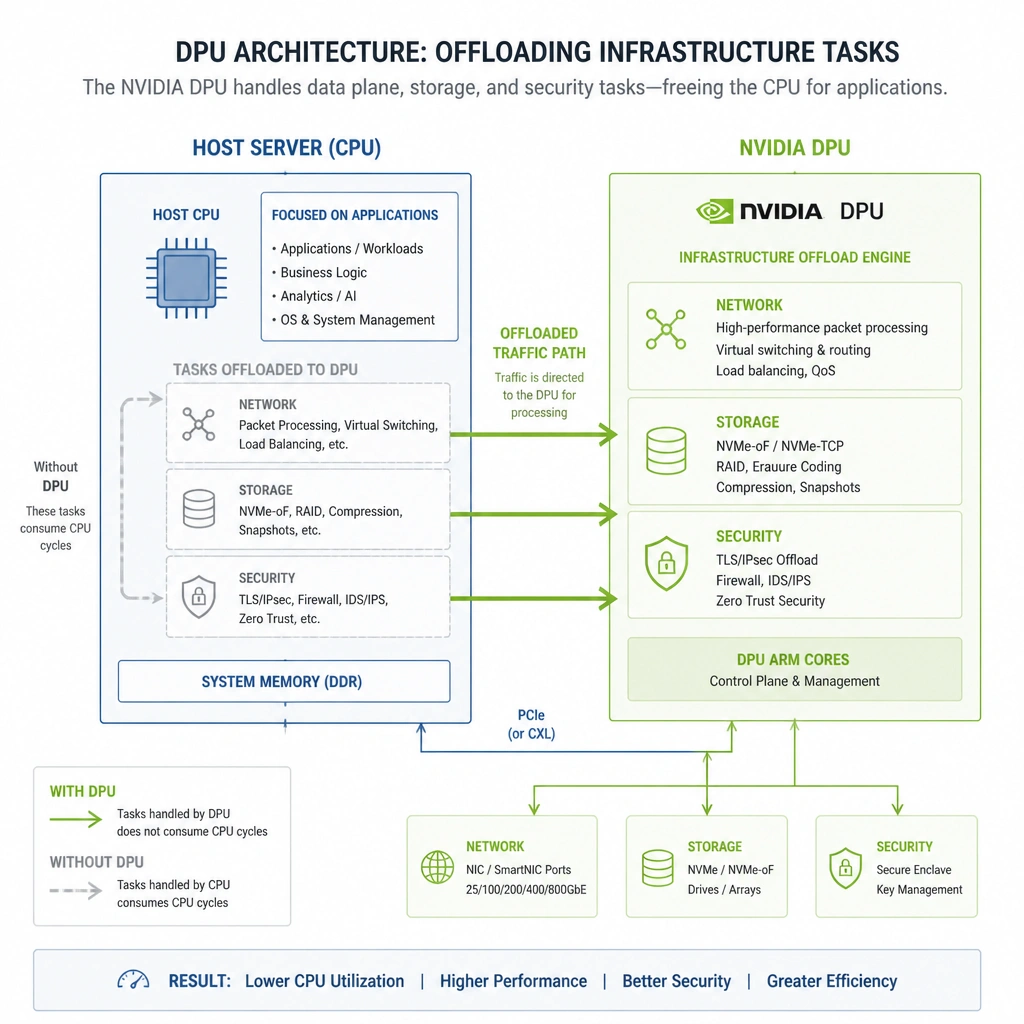
Full Explanation
Data Processing Units (DPUs), such as the NVIDIA BlueField series, are specialized SmartNICs designed to offload, accelerate, and isolate infrastructure workloads from the host CPU. In a modern AI data center, host CPUs are often burdened with heavy infrastructure tasks, including software-defined networking (e.g., OVS, overlay networks), storage virtualization (e.g., NVMe-oF), security protocols (e.g., IPsec, TLS), and cluster management tasks. If these tasks are not offloaded, the host CPU becomes a bottleneck, leading to increased network latency and CPU starvation for the actual applications.
Simply installing the hardware is insufficient; the host operating system, virtualization hypervisor, and application software stacks must be explicitly configured to hand off these operations to the DPU's onboard ARM cores and network acceleration engines. If this offloading is not enabled or is misconfigured, the host CPU will continue to process these infrastructure services in software, negating the performance benefits of the DPU.
Let's review the incorrect options: - Option B is incorrect because DPUs are not designed to execute heavy AI training or inference kernels, which are the domain of GPUs; they are designed for infrastructure data-path acceleration. - Option C is incorrect because while PCIe generation mismatches can limit bandwidth, they generally do not cause high host CPU utilization; also, DPUs are backwards compatible with PCIe standards. - Option D is incorrect because DPUs manage infrastructure and data-plane routing, not AI inference workloads.