An automotive manufacturer is developing a new line of self-driving commercial trucks. The onboard computer must process simultaneous inputs from multiple cameras, LiDAR, and radar sensors, perform real-time deep learning inference for object detection and path planning, and meet strict automotive safety standards. Which NVIDIA platform is designed specifically for these autonomous vehicle requirements?
Select an answer to reveal the explanation.
Short Explanation and Infographic
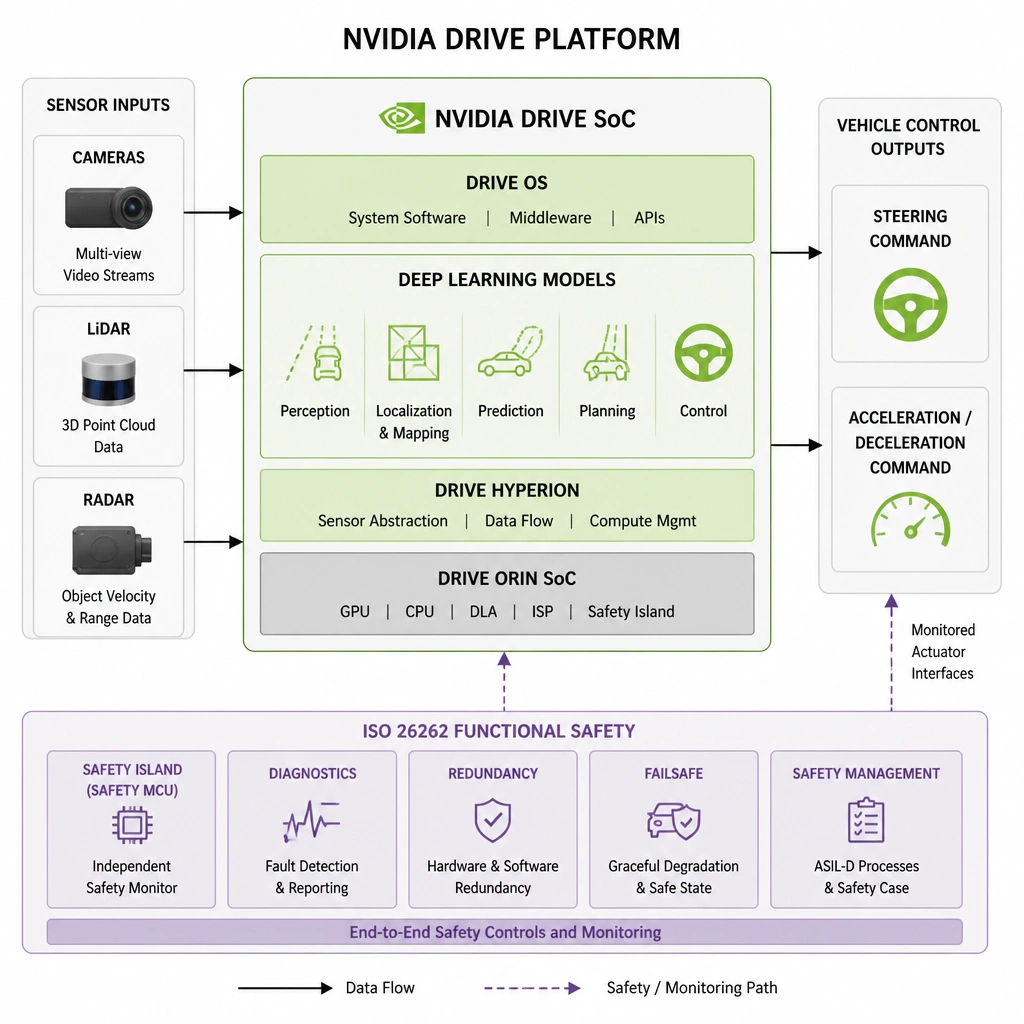
Think of it like this: you wouldn't use a golf cart to haul a heavy semi-truck load. NVIDIA has different platforms for different jobs. If you're building smart cameras or small robots, you look at Jetson. If you're in a hospital analyzing MRI scans, you go with Clara. But if you are building self-driving cars or autonomous truck fleets, you need a system built from the ground up for automotive safety, sensor fusion, and real-time path planning. That's NVIDIA Drive. It's got the specialized hardware and the software stack (like DriveOS) to handle all those camera and LiDAR feeds in real time. Trust me on this one, for autonomous vehicles, NVIDIA Drive is the correct answer.
Full explanation below image
Full Explanation
NVIDIA offers specialized hardware and software platforms tailored to specific industry verticals and deployment environments. For autonomous vehicles, the dedicated solution is the NVIDIA Drive platform. NVIDIA Drive is an end-to-end platform (comprising hardware like the DRIVE Orin/Thor System-on-Chips and software like DRIVE OS, DriveWorks, and DRIVE AV/Chauffeur) designed specifically for autonomous driving. It excels at sensor fusion—processing data from cameras, radar, and LiDAR simultaneously—and executing deep learning models in real time to perform object detection, path planning, and driver monitoring. Crucially, the hardware and software are built to meet strict automotive functional safety standards (such as ISO 26262 ASIL-D). Let's look at why the other options are incorrect. Option A (NVIDIA Clara) is NVIDIA's application framework and developer platform designed for healthcare, medical imaging, genomics, and digital health applications. Option B (NVIDIA Jetson) is an embedded computing platform designed for low-power edge applications like drones, smart cameras, and industrial robotics. While it is used for edge AI, it lacks the specific automotive-grade safety certifications, interfaces, and software stack required for full-scale autonomous vehicle fleets. Option D (NVIDIA DeepStream) is a Software Development Kit (SDK) for multi-sensor processing and video/audio analytics, often run on Jetson or data center GPUs. It is a software library, not a dedicated autonomous vehicle system-on-chip and platform.