Your organization is setting up a shared AI research platform where multiple development teams need to run model training and inference workloads simultaneously. To keep costs down, you want multiple virtual machines to share the hardware capabilities of a single physical GPU, but you must guarantee that each team's workload is securely isolated and does not interfere with the others. Which virtualization method best meets these requirements?
Select an answer to reveal the explanation.
Short Explanation and Infographic
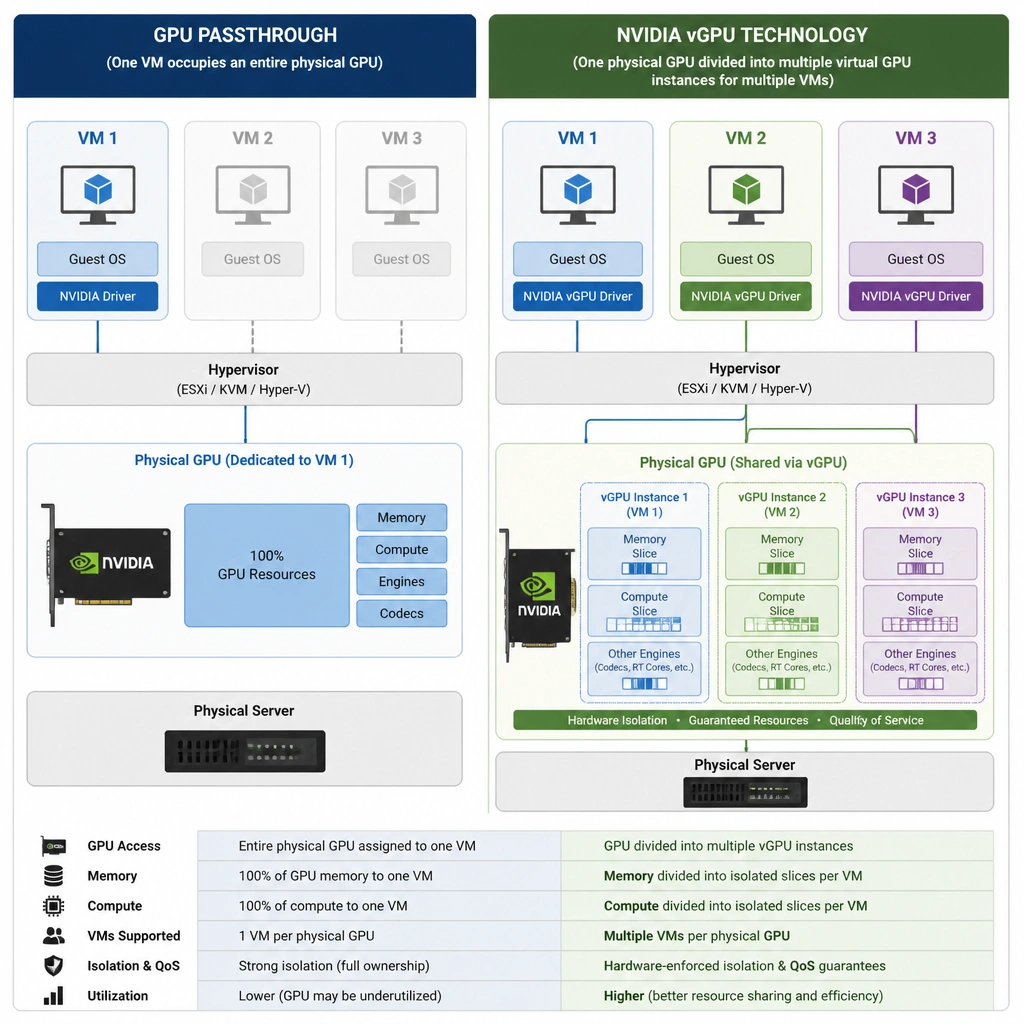
Check this out: if you have different teams fighting over GPU power, you don't want to buy a massive physical card for every single developer. That would obliterate your budget! But you also can't just let them run wild on the same card without any boundaries, because they'll crash into each other's workloads. That's where NVIDIA vGPU steps in. Think of it like renting out rooms in a secure apartment building. Everyone gets their own isolated space, their own guaranteed slice of the GPU power, and they can't spy on or disrupt their neighbors. Passthrough gives the whole card to one tenant—great for performance, but terrible for sharing. Using vGPU is the sweet spot where you get both sharing and rock-solid isolation.
Full explanation below image
Full Explanation
In a multi-tenant AI environment, optimizing hardware utilization while maintaining strict tenant isolation is a critical architectural challenge. NVIDIA vGPU (Virtual GPU) technology addresses this by allowing multiple virtual machines (VMs) to share the physical resources of a single GPU. The physical GPU is split into virtual GPU instances, each with dedicated frame buffer memory and shared access to the GPU's execution engines. This virtualization layer is managed by a software manager (the vGPU manager) running inside the hypervisor, ensuring that each VM operates independently and securely. This prevents one tenant's processes from accessing another tenant's data or memory space, ensuring security compliance and performance stability.
Other virtualization techniques do not achieve this balance. Direct GPU Passthrough assigns an entire physical GPU directly to a single VM. While this offers maximum performance, it prevents any resource sharing, leading to underutilized hardware and high capital costs. Software-based CPU emulation or virtualization is far too slow for machine learning workloads, as CPUs lack the massive parallel computing cores required for deep learning tensor operations. Lastly, deploying containerized applications without explicit GPU isolation mechanisms leads to resource contention and potential security leaks, as containers would share the host's GPU driver space without any strict hardware boundary partitioning. Therefore, NVIDIA vGPU represents the most effective architecture for secure, high-density, multi-tenant GPU sharing.