A cloud-based AI cluster hosts both massive distributed training jobs and real-time, low-latency API inference services. Recently, users have reported intermittent latency spikes and slowdowns during inference requests, although GPU utilization metrics indicate that there is plenty of compute capacity remaining on the inference nodes. What is the most likely infrastructure bottleneck causing this issue, and how should it be resolved?
Select an answer to reveal the explanation.
Short Explanation and Infographic
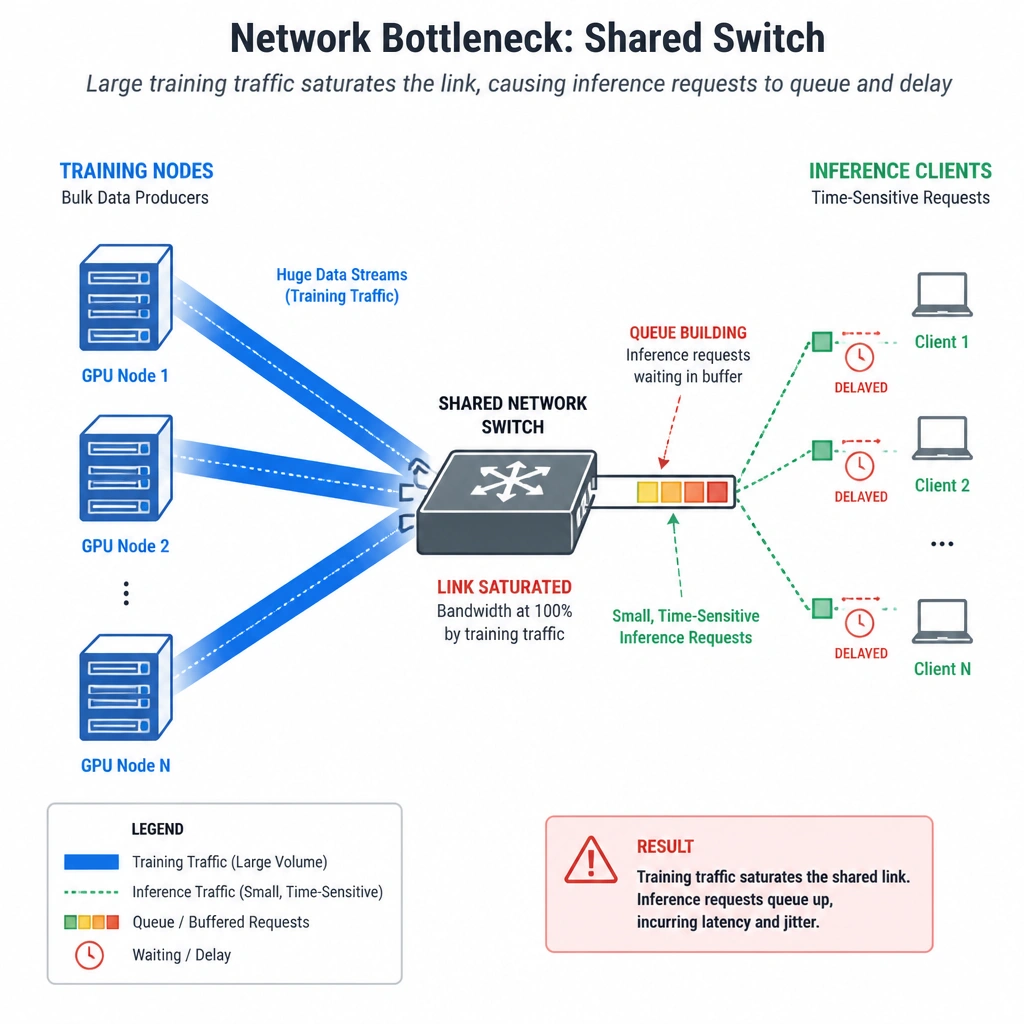
Pay close attention here, because this one bites people in production all the time. You look at your dashboards, and your GPU utilization is low, but your users are screaming that their real-time inference requests are lagging. What gives? Think of it like this: your GPU compute cores are ready to run, but they're sitting at the table waiting for the food to arrive. If your massive training jobs are constantly hogging the entire network highway to copy terabytes of training data, your tiny, time-sensitive inference requests get stuck in the traffic jam. The solution is simple: you have to manage that network traffic. Set up Quality of Service (QoS) to prioritize inference packets, or run those heavy training data syncs off-peak.
Full explanation below image
Full Explanation
Distributed AI training is a network-intensive process. During training, nodes must continuously load large batches of high-resolution datasets from storage systems and exchange weight gradients across the network (often using collective communication libraries like NCCL). This massive, continuous data transfer can easily saturate the network switches and network interface cards (NICs) within the cluster. On the other hand, inference is highly latency-sensitive; it requires receiving a request over the network, passing it through the model, and returning the output within milliseconds.
If both training and inference tasks share the same network links without proper traffic isolation or Quality of Service (QoS) configurations, the massive data streams from training will cause network congestion, packet queuing, and packet loss. This starves the inference tasks of network bandwidth, leading to high latency and timeouts, even if the inference GPUs have zero compute bottlenecks. To resolve this, network administrators must implement traffic management strategies. This includes segregating training and inference traffic onto separate physical networks (or VLANs), configuring bandwidth limits on training nodes, or implementing priority queuing to ensure inference packets are always routed first.
Other options are less likely. Thermal throttling is typically localized to the specific overheating GPU node and does not dynamically spread to other dedicated inference nodes. Compilation issues or memory leaks would exhibit continuous, non-intermittent degradation and would be reflected in local node-level system metrics rather than network-dependent spikes.