A cluster of high-density AI servers running massive transformer model training is experiencing thermal throttling. The existing hot/cold aisle containment and air handling units are running at peak capacity, but GPU junction temperatures are approaching critical levels. How can the engineering team best resolve this thermal bottleneck to sustain continuous maximum compute density?
Select an answer to reveal the explanation.
Short Explanation and Infographic
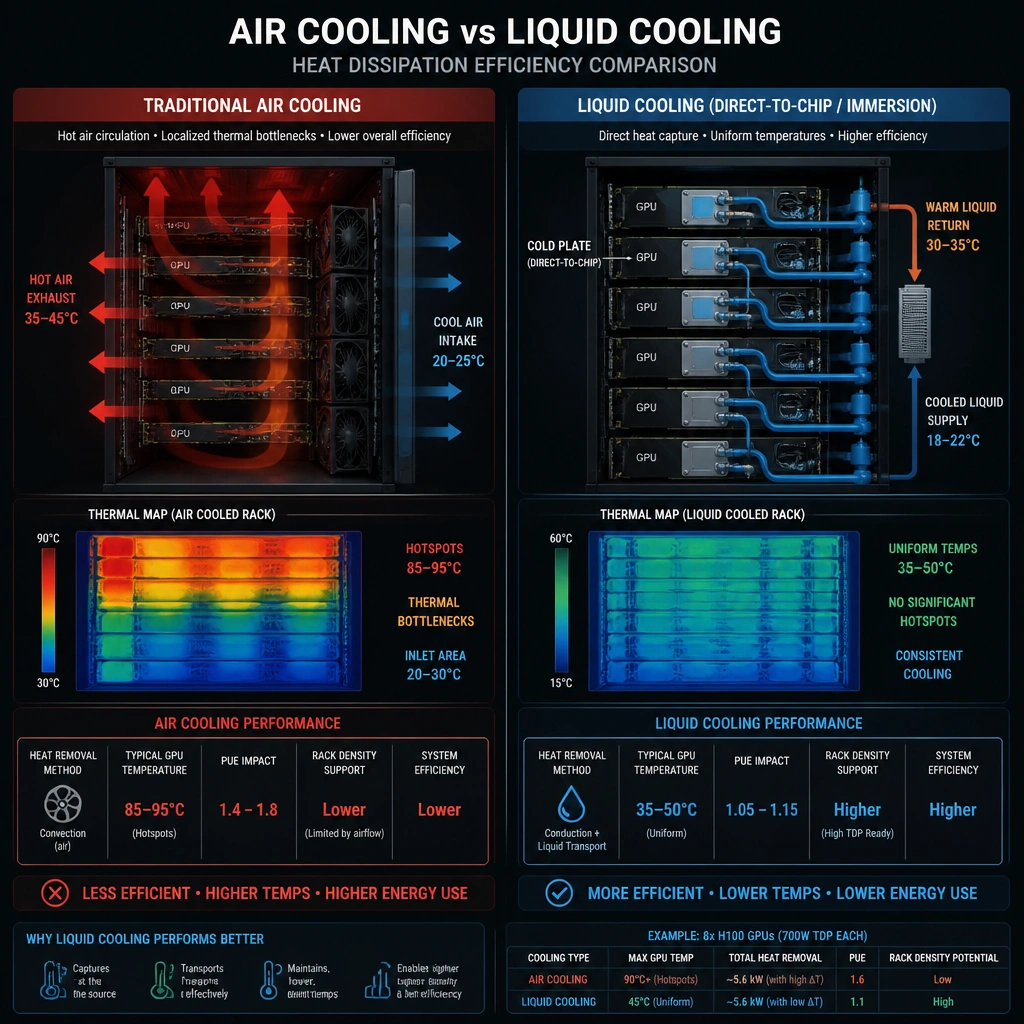
Here's the deal: deep learning training is an absolute beast when it comes to power and heat. If you've got racks packed with high-end GPUs pulling 700 watts or more each, traditional air cooling is going to tap out fast. Think of it like trying to cool a high-performance race car engine with a desk fan — it's just not going to cut it. Liquid has a heat capacity that's orders of magnitude higher than air, which is why direct-to-chip or immersion liquid cooling is the real-world answer when your racks start sweating. Sure, you could crank the fans to maximum, but you'll just create a deafening roar and run into a brick wall of thermal throttling. And shifting workloads around or waiting until night? That's just dodging the problem when you need that compute running 24/7. Liquid cooling gets the heat away from the silicon fast so you can keep the pedal to the metal.
Full explanation below image
Full Explanation
In modern data centers hosting high-performance AI workloads, thermal management is a critical operational constraint. High-density GPU accelerators, such as those used for training large deep learning models, generate thermal design power (TDP) levels that exceed the dissipation capabilities of traditional air-based cooling systems. Air cooling relies on convective heat transfer, which becomes highly inefficient as power densities exceed 30 to 50 kW per rack. When GPUs operate continuously at peak capacity, thermal resistance between the silicon junction and the ambient air leads to heat accumulation. This causes the hardware to engage in thermal throttling—reducing clock speeds to protect the components—or trigger thermal shutdown, disrupting workloads and potentially causing permanent hardware degradation. Liquid cooling, either through direct-to-chip (cold plate) technology or immersion cooling, offers a significantly higher heat transfer coefficient and thermal conductivity compared to air. Water or specialized dielectric fluids can absorb and transport heat far more rapidly. By target-cooling the most heat-intensive racks, operators can manage temperatures at the source. This enables the infrastructure to support higher compute densities (racks exceeding 100 kW) while maintaining optimal GPU operating temperatures and maximizing FLOPS performance. Reviewing the distractors: Distributing workloads (Option A) across standard or lower-density nodes fails because deep learning training requires tight interconnects and high-speed GPU clusters; spreading the workload decreases communication efficiency and violates the architectural requirements of large-scale distributed training. Scheduling workloads for off-peak hours (Option B) does not address the peak thermal output of active training runs and introduces unacceptable idle times for expensive hardware assets. Increasing fan speeds (Option D) is insufficient once the physical limits of air heat capacity are reached. Furthermore, high-RPM fans consume massive amounts of parasitic power (parasitic load) and do not resolve localized hotspot issues in high-density configurations.