A financial technology company runs a real-time risk assessment model that spans both an on-premises private cloud and a public cloud environment. High data transfer times between the on-premises database and the cloud-based GPU inference cluster are causing the system to miss real-time transaction deadlines. Which network modification will best resolve the latency bottleneck while preserving the existing hybrid deployment architecture?
Select an answer to reveal the explanation.
Short Explanation and Infographic
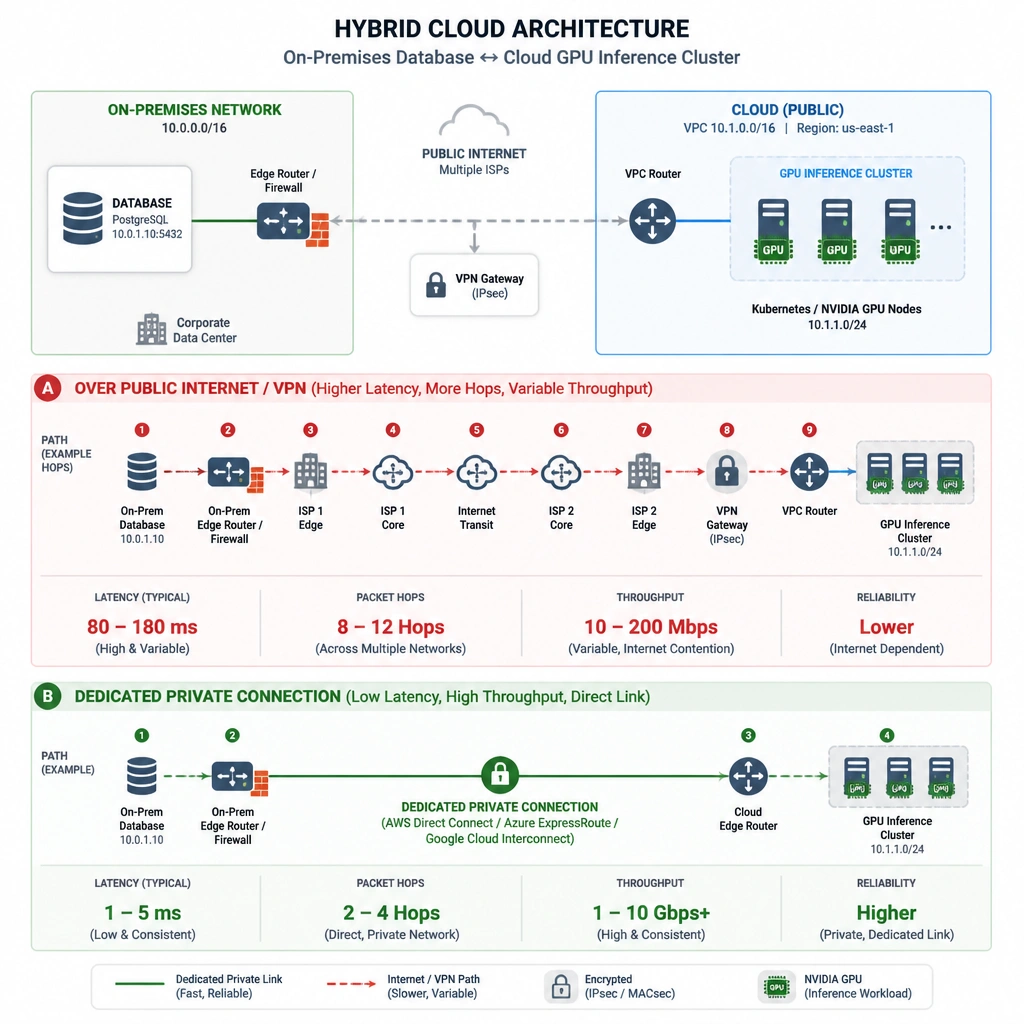
Check this out: when you're running a hybrid cloud setup, you're trying to get the best of both worlds — keeping sensitive data close to home on your own servers, while spinning up massive GPU clusters in the cloud. But if your network link between them is sluggish, you've got a major bottleneck. It's like trying to feed a fire hose with a garden hose. If your transaction data is lagging over a standard internet connection, your real-time model is going to time out and miss critical events. The fix isn't to tear down the whole architecture and move everything to one side, which is a massive headache and might violate compliance. The real-world fix is to put in a dedicated, high-throughput private connection — like AWS Direct Connect or Azure ExpressRoute. This bypasses the public internet completely, drops your latency to the floor, and keeps the data flowing fast enough for real-time processing.
Full explanation below image
Full Explanation
In hybrid cloud architectures supporting real-time AI applications, data transit latency between the on-premises environment and the public cloud is a common operational bottleneck. Real-time inference pipelines, such as those used for fraud detection or risk assessment, operate under strict SLA constraints (often sub-100 milliseconds). If data must traverse standard internet connections or basic VPN tunnels, packet delivery times become unpredictable due to routing hops, jitter, and network congestion. Implementing a dedicated, low-latency, high-throughput direct connection (such as AWS Direct Connect, Azure ExpressRoute, or Google Cloud Dedicated Interconnect) bypasses the public internet entirely. It establishes a physical, private telecommunications circuit between the enterprise data center and the cloud provider's edge location. This guarantees consistent bandwidth, dramatically reduces round-trip times (RTT), and provides a highly secure channel for sensitive transaction data. This solution directly addresses the latency issue while allowing the organization to maintain its hybrid architecture, which may be required for compliance, data sovereignty, or cost management reasons. Evaluating the distractors: Migrating the entire workload on-premises (Option A) or to a single cloud provider (Option B) ignores the organizational requirements that drove the hybrid model choice in the first place, such as security policies, capital expenditure utilization, or regulatory constraints. Adding more local GPUs (Option C) does not solve the data transfer latency issue if the application still depends on real-time data syncs or model updates between the local site and the cloud. Routing traffic over standard VPNs (Option D) actually increases packet overhead and latency due to encryption processing and the unpredictable nature of public internet routing.