An MLOps engineer is designing an automated retraining pipeline for a predictive maintenance model. The goal is to ensure the model always incorporates the latest sensor readings while preventing unnecessary computation and hardware strain. Which orchestration strategy best meets these requirements?
Select an answer to reveal the explanation.
Short Explanation and Infographic
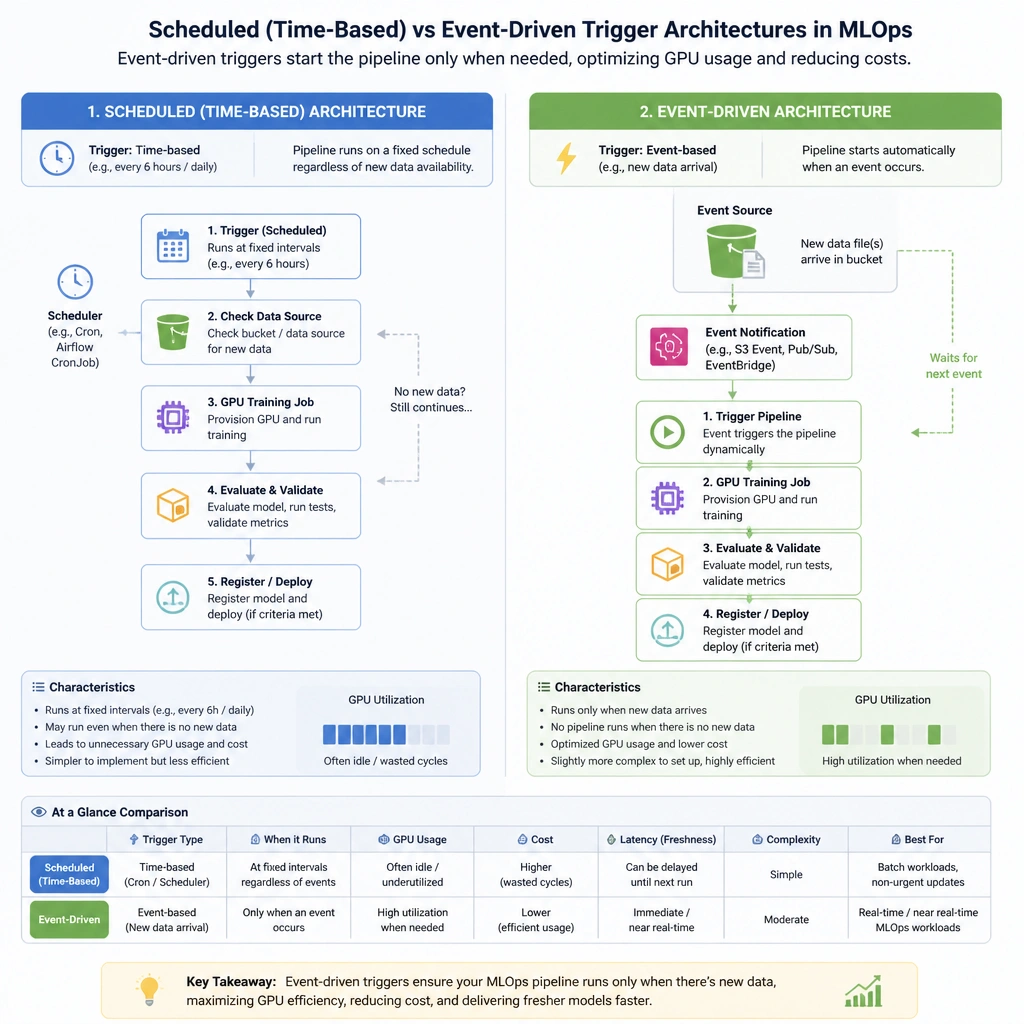
Here's the deal: if you set your MLOps pipeline to run on a rigid schedule — say, every single hour — you're going to waste a ton of expensive compute. If no new data came in, you're just training the exact same model again. Not very efficient! On the flip side, if you just wait until the weekend, your model will be running on stale data all week, which is bad news for accuracy. And manual execution? Trust me, you don't want to be waking up at 3 AM to push a button. The smart way to handle this is with event-driven triggers. You hook up your storage bucket to kick off the pipeline only when new data actually arrives and hits a certain threshold. This keeps your model fresh and saves your GPU resources for when they are actually needed.
Full explanation below image
Full Explanation
In MLOps (Machine Learning Operations), designing efficient pipelines requires balancing model accuracy (which depends on training on the most current data) with resource optimization (minimizing compute costs and hardware wear). Event-driven orchestration is the most effective way to achieve this balance. Instead of running pipelines on arbitrary schedules, the orchestration platform (such as Kubeflow Pipelines, Apache Airflow, or Prefect) listens for specific events—such as a file upload to an S3 bucket, a new database record, or a message in a queue. When new data arrives and meets pre-defined criteria (like data volume or quality checks), the event triggers the preprocessing, training, and deployment steps. This ensures that the model is updated only when there is new information to learn from, eliminating redundant runs that would otherwise overload the compute cluster. Reviewing the alternatives: Hourly scheduling (Option A) leads to resource waste when data is static, as the system consumes power and GPU cycles to retrain on unchanged datasets. Off-peak scheduling (Option C) ensures low load during busy hours but fails to keep the model updated in a timely manner. If critical data arrives on Monday morning, the model remains outdated until the weekend. Manual execution (Option D) does not scale, introduces human error, and contradicts the core MLOps goal of automation.