During deep learning model training on a multi-GPU cluster, you monitor the hardware metrics and observe that GPU utilization remains low (around 30%), while I/O wait times on the storage volumes are consistently high. Which infrastructure modification will resolve this bottleneck and increase GPU utilization?
Select an answer to reveal the explanation.
Short Explanation and Infographic
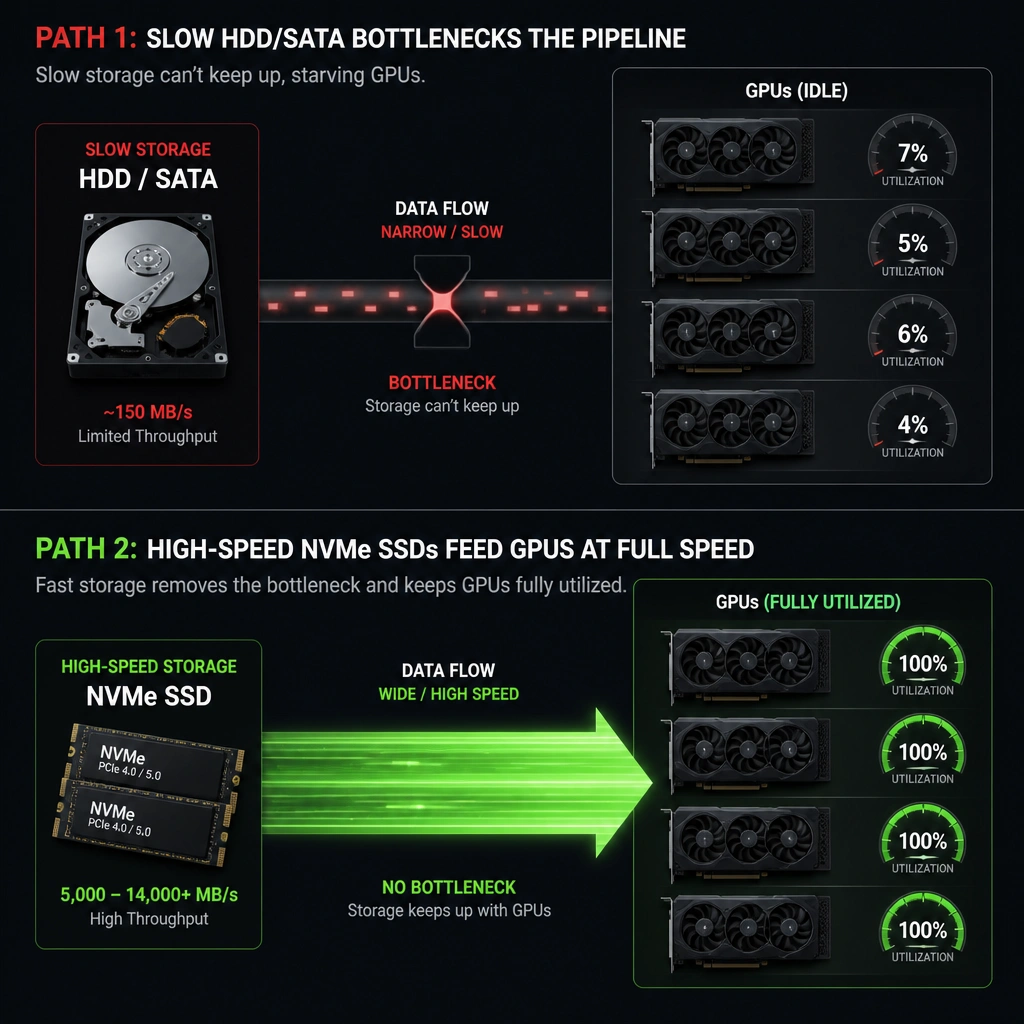
Okay, let's dive in. Picture this: you've got a Ferrari of a GPU cluster ready to burn rubber, but you're feeding it data through a tiny drinking straw. That's a storage bottleneck, and it's one of the most common issues you'll run into in AI training. If your GPUs are sitting around at 30% utilization while waiting for data, adding more GPUs is just going to waste more money. And reducing your batch size? That actually makes the I/O problem worse because the system has to make more small reads from the disk! You've got to fix the straw. Upgrading to high-throughput NVMe SSDs gives your system the massive read speeds and low latency it needs to keep those GPUs fed and working at 100%. Got it? Sweet.
Full explanation below image
Full Explanation
In deep learning training, the storage subsystem must supply training data (such as images, video, or large text corpora) to the GPUs fast enough to keep their tensor cores fully occupied. If the storage media has high latency or low read throughput, the GPUs will sit idle, a state characterized by high I/O wait times and low GPU utilization. Upgrading to Non-Volatile Memory Express (NVMe) SSDs directly addresses this because NVMe devices communicate over the high-speed PCIe bus, offering gigabytes-per-second throughput and parallel queues that drastically reduce I/O bottlenecks compared to legacy SATA drives or standard mechanical HDDs.
Why the other options fail to solve the bottleneck: - Reducing the batch size (Option A) actually increases the frequency of I/O requests. Each epoch will require more steps, which increases the overhead of the storage request pipeline and can worsen the CPU/storage bottleneck. - Data augmentation (Option C) is typically a CPU-bound process. Adding more data augmentation in real time actually increases the CPU workload per batch, which could further delay data transfer to the GPU if the CPU is already struggling to keep up. - Adding more GPUs (Option D) increases the overall demand on the storage subsystem. If the storage cannot feed the existing GPUs, adding more GPUs will only decrease individual GPU utilization further, resulting in higher hardware costs with no performance gain.
To maximize throughput, high-performance AI architectures often combine NVMe storage with technologies like GPUDirect Storage (GDS), which bypasses the CPU entirely and moves data directly from NVMe storage to GPU memory.