Which of the following scenarios best illustrates a "facilitation payment" (often referred to as a "grease payment") that is highly scrutinized and generally prohibited by global anti-corruption standards and many corporate policies?
Select an answer to reveal the explanation.
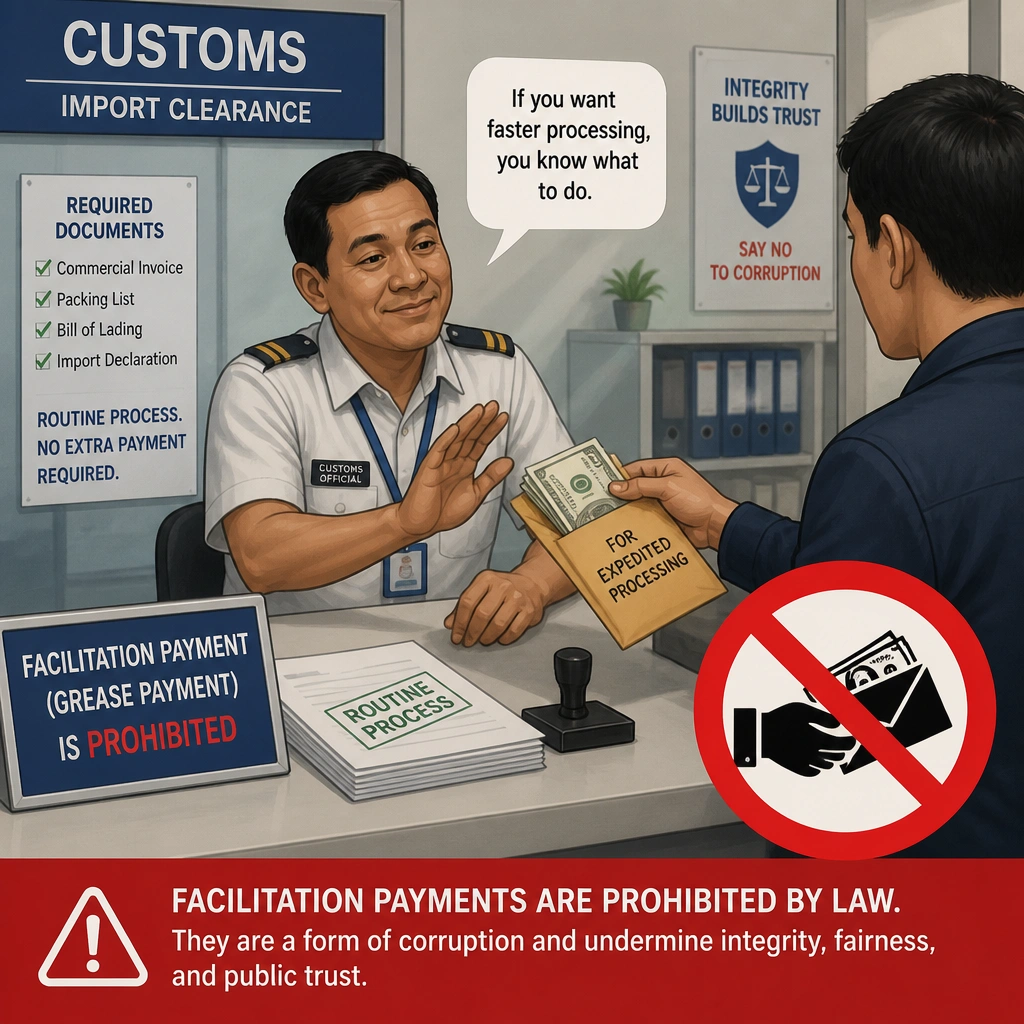
Short Explanation and Infographic
Pay close attention here, because this one bites people all the time. You might hear someone call these 'grease payments' or 'speed money.' Under the original text of the U.S. FCPA, there was a narrow exception for small payments to low-level officials to get them to do their regular jobs—like stamping a visa or clearing a shipment. But here is the real-world deal: almost every other anti-bribery law on earth (like the UK Bribery Act) bans these payments completely, and most modern corporate policies prohibit them too. If you pay a customs guy ten bucks to move your paperwork to the top of the pile, you're crossing a dangerous line.
Full explanation below image
Full Explanation
A facilitation payment is a small payment made to a low-level government official to expedite or secure the performance of a routine, non-discretionary governmental action (e.g., processing government papers, providing police protection, or clearing goods through customs). While the U.S. Foreign Corrupt Practices Act (FCPA) historically contained a narrow exception for these payments, they are illegal under the local laws of almost all countries where they are paid, and they are strictly prohibited under the UK Bribery Act. Consequently, modern corporate compliance programs almost universally prohibit facilitation payments to eliminate legal risk and maintain ethical consistency.
Let's see why A is correct. A is correct because paying an official to perform a routine task faster is the classic definition of a facilitation payment.
Distractor B describes a standard commercial transaction for legitimate services, which is permissible as long as the fees are reasonable and reflect fair market value.
Distractor C describes a charitable contribution, which requires vetting to ensure it is not a disguised bribe, but it is not defined as a facilitation payment.
Distractor D describes standard employee compensation, which is a legitimate business expense and not a bribe or facilitation payment.