What is the primary purpose of establishing a comprehensive Third-Party Risk Management (TPRM) framework within an organization?
Select an answer to reveal the explanation.
Short Explanation and Infographic
Okay, let's dive in. In today's business world, we rely on a massive web of vendors, suppliers, and contractors. But remember: you can outsource the work, but you can never outsource the responsibility. If a vendor leaks your customer data or uses child labor, your company is the one that's going to end up on the front page of the news. That's why we use Third-Party Risk Management (TPRM). Think of it like setting up access control lists (ACLs) for your external connections. You need to know who is connecting to your business, what risks they bring, and how you're going to keep those risks under control. It's not about making sure their bills are paid on time (Option A), managing payroll (Option B), or shutting out suppliers entirely (Option D). It's about smart, safe collaboration. Got it? Sweet.
Full explanation below image
Full Explanation
Third-Party Risk Management (TPRM) is a critical discipline that focuses on analyzing and controlling the risks that arise when organizations partner with external entities. Modern enterprises rely heavily on third parties, such as vendors, cloud service providers, distributors, and agents, to execute core business functions. While outsourcing offers operational efficiencies, it also exposes organizations to significant legal, financial, operational, cybersecurity, and reputational risks.
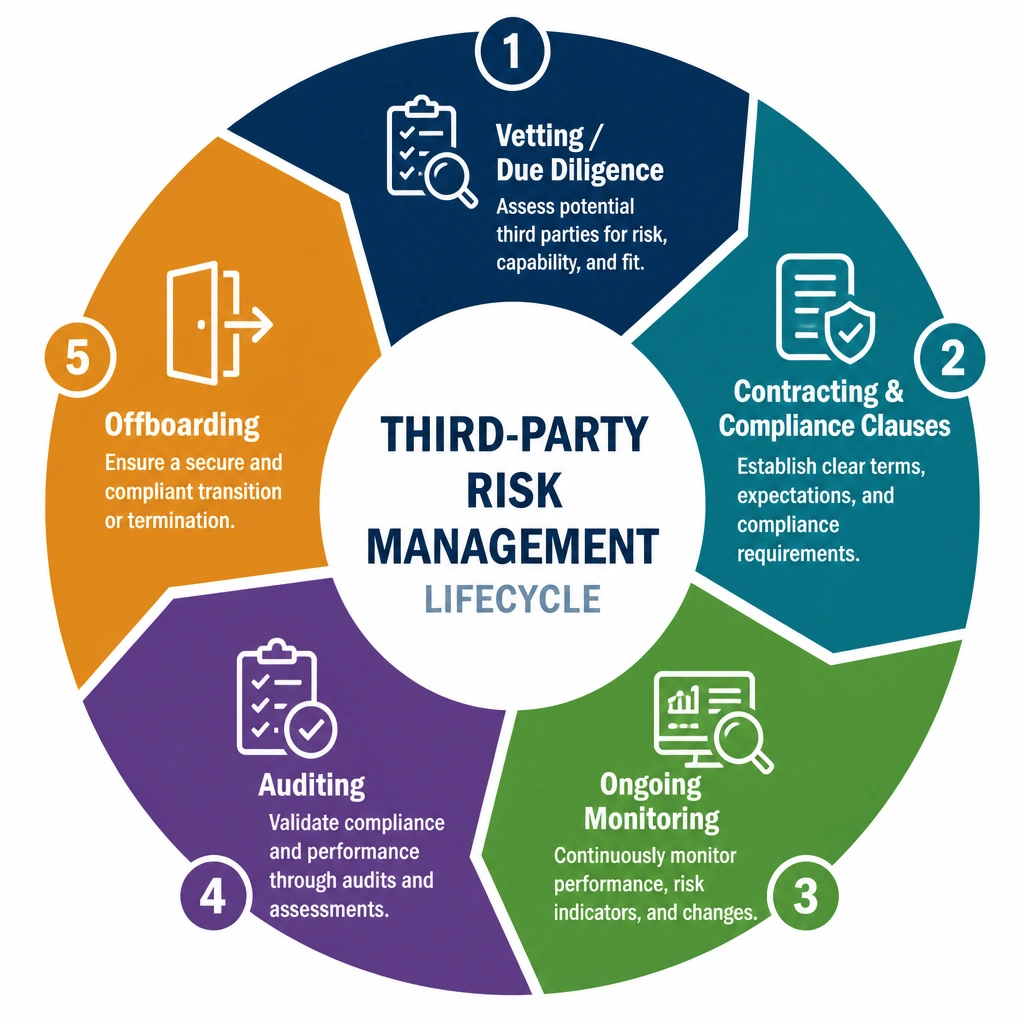
Let’s break down the options to understand why the correct answer stands out: - Option C is correct because a TPRM framework provides a structured methodology throughout the lifecycle of a third-party relationship. This lifecycle includes pre-contractual due diligence, risk-tiering, contract negotiation (incorporating compliance clauses), continuous monitoring, and eventual offboarding. By doing this, organizations protect themselves from liabilities arising from data breaches, supply chain disruptions, corruption, or labor violations committed by their partners. - Option A is incorrect because ensuring timely payments to vendors is an operational accounting and accounts payable function, not the objective of a risk management framework. - Option B is incorrect because internal payroll administration is managed by Human Resources and Finance departments, focusing on employees rather than external third-party risks. - Option D is incorrect because avoiding all external suppliers is commercially unfeasible for modern businesses. TPRM is designed to enable safe, compliant engagement with third parties, not to eliminate outsourcing entirely.
Regulators look closely at an organization's TPRM program to determine if the compliance culture extends beyond its corporate walls.