An organization appoints and trains employees from various non-compliance departments to serve as 'compliance champions' or 'ethics ambassadors.' What is the primary operational benefit of this network?
Select an answer to reveal the explanation.
Short Explanation and Infographic
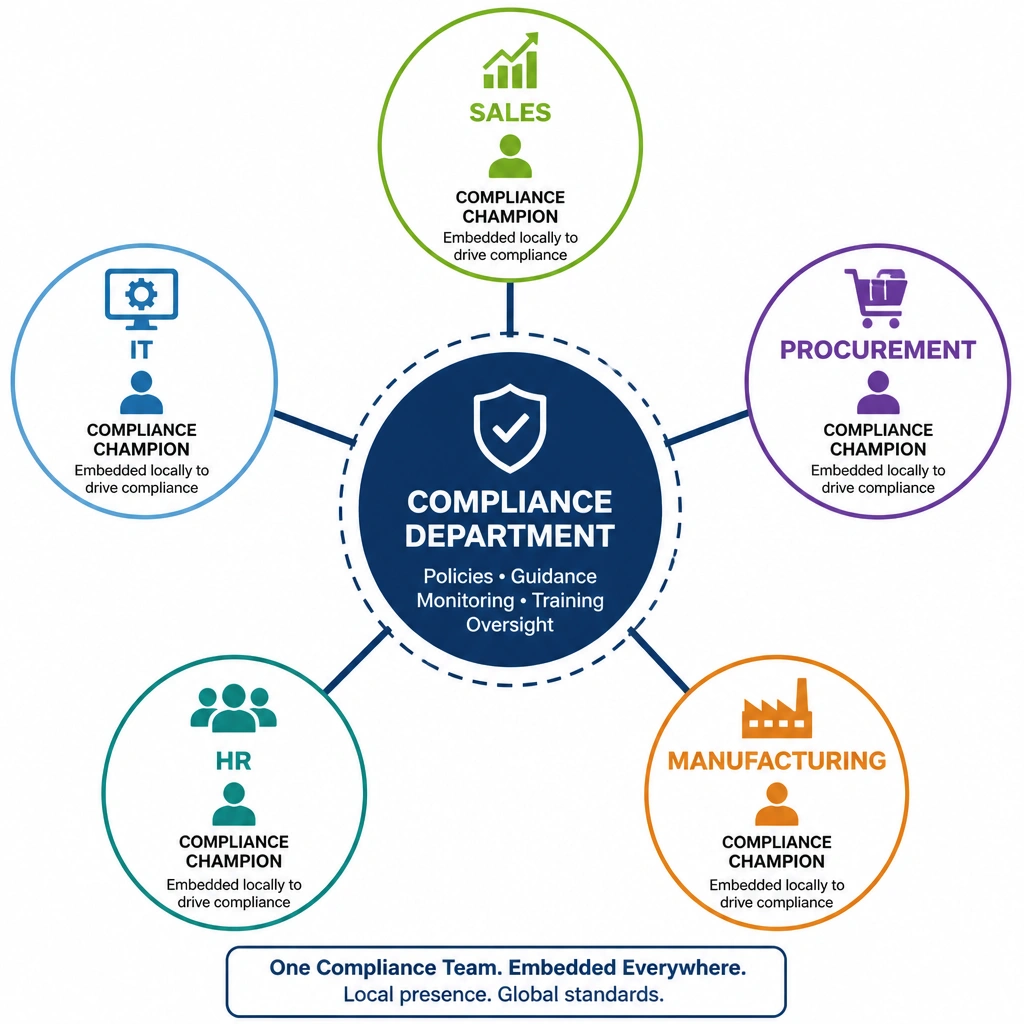
Check this out: if you're the compliance officer sitting in a corporate office, you're miles away from the day-to-day action on the sales floor or in the warehouse. You can't be everywhere at once! Think of compliance champions like setting up local repeaters or switches in a large network to boost the signal. These are regular employees—engineers, sales reps, managers—who get extra training to act as the eyes and ears of compliance on the ground. They help their teammates understand the rules and build a culture of integrity right where the work happens. It's not about rewarding sales (Option B), hiding from employees (Option C), or firing your compliance team to save a buck (Option D). It's about scaling your compliance program and making it a natural part of daily operations. Trust me, it works!
Full explanation below image
Full Explanation
A common challenge for compliance departments is overcoming the perception that compliance is a distant, bureaucratic function disconnected from commercial realities. To bridge this gap, modern organizations implement "compliance champion" or "ethics ambassador" networks. These networks consist of respected, non-compliance employees who volunteer or are selected to promote compliance values within their respective business units, geographies, or functional areas.
Let’s review the options to see why Option A is the correct answer: - Option A is correct because compliance champions serve as local advocates who translate high-level policies into the context of daily business activities. They provide accessible, first-line feedback to peers, help identify localized compliance risks, and act as a two-way communication channel between their departments and the central compliance office. This integration helps operationalize compliance and foster a culture of integrity. - Option B is incorrect because sales incentive programs are structured by sales management and HR, and are unrelated to compliance ambassador programs, which focus on ethics rather than financial sales targets. - Option C is incorrect because the existence of champions should enhance and facilitate communication, not serve as a barrier to keep the compliance department isolated from employees. - Option D is incorrect because a network of ambassadors does not replace the need for professional, dedicated compliance staff. Champions are not legal or regulatory experts; they supplement, rather than substitute, the core compliance department.
By leveraging localized networks, compliance officers can significantly increase the reach and effectiveness of their programs.