Imagine you've just uploaded your company's newly revised Code of Conduct to the corporate intranet. Under the Federal Sentencing Guidelines for Organizations (FSGO), why is simply publishing the document online insufficient for establishing an "effective" compliance communication program?
Select an answer to reveal the explanation.
Short Explanation and Infographic
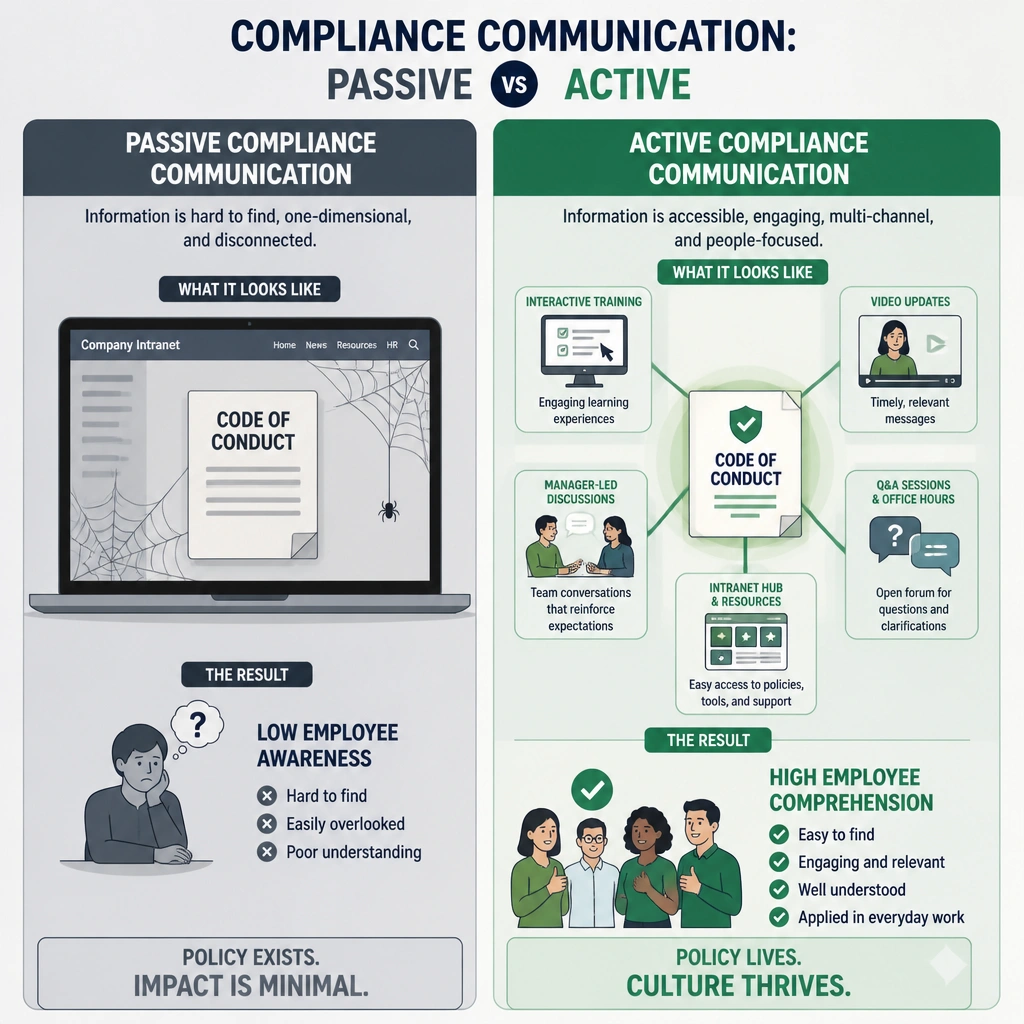
Here's the deal: uploading your compliance code to the intranet and calling it a day is like buying a gym membership and expecting to get in shape without ever walking through the door. It just doesn't work! The Federal Sentencing Guidelines for Organizations (FSGO) aren't looking for a passive repository where policies go to die. They want you to actively get the word out. That means using different channels—town halls, team meetings, video messages, and interactive training—so the message actually sinks in. The correct answer is B. Don't fall into the trap of thinking a physical booklet (Option A) or a once-a-month email blast (Option C) ticks the box. And while signing an attestation (Option D) is good for tracking, it doesn't prove anyone actually understood what they signed. You've got to be creative and proactive with your communication, or your program is just a paper tiger.
Full explanation below image
Full Explanation
The correct answer is B. Under the Federal Sentencing Guidelines for Organizations (FSGO), specifically Section 8B2.1(b)(4), organizations must take reasonable steps to communicate periodically and in a practical manner their standards and procedures to all employees and agents. Simply posting the code of conduct on a corporate intranet is a passive approach that does not guarantee awareness, understanding, or engagement. To meet the threshold of an 'effective' compliance program, organizations must employ a variety of active communication channels—such as interactive training, team meetings, leadership messages, and newsletters—tailored to different employee groups to ensure that the standards are truly understood.
Let's analyze why the other options are incorrect: - Option A is incorrect because the FSGO does not mandate physical, printed copies of the code of conduct. Doing so would be highly impractical and costly for large or remote workforces, and it does not guarantee comprehension. - Option C is incorrect because sending a periodic automated email with a link is still a passive, one-way communication method that fails to measure or ensure understanding. While emails can support a communication plan, they cannot be the sole method of dissemination. - Option D is incorrect because obtaining a signed attestation, while a valuable documentation practice for demonstrating participation, does not satisfy the communication requirement on its own. A signature proves that an employee clicked 'accept,' but it does not ensure they understand the behavioral expectations or know how to apply them.
Effective compliance communication requires a multi-faceted, active learning strategy that reinforces key principles across different mediums, ensuring that employees at all levels know how to report concerns and navigate ethical dilemmas in their daily roles.