When establishing an organizational compliance committee, why is it critical to recruit members from a wide variety of operational and business departments rather than staffing it solely with compliance or legal specialists?
Select an answer to reveal the explanation.
Short Explanation and Infographic
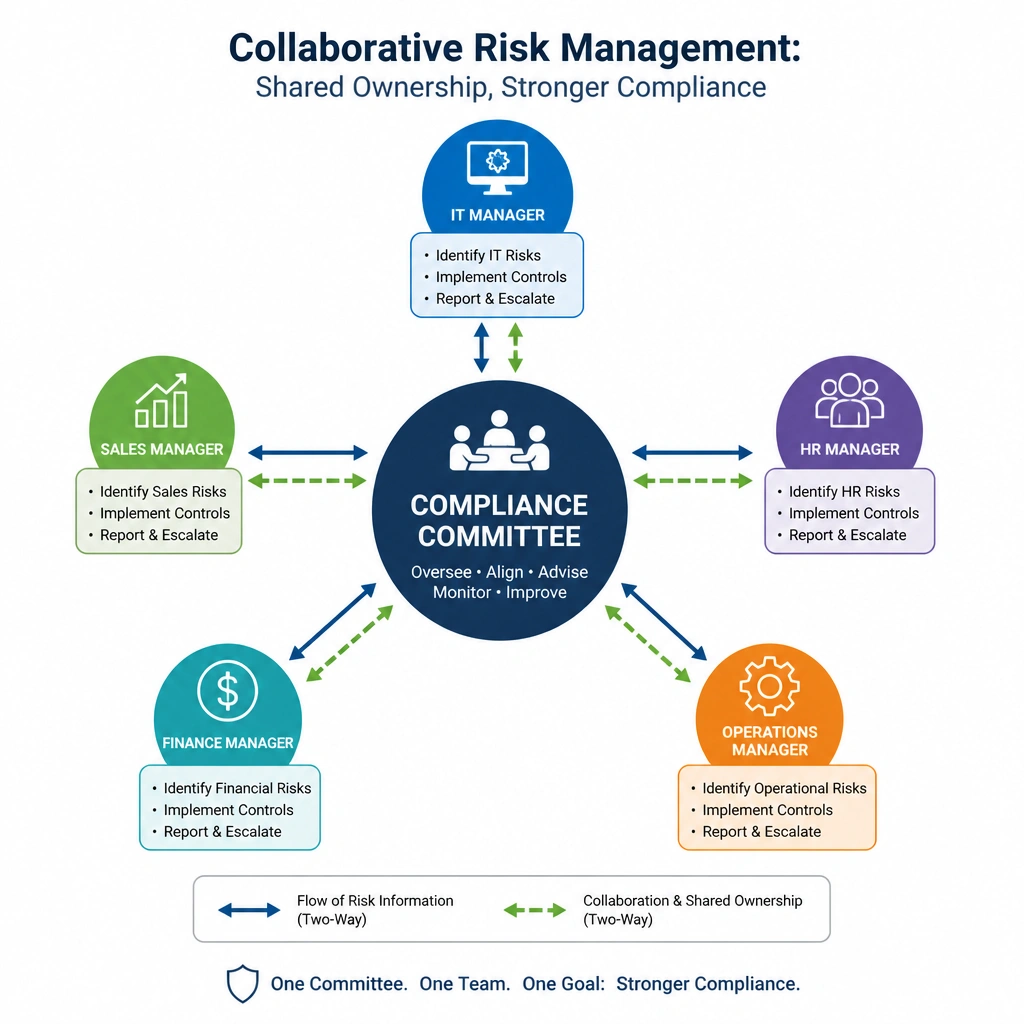
Think of it this way: if you try to run a network security team but never talk to the database admins or the cloud team, you're going to miss a ton of vulnerabilities. The same thing happens in compliance! If your compliance committee is just a bunch of lawyers sitting in a dark room, they won't know how things actually work on the warehouse floor or in the sales offices. By bringing in folks from different business units, you're building a network of champions. They help you spot risks you'd never see, and they take the message back to their teams. The correct answer is C. You can't just run this in a silo, you still need a leader, and we definitely aren't letting units make up their own rules. Trust me, cross-functional ownership is key to a program that actually works!
Full explanation below image
Full Explanation
The correct answer is C. A compliance committee should be composed of members from different business units (such as HR, Sales, IT, Finance, Operations, and Legal) to promote compliance program ownership throughout the organization. This cross-functional composition brings diverse perspectives on operational risks that a centralized compliance department might not fully appreciate or detect. Representatives from each business unit understand the granular workflows, vulnerabilities, and cultural dynamics of their respective areas, enabling the committee to design more practical and effective controls. Furthermore, when department leaders participate in compliance oversight, they act as ambassadors, facilitating better adoption of compliance policies within their teams.
Let's review the incorrect options: - Option A is incorrect because establishing a compliance committee does not shield the compliance department or CCO from regulatory accountability. In fact, regulatory bodies like the DOJ look at the committee's activity to verify that the compliance function has sufficient executive support and oversight. - Option B is incorrect because a compliance committee does not replace the compliance officer. The Federal Sentencing Guidelines for Organizations (FSGO) require that specific high-level personnel (such as a Chief Compliance Officer) be given overall responsibility for the compliance and ethics program. - Option D is incorrect because the committee's purpose is to align operational units with the organization's standards, not to allow individual departments to bypass corporate policies or create their own arbitrary rules.