Organizations often publish both a Code of Ethics and a Code of Conduct. Which of the following best describes the key distinction in objective between these two documents?
Select an answer to reveal the explanation.
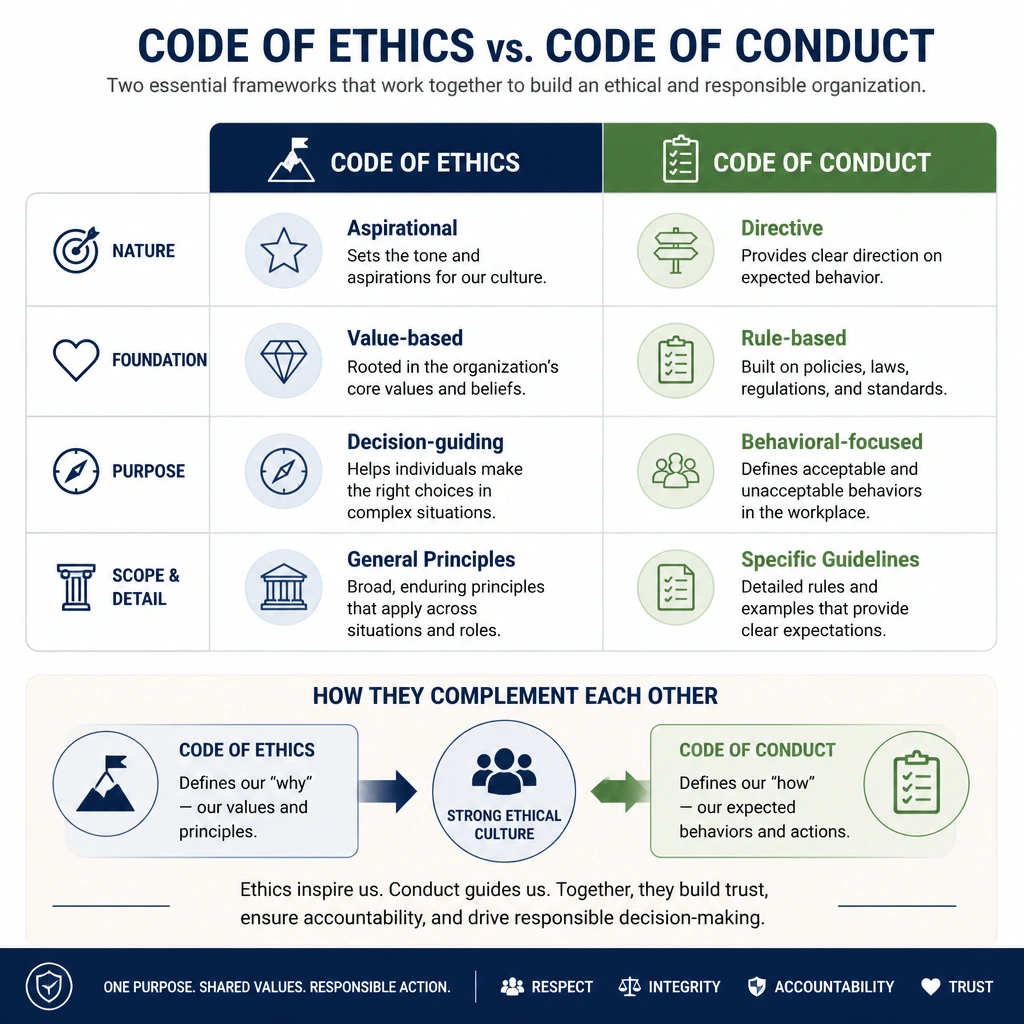
Short Explanation and Infographic
Trust me on this: these two documents have different jobs. Think of a Code of Ethics as the company's moral compass. It's all about high-level, aspirational values—like integrity, respect, and responsibility. It helps you make decisions when you're in a gray area. A Code of Conduct, on the other hand, is your rulebook. It tells you exactly what you can and cannot do, like the policy on gifts or conflicts of interest. So, ethics is about values; conduct is about specific rules. Got it? Option C is the winner.
Full explanation below image
Full Explanation
While the terms 'Code of Ethics' and 'Code of Conduct' are sometimes used loosely in casual conversation, they serve distinct purposes within a mature compliance and ethics framework. An effective program utilizes both to address different aspects of employee behavior and decision-making. Option C is the correct answer because a Code of Ethics is value-based. It establishes the high-level, aspirational principles and ethical foundations of the organization (e.g., honesty, fairness, respect, accountability). It is intended to guide judgment, especially in complex situations where specific rules may not exist. In contrast, a Code of Conduct is rule-based. It translates those high-level ethical values into concrete, mandatory behaviors, procedures, and restrictions (e.g., policy limits on entertainment, data security protocols, reporting structures). Option A is incorrect because a Code of Ethics is generally not a standalone legally binding contract in itself, and a Code of Conduct is definitely not optional; compliance with the Code of Conduct is mandatory for all employees as a condition of employment. Option B is incorrect because both documents are meant to apply to all levels of the organization, from entry-level staff to the Board of Directors, to ensure a unified ethical culture. Option D is incorrect because treating the two documents as identical ignores their structural differences. Mixing high-level values with specific rules in a single, unstructured format can make compliance guidance harder for employees to navigate and apply.