A major corporation is restructuring its compliance program to focus specifically on preventing and detecting criminal conduct. Which regulatory framework provides the primary financial and legal incentive—specifically through potential reductions in fines and penalties—for implementing this structure?
Select an answer to reveal the explanation.
Short Explanation and Infographic
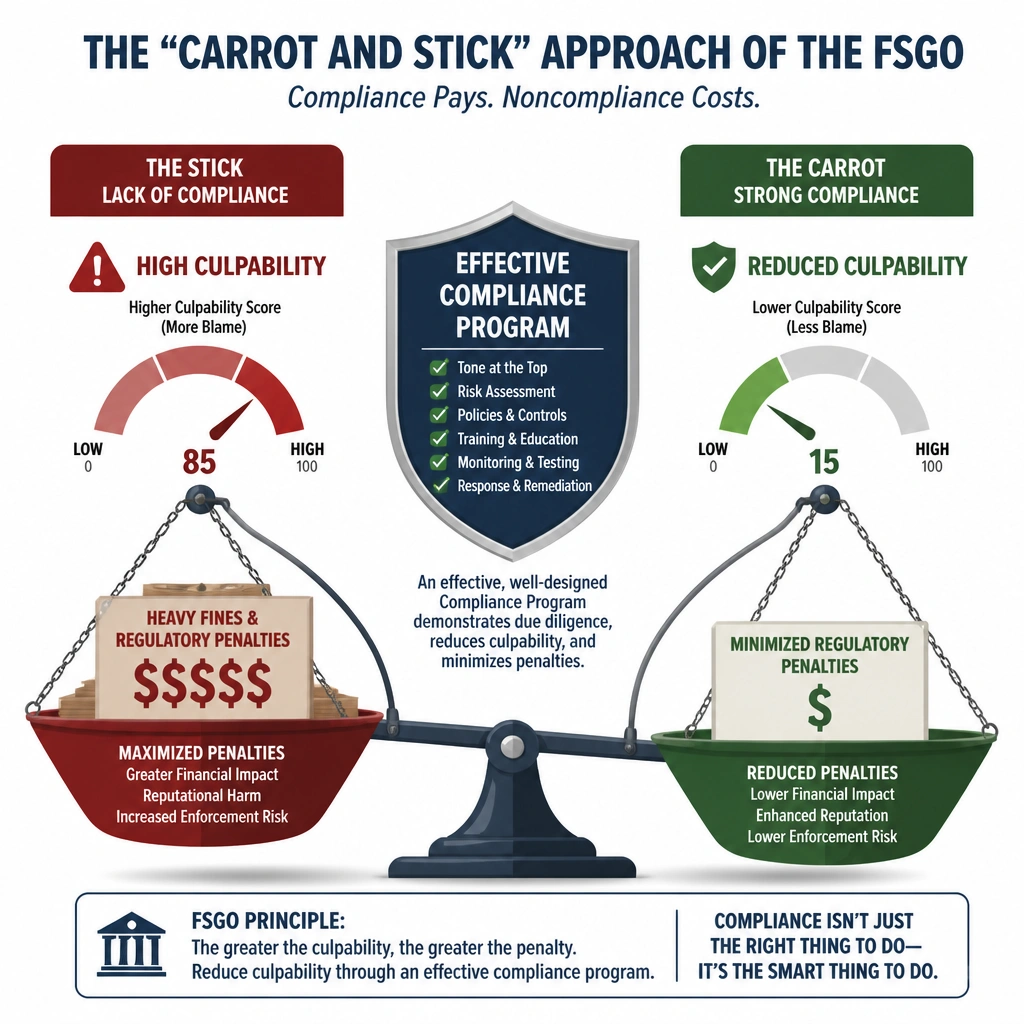
Think of this like insurance for your car. You don't drive carefully just because your dashboard clock looks nice—you do it to avoid accidents and keep your insurance premiums low! In the corporate world, the Federal Sentencing Guidelines for Organizations (FSGO) is that insurance policy. Back in 1991, the government basically said, 'Hey, if your employees do something illegal, we're going to fine you into next week. But, if you can show us you had a real, working compliance program designed to catch and stop that criminal behavior, we'll slash those fines by up to 95 percent.' That's a massive incentive! The correct answer is D because the FSGO is the big stick and the carrot that drives companies to build these programs. External consultants (Option A), corporate citizenship (Option B), and mission statements (Option C) are nice to have, but nothing gets a board of directors to invest in compliance quite like the threat of multi-million-dollar fines being cut down by the FSGO. Keep that in mind for the exam!
Full explanation below image
Full Explanation
The correct answer is D. The primary driver for designing compliance programs specifically to prevent and detect criminal conduct is the Federal Sentencing Guidelines for Organizations (FSGO), promulgated by the United States Sentencing Commission in 1991. The FSGO established a "carrot and stick" approach: it imposes severe penalties on organizations convicted of federal crimes, but also provides for a significant reduction in the culpability score (which determines the fine range) if the organization has an "effective compliance and ethics program" in place at the time of the offense. An effective program under FSGO must be reasonably designed, implemented, and enforced to prevent and detect criminal conduct.
Let's analyze why the other options are incorrect: - Option A is incorrect because while external consultants provide valuable advice and benchmarking, their opinions carry no regulatory or legal authority and do not provide legal defense or penalty mitigation. - Option B is incorrect because wanting to be a good corporate citizen is a noble aspirational goal, but it is not the primary legal or financial driver that structures compliance programs to meet specific criminal-detection standards. - Option C is incorrect because a company's mission statement represents its strategic and cultural goals. While it should align with compliance, it does not dictate the legal standards or provide the structured liability reductions found in the FSGO. Understanding the FSGO's role is critical, as it forms the foundational blueprint for modern compliance program design across almost all industries.