An international shipping company is reviewing its compliance controls to ensure it can quickly identify potential bribery or kickbacks. Which of the following measures operates as a detective compliance control?
Select an answer to reveal the explanation.
Short Explanation and Infographic
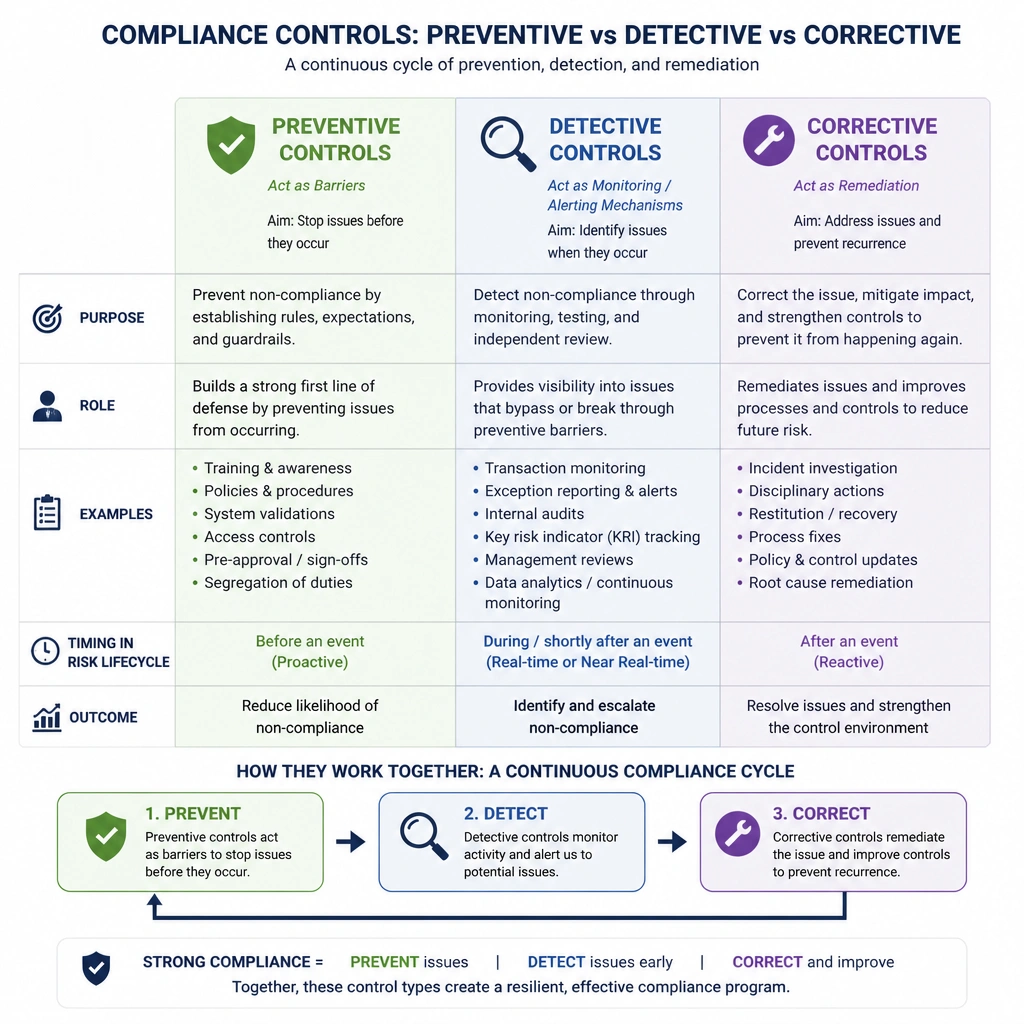
Check this out: in the compliance world, you've got three main flavors of controls: preventive, detective, and corrective. Think of a preventive control like locking your front door—it stops the bad stuff before it happens. A detective control, though, is like a motion-activated security camera. It doesn't block the door, but it starts flashing and alerts you the second someone steps inside! That's exactly what transaction monitoring does. It sits in the background, watches the cash flow, and flags anything that looks fishy—like an unexpected, massive payment to a random consulting firm. Now, signing a code of conduct (choice B) or taking a training class (choice A) are great, but they are preventive—they try to guide behavior before someone does something crazy. A zero-tolerance policy (choice D) is also preventive because it sets the rules of the road before the engine starts. Got it? Sweet. Let's keep rolling.
Full explanation below image
Full Explanation
Compliance controls are categorized by their timing and intent relative to a compliance failure: preventive controls aim to prevent the violation from occurring, detective controls identify violations after they have occurred, and corrective controls remediate the violation. An automated transaction monitoring system operates as a detective control because it analyzes transactions post-execution (or during processing) to identify anomalies, unauthorized payments, or potential red flags (such as suspicious third-party disbursements) that warrant further investigation. By contrast: Option A (Mandatory annual training) is a preventive control because it educates employees beforehand to ensure they understand legal requirements (like the FCPA) and avoid making non-compliant decisions. Option B (Signing the Code of Conduct) is also a preventive control, establishing expectations and securing employee commitment to ethical behavior before they engage in business activities. Option D (Zero-tolerance conflict of interest policy) is a preventive control, setting clear rules and thresholds to deter employees from entering into situations where conflicts of interest could arise. Therefore, transaction monitoring is the only detective control among the options, designed to identify and flag issues that have already bypassed preventive barriers.