During a corporate town hall, the Chief Executive Officer explicitly states that the company will walk away from lucrative vendor agreements if those vendors do not adhere strictly to the organization's environmental and anti-bribery standards. Which of the following compliance concepts does this executive behavior best exemplify?
Select an answer to reveal the explanation.
Short Explanation and Infographic
Check this out—compliance isn't just about handing out a dense rulebook and hoping for the best. It starts right at the peak of the mountain. When the big boss stands up and says, "Look, we care about doing the right thing more than we care about a fast buck," that sends a massive signal to everyone down the line. It's called the "tone at the top." If the executives don't care, trust me, the front-line staff won't either. It's all about leadership setting the pace and showing that integrity actually matters in the real world. Got it? Sweet. Let's keep rolling.
Full explanation below image
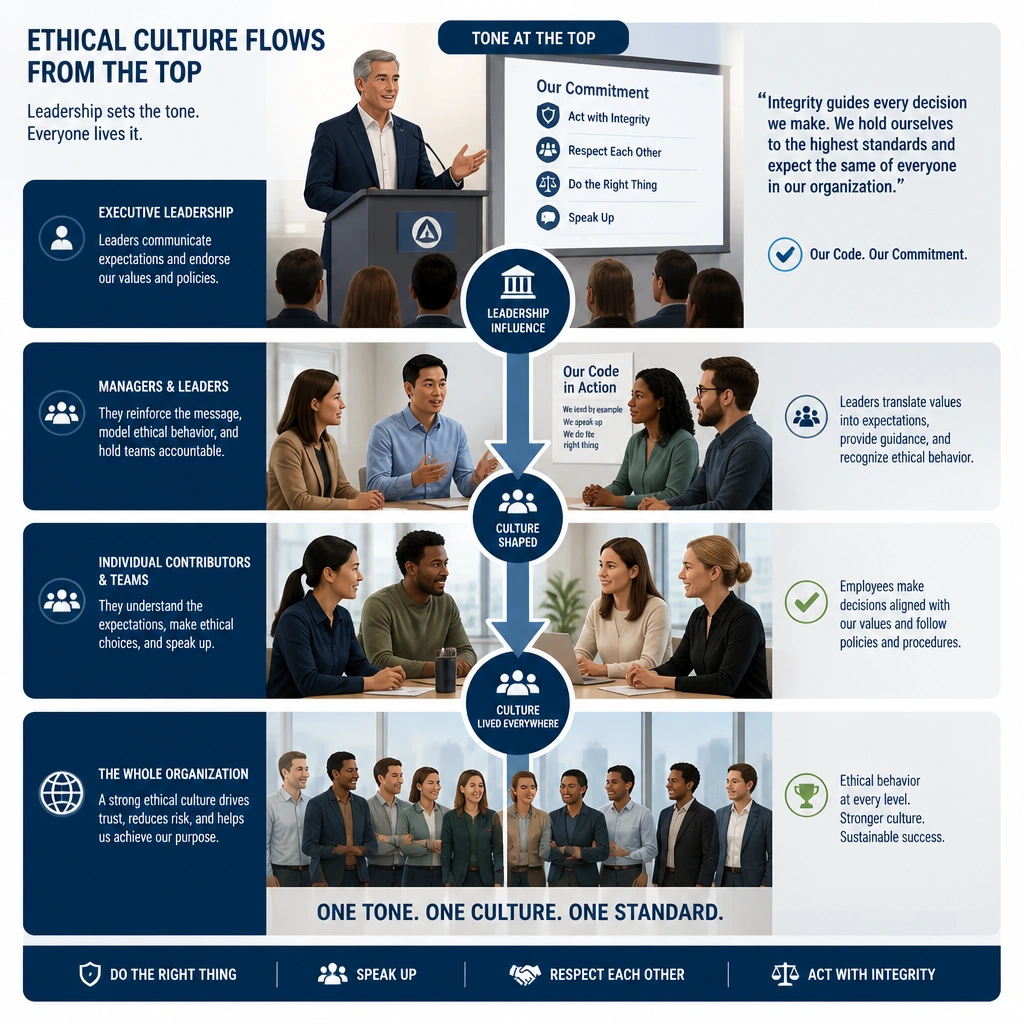
Full Explanation
The correct answer is C, "Tone at the top." This term refers to the ethical atmosphere created in the workplace by an organization's leadership, including the board of directors, CEO, and senior management. When executives actively demonstrate and communicate a commitment to compliance and ethical behavior—even when it potentially impacts short-term financial performance—they establish a culture where integrity is valued. This commitment is widely recognized by regulators (such as the U.S. Department of Justice in its evaluation of corporate compliance programs) as a foundational element of an effective compliance program. A strong tone at the top flows downward, encouraging employees at all levels to prioritize ethical decision-making.
Let's look at the distractors to understand why they do not fit: - A (Downward communication channel) is incorrect because while the CEO is indeed communicating downward, the specific concept of leadership modeling and prioritizing ethics is defined as "tone at the top." A communication channel is simply the medium or mechanism used, not the cultural influence itself. - B (Independent compliance authority) is incorrect because it refers to the autonomy and resource allocation of the compliance officer or department, ensuring they can operate without undue interference from business units. A speech by the CEO does not establish or represent this structural independence. - D (Performance incentive alignment) is incorrect because it relates to how employees are evaluated and rewarded (e.g., tying bonuses to compliance metrics). While tone at the top supports this alignment, a verbal commitment from leadership during a town hall is a direct reflection of executive culture rather than a structured incentive system. Aligning incentives is an operational practice, whereas tone at the top is a cultural driver.