A medical diagnostics company is evaluating a model that detects a rare disease. In this scenario, missing a positive case (a false negative) is extremely dangerous. The team needs to measure the model's ability to find all the actual positive cases. Which evaluation metric specifically calculates the ratio of correctly predicted positive instances to all actual positive instances in the dataset?
Select an answer to reveal the explanation.
Short Explanation and Infographic
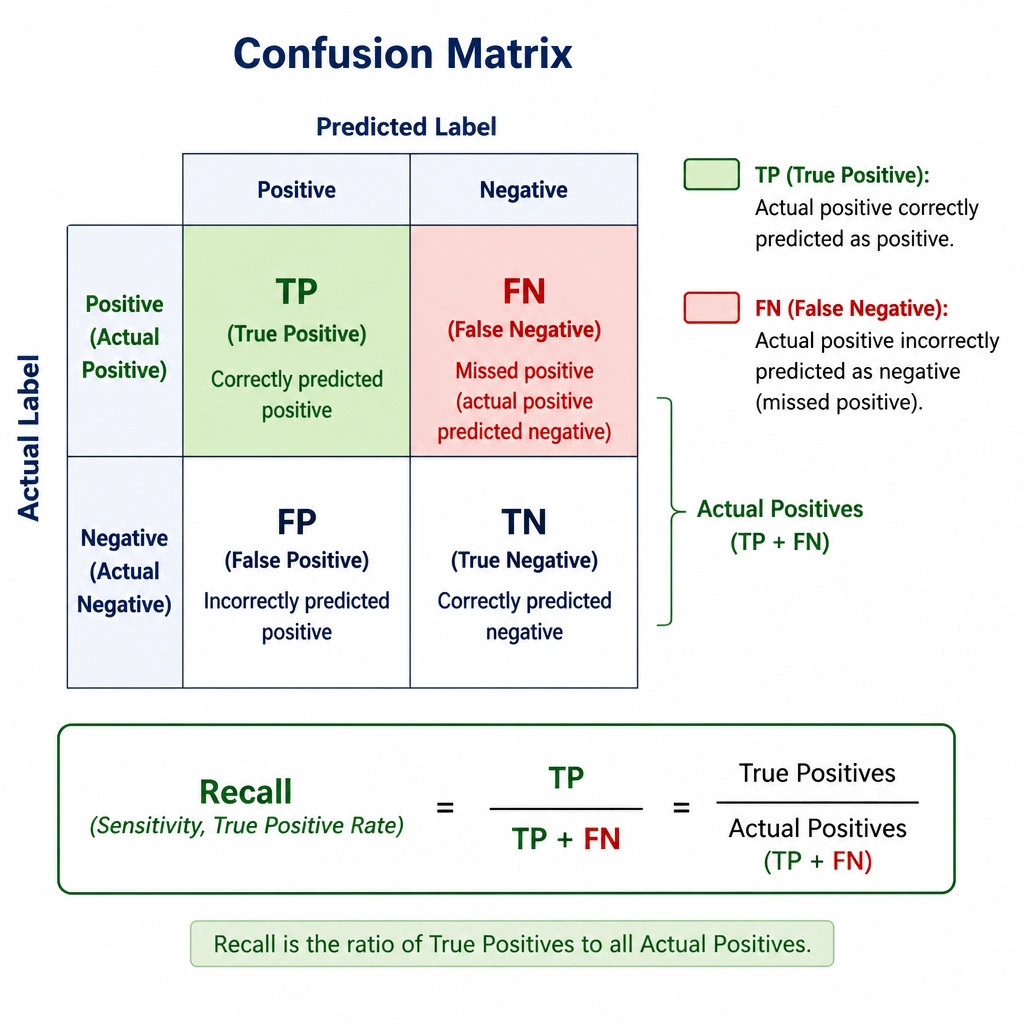
Imagine your boss walks in and says, "If our AI misses even one patient with this disease, we're in big trouble." That means you cannot afford false negatives. You need to know: out of everyone who actually has the disease, how many did our model catch? That's what we call Recall (sometimes called sensitivity). Think of it as a net—how much of the target did we reel in? Precision, on the other hand, is about how clean your guesses are. If you guess positive, are you actually right? For finding all the real positives, Recall is your metric. Remember that for the exam!
Full explanation below image
Full Explanation
In classification tasks, especially in binary classification, performance metrics are derived from the confusion matrix, which consists of True Positives (TP), True Negatives (TN), False Positives (FP), and False Negatives (FN). Recall (Option B), also known as sensitivity or the True Positive Rate (TPR), measures the proportion of actual positives that were correctly identified. Mathematically, it is defined as: Recall = TP / (TP + FN). Where TP represents correctly predicted positives and (TP + FN) represents the total number of actual positive cases in the dataset. Recall is critical in domains where the cost of false negatives is high, such as medical diagnoses or threat detection. Accuracy (Option A) is the ratio of correctly predicted observations to the total observations: Accuracy = (TP + TN) / (TP + TN + FP + FN). Accuracy can be misleading when evaluated on highly imbalanced datasets. Precision (Option C) measures the proportion of positive identifications that were actually correct. Mathematically, it is: Precision = TP / (TP + FP). This metric focuses on minimizing false positives. F1-Score (Option D) is the harmonic mean of Precision and Recall, calculated as: F1-Score = 2 (Precision Recall) / (Precision + Recall). It provides a single metric that balances both precision and recall, but does not isolate actual positive cases on its own. Hence, Recall is the correct metric for measuring the ratio of correct positive predictions relative to total actual positives.