You are preparing a tabular dataset to train a machine learning model that predicts whether a customer will churn. The dataset includes columns such as 'Monthly_Spend', 'Contract_Length', and 'Customer_Age'. In machine learning terminology, what term is used to describe these individual input variables used to make predictions?
Select an answer to reveal the explanation.
Short Explanation and Infographic
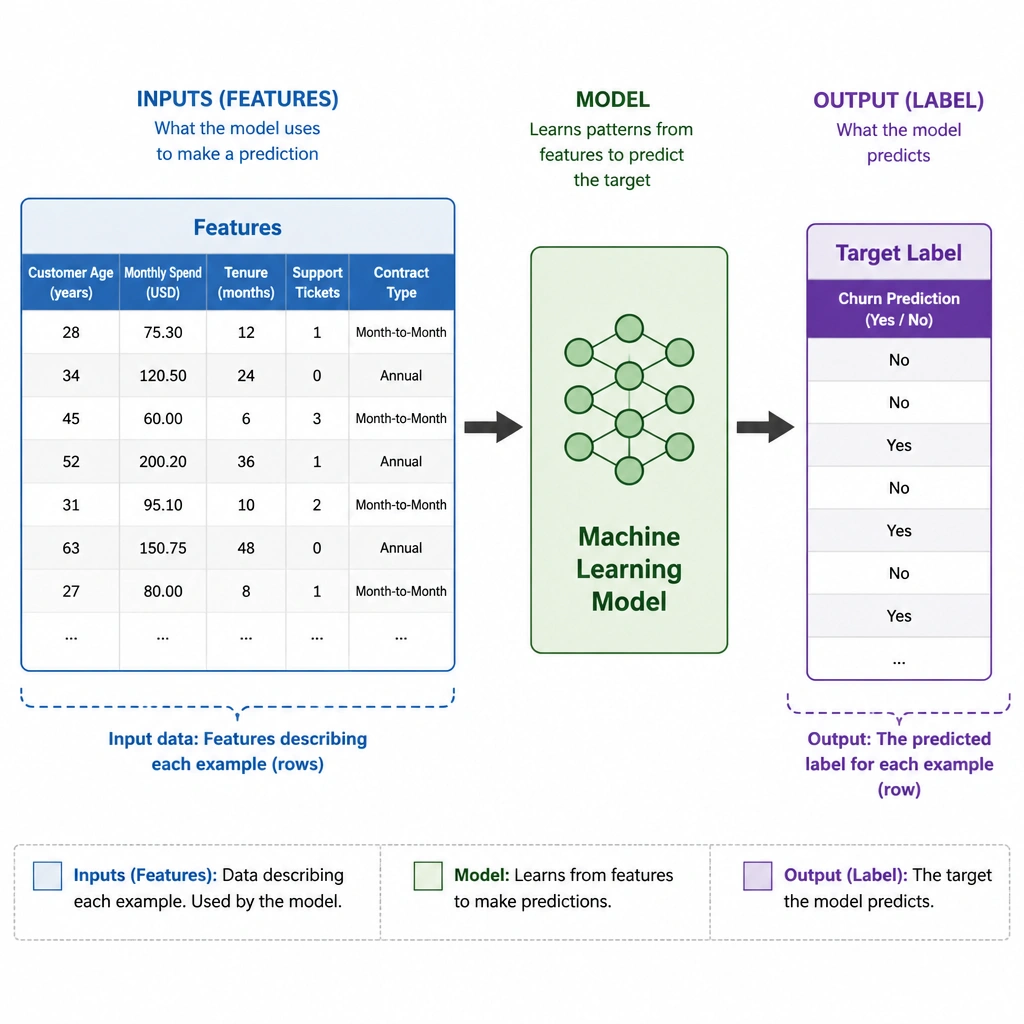
Think of a machine learning model like a detective trying to solve a case. The detective needs clues, right? In our data world, those clues are called features. They're the input variables you feed into the model—like a customer's age, how long they've had their contract, or how much they spend. The target label is what the detective is trying to solve (like "will they churn?"). The hyperparameters are the settings you tweak on the detective's tools. Loss function is how we measure how many mistakes the detective made. So, those input columns? Those are your features. Got it? Sweet.
Full explanation below image
Full Explanation
In machine learning, data preparation is a foundational step before training any model. Understanding the vocabulary of datasets is critical. A Feature (Option D) is an individual measurable property or characteristic of a phenomenon being observed. In the context of tabular datasets used in machine learning, features correspond to the independent input variables (columns) that the model analyzes to learn patterns and make predictions. For example, to predict housing prices, features might include square footage, number of bedrooms, and zip code. Target label (Option A) refers to the dependent output variable that the model is trying to predict. In supervised learning, this is the ground-truth label associated with each instance in the training data (e.g., whether a customer churns or the final sale price of a house). Hyperparameters (Option B) are the configuration settings external to the model that cannot be learned directly from the training data. Examples include the learning rate, the number of trees in a random forest, or the number of hidden layers in a neural network. They must be set before training begins to guide the optimization process. Loss function (Option C) is a mathematical method used to measure how well a machine learning model's predictions match the actual target labels during training. The goal of optimization is to minimize the output of the loss function. Therefore, the input columns/variables representing the properties used for predicting the outcome are correctly referred to as features.