You are designing a Convolutional Neural Network (CNN) for facial recognition. As the feature maps pass deeper into the network, the computational load threatens to overwhelm your hardware. Which type of layer should you insert to downsample the feature maps, reducing their width and height while retaining the most important visual information?
Select an answer to reveal the explanation.
Short Explanation and Infographic
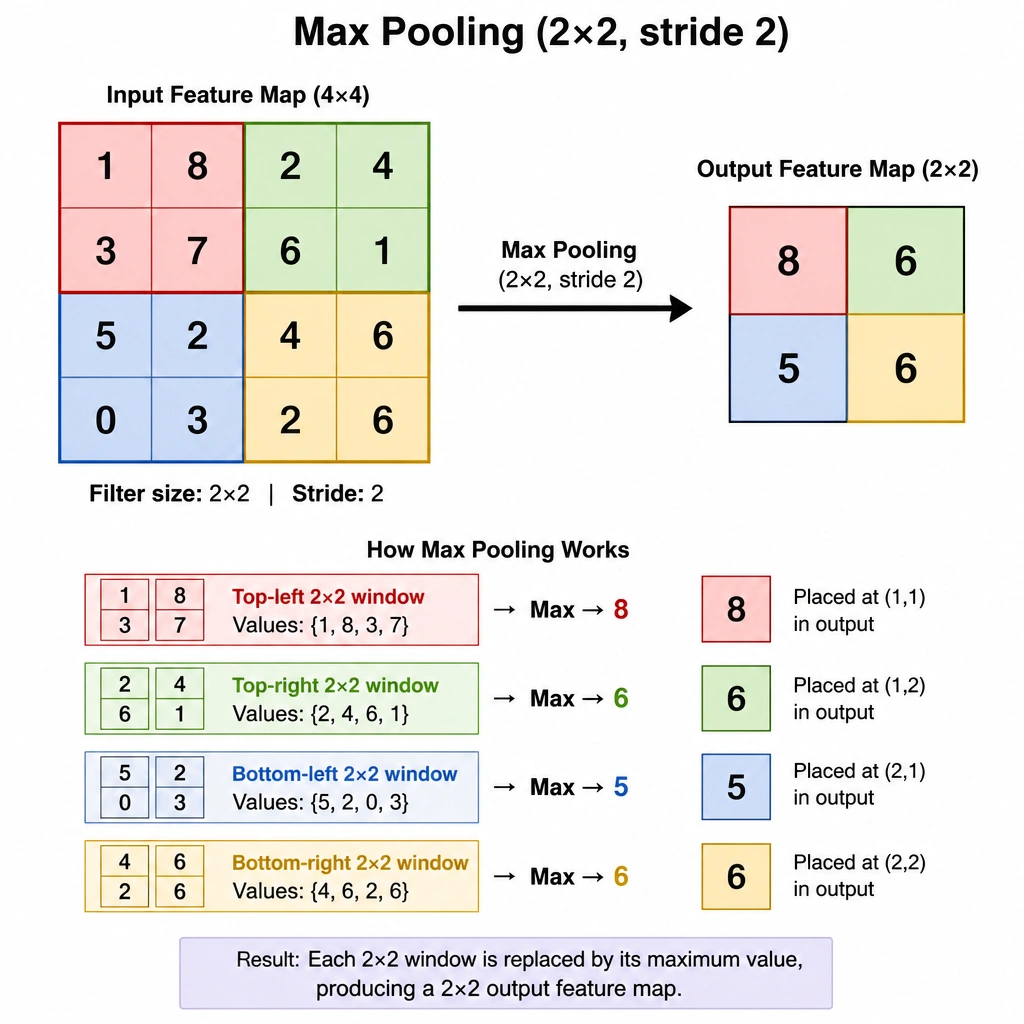
Check this out—when a convolutional layer runs over an image, it generates a massive pile of data called feature maps. If you keep passing those huge grids down the line, your GPU is going to choke on the math. Enter the pooling layer. Think of it like a summary editor. A standard Max Pooling layer looks at a 2x2 grid of pixels and says, "What's the biggest, most important number here?" It grabs that one number and throws away the other three. Boom—you've just cut the height and width of your feature map in half! This keeps the computation manageable, prevents overfitting, and gives your model "translation invariance"—which is just a fancy way of saying it can recognize a nose whether it's in the top corner or the center of the photo. Pretty cool, right?
Full explanation below image
Full Explanation
In Convolutional Neural Networks (CNNs), a pooling layer is a standard component inserted between successive convolutional layers. Its primary purpose is to reduce the spatial dimensions (width and height) of the input volume (the feature maps).
Pooling operates independently on each depth slice of the input and downsamples it. The most common form is Max Pooling, which applies a filter (typically 2x2 with a stride of 2) across the input and selects the maximum value within that sub-window, discarding the remaining values. Another variation is Average Pooling, which calculates the mean value of the sub-window.
By reducing the spatial dimensions, pooling serves several critical functions: 1. Computational Efficiency: It reduces the total number of parameters and computations required in the subsequent layers of the network, preventing GPU memory exhaustion. 2. Overfitting Control: By summarizing features, it abstracts the representation and reduces the risk of the model memorizing precise pixel locations. 3. Translation Invariance: It helps the network become invariant to small translations, rotations, or distortions of the features in the input image. If an active feature shifts slightly, its pooled value will often remain the same.
Let's review the incorrect options: - Fully connected layers (Option A) flatten the feature maps and connect every neuron to every activation of the previous layer, which actually increases the parameter count significantly. - Batch normalization (Option C) standardizes activations to stabilize and accelerate training, but does not alter the spatial dimensions of feature maps. - Activation layers (Option D) apply element-wise mathematical transformations (like ReLU) to introduce non-linearity, keeping the spatial dimensions identical.
Therefore, the pooling layer (Option B) is specifically designed to downsample the spatial dimensions.