During the training of a deep neural network, after the input has passed forward through the layers and the prediction error has been calculated, how does the network determine exactly how to adjust the millions of weights and biases inside its hidden layers to reduce that error?
Select an answer to reveal the explanation.
Short Explanation and Infographic
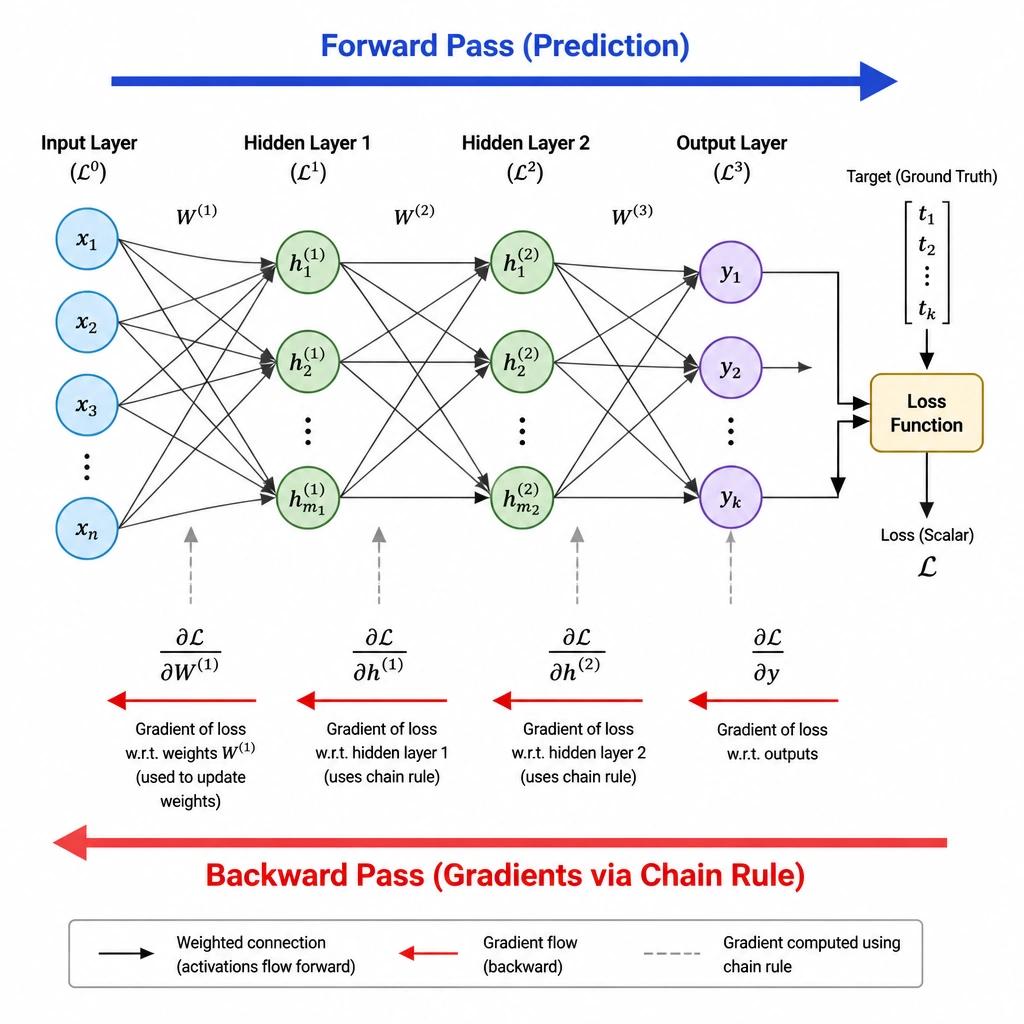
Here's the deal—forward propagation is where the network takes a guess. It sends the data from front to back, makes a prediction, and compares it to the real answer. But the real magic happens during backpropagation. Once we know how wrong we are (the error), we start at the output layer and work our way backward through the network. We use a bit of calculus called the chain rule to calculate exactly how much each individual weight and bias contributed to that error. It's like tracing a mistake back to the source. Once we know who's responsible for the error, the optimizer steps in and nudges those weights in the right direction. That's how a network actually learns!
Full explanation below image
Full Explanation
Backpropagation, short for "backward propagation of errors," is the core algorithm used to train artificial neural networks. It is a supervised learning method that works in conjunction with an optimization algorithm, such as Gradient Descent, to minimize the network's loss.
The training loop of a neural network consists of three main steps: 1. Forward Pass: Input data is fed forward through the network. Each layer applies weights, biases, and activation functions, culminating in a prediction at the output layer. 2. Loss Calculation: The output prediction is compared against the actual target value using a loss function, yielding a scalar error value. 3. Backward Pass (Backpropagation): The algorithm calculates the partial derivatives (gradients) of the loss function with respect to every weight and bias in the network. Starting from the output layer, it uses the calculus chain rule to recursively compute gradients for each preceding hidden layer.
Once the gradients are calculated via backpropagation, the optimizer uses them to update the weights and biases (e.g., subtracting a fraction of the gradient scaled by the learning rate). This process is repeated across many epochs, gradually minimizing the error.
Let's look at the incorrect options: - Forward propagation (Option A) only computes the intermediate activations and output predictions; it does not calculate gradients or update weights. - Weight initialization (Option C) is a one-time setup step performed before training begins to prevent issues like vanishing or exploding gradients. - Hyperparameter tuning (Option D) is an external process of selecting structural settings (like learning rate or number of layers) and does not calculate gradients or update weights during normal backpropagation iterations.
Therefore, backpropagation (Option B) is the process of calculating gradients to update weights and biases.