You are training a convolutional neural network to classify different species of birds, but you only have 200 images of each species. To prevent the model from overfitting and to help it generalize to new, unseen photos, you want to artificially increase the size of your training set without taking new pictures. What technique should you use?
Select an answer to reveal the explanation.
Short Explanation and Infographic
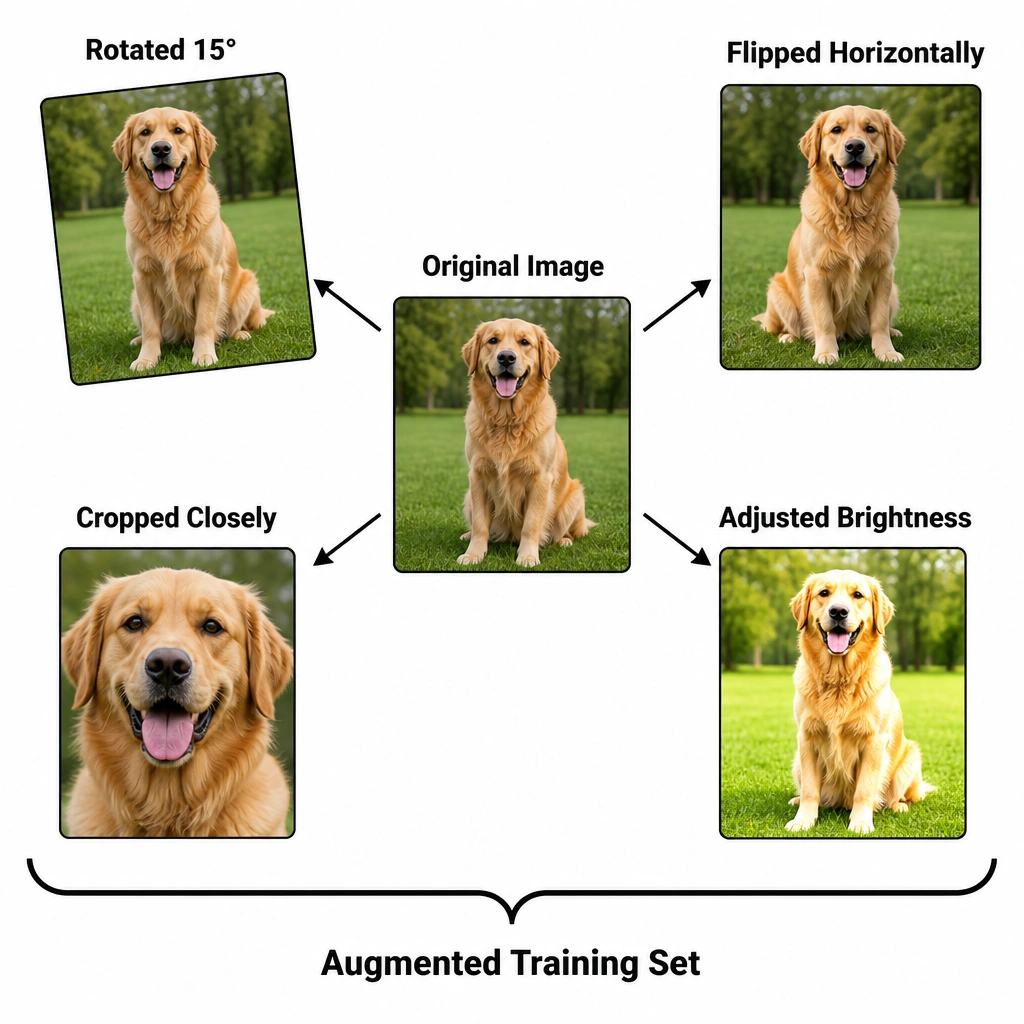
Check this out—if you train your bird-classifier model on just a few hundred clean, perfectly centered photos, it's going to struggle in the real world. The first time it sees a bird that's upside down, zoomed out, or in different lighting, it'll fail. But you don't have the time or money to go take a million more photos. Instead, you use data augmentation. You tell the computer to take your existing photos and randomly flip them horizontally, rotate them a few degrees, crop the edges, or tweak the brightness. To the neural network, these look like brand-new pictures! You easily multiply the size of your dataset by 10 or 20 times, and the model learns to recognize the bird itself, not just the specific angle of the original photo. Simple and highly effective!
Full explanation below image
Full Explanation
Data augmentation is a technique commonly used to artificially expand the size and diversity of a training dataset by creating modified versions of the existing data points. It is especially prevalent in computer vision, but it is also used in natural language processing and audio classification.
When training deep learning models, having insufficient data often leads to overfitting, where the model memorizes the specific details of the training set rather than learning generalizable patterns. Data augmentation addresses this by applying various random, label-preserving transformations to the input data. For image datasets, these transformations include: - Horizontal and vertical flipping - Rotation (by small angles) - Zooming and cropping - Adjusting brightness, contrast, or color saturation - Adding minor noise (like Gaussian noise)
Since these modifications do not change the actual class of the image (an image of a blue jay is still a blue jay even if it is flipped or rotated), they force the model to be invariant to these transformations. This improves the model's generalization capabilities on unseen test data.
Let's analyze why the other options are incorrect: - Feature extraction (Option A) refers to identifying important descriptors in the images, but it does not increase the dataset size. - PCA (Option C) is a dimensionality reduction technique used to compress features and reduce dataset width, not to expand the number of training samples. - Dataset pruning (Option D) involves removing data points to clean up or downsize the dataset, which is the opposite of expanding the training set.
Therefore, data augmentation (Option B) is the correct technique for artificially increasing dataset size and diversity.