When deploying machine learning systems, developers must distinguish between the phase where a neural network learns and the phase where it is put to work. What is the fundamental difference between the training phase and the inference phase of a model's lifecycle?
Select an answer to reveal the explanation.
Short Explanation and Infographic
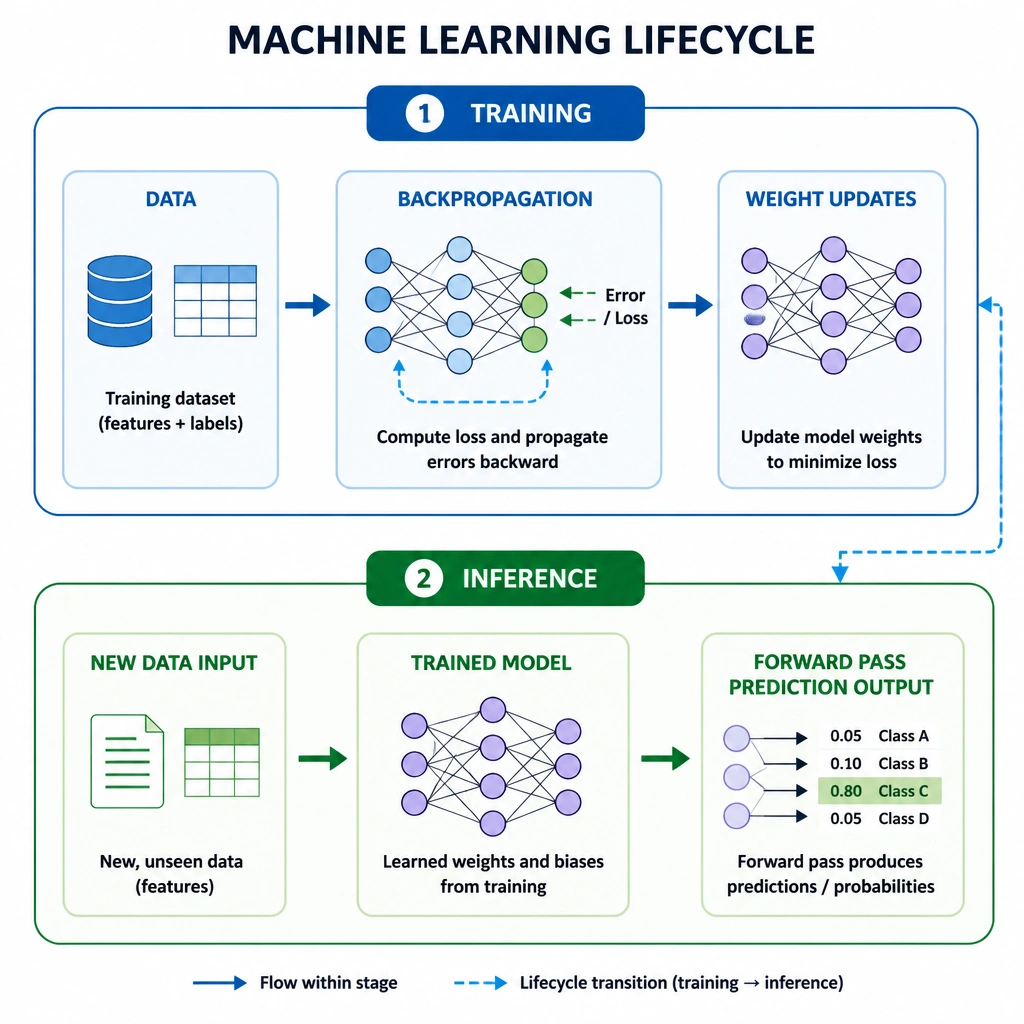
Here's the deal: training and inference are like studying for a big exam versus actually taking it. When you're training a neural network, the model is hit with a ton of data, and it's constantly adjusting its internal weights to get smarter. It's computationally heavy, requires serious GPU power, and takes time. But once the network is trained, its weights are locked in place. That's when we transition to inference. Now, you're feed-forwarding new, unseen data into that model to get a prediction. It's fast, computationally cheap, and represents the real-world utility of your AI. Don't fall for the exam traps here—training isn't cheap, and you definitely don't train on test data. Keep those phases straight and you'll do great!
Full explanation below image
Full Explanation
The machine learning lifecycle is divided into training and inference phases. During training, a model learns the underlying patterns in a dataset by iteratively updating its parameters (weights and biases) via backpropagation to minimize a loss function. This phase is computationally intensive and requires substantial hardware resources, such as GPUs or TPUs. Once trained, the model's parameters are frozen. In the inference phase, the trained model is deployed to make predictions or decisions on new, unseen data. Inference requires only a single forward pass, making it significantly faster and less resource-intensive than training. - Distractor B is incorrect because training is highly resource-intensive due to backpropagation, while inference is computationally lightweight. - Distractor C is incorrect because training uses the training dataset to build the model, while testing and inference are performed on separate datasets to evaluate and use the model. - Distractor D is incorrect because both training and inference are required for both classification and regression tasks.