A deep learning engineer is selecting a framework for a new computer vision project. When comparing TensorFlow and PyTorch, which of the following best describes their typical usage and architectural differences from a developer's perspective?
Select an answer to reveal the explanation.
Short Explanation and Infographic
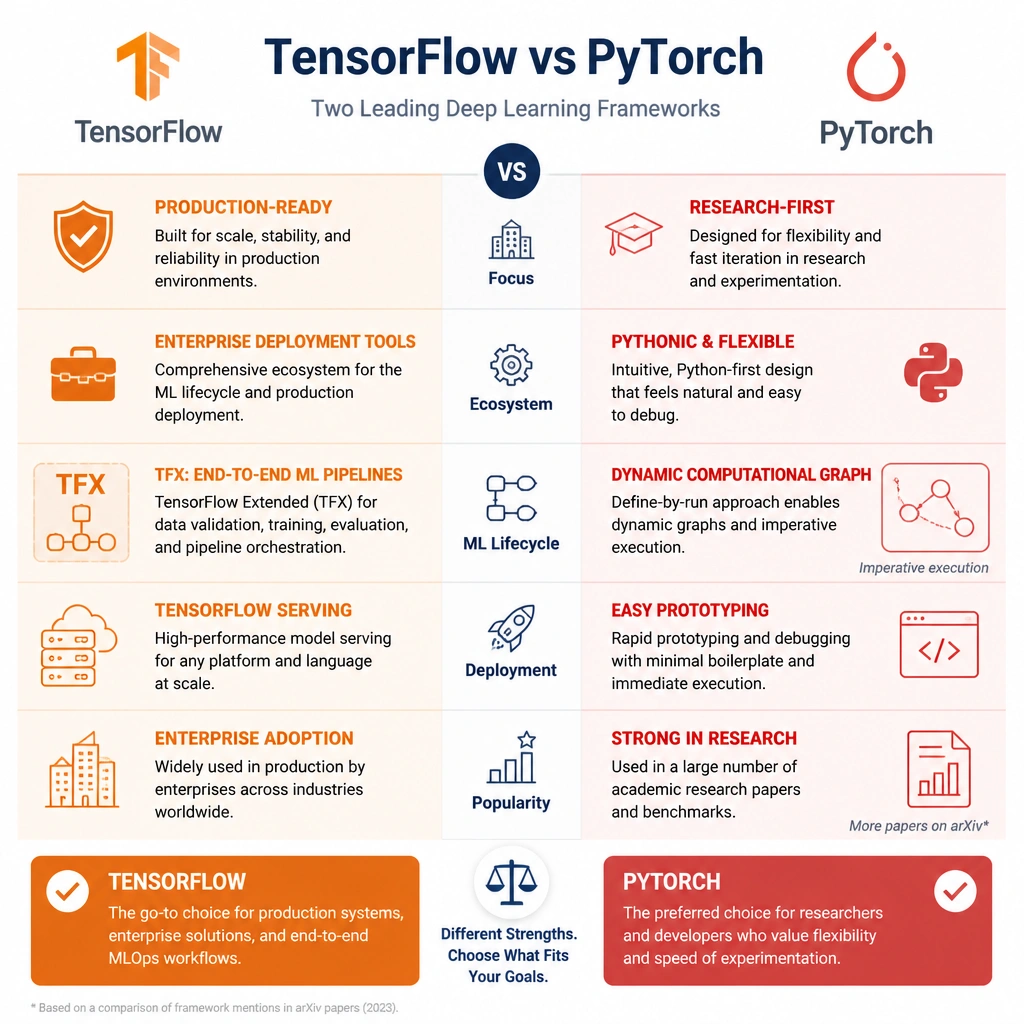
Okay, let's dive into the classic battle: TensorFlow versus PyTorch. If you've been around the block, you know both of these frameworks can get the job done, but they have very different vibes. TensorFlow is like the corporate heavy-lifter. It's got amazing tools like TensorFlow Serving and TFX, which makes it a dream for production environments and massive deployments. On the other hand, PyTorch is extremely popular in the research world. Why? Because it uses a dynamic compute graph, meaning you can change things on the fly as your code runs. It feels like natural Python. So, research and prototyping? Usually PyTorch. Scaling to production? Historically, TensorFlow has the edge. Remember this distinction because it bites people on the exam all the time!
Full explanation below image
Full Explanation
TensorFlow and PyTorch are the two dominant deep learning frameworks, but they cater to slightly different developer experiences and deployment scenarios. PyTorch uses a dynamic computation graph (eager execution by default), which allows developers to modify the network's behavior at runtime. This makes debugging easier and makes PyTorch highly popular in research and academic environments. TensorFlow, while supporting eager execution, was originally designed around static graphs. It excels in production environments due to its robust ecosystem of deployment tools (such as TensorFlow Serving, Lite, and Extended), making it highly optimized for scaling models in enterprise pipelines. - Distractor A is incorrect because both frameworks support GPU acceleration (e.g., via CUDA). - Distractor C is incorrect because it reverses the roles; PyTorch is highly research-oriented, and TensorFlow is historically strong in production. - Distractor D is incorrect because both frameworks offer both high-level APIs (such as Keras for TensorFlow and PyTorch Lightning for PyTorch) and low-level APIs.