When working within the PyTorch framework to build deep learning models, what is the primary purpose and nature of a Tensor?
Select an answer to reveal the explanation.
Short Explanation and Infographic
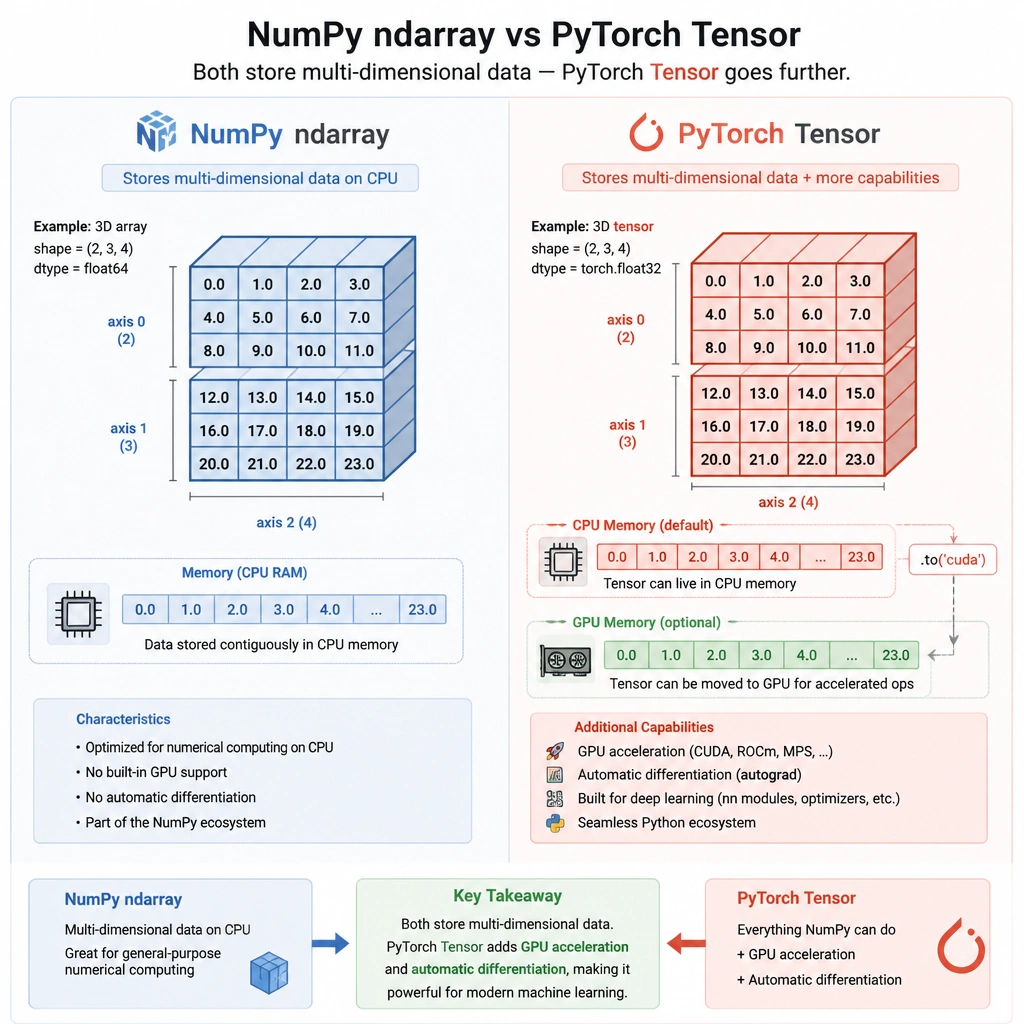
Check this out: in PyTorch, everything revolves around the tensor. Think of a tensor as a multi-dimensional grid of numbers—like a vector or a matrix. If you've ever used Python's NumPy library, you'll feel right at home because a PyTorch tensor is super similar to a NumPy array. But here's the kicker: tensors are built to run on hardware accelerators like GPUs. That means they can crunch numbers at lightning speed, which is exactly what we need to train deep neural networks. They also track operations to help compute gradients automatically. It is NOT a loss function, it's NOT an optimizer, and it's NOT the network structure itself. It's the raw data structure holding the numbers. Got it? Sweet. Let's keep rolling!
Full explanation below image
Full Explanation
In PyTorch, a tensor is the fundamental data structure used to represent data, weights, and gradients. Mathematically, a tensor is a multi-dimensional array of numbers. While highly similar to NumPy's ndarray, PyTorch tensors are designed with deep learning in mind: they can run on accelerated hardware like GPUs or TPUs to speed up computations, and they support automatic differentiation (Autograd) to automatically track operations for gradient calculations. - Distractor A is incorrect because PyTorch defines loss functions within the torch.nn module (e.g., nn.MSELoss or nn.CrossEntropyLoss), which process tensors but are not tensors themselves. - Distractor B is incorrect because optimizers are defined in torch.optim (e.g., SGD, Adam) and are classes designed to update tensor weights. - Distractor C is incorrect because neural network modules inherit from torch.nn.Module, which contains layers that use tensors as parameters.