A company is building a large-scale language model and needs to speed up the training phase. They decide to move their training workload from standard multi-core CPUs to high-performance GPUs. What is the fundamental hardware architecture advantage that makes GPUs far superior to CPUs for training deep neural networks?
Select an answer to reveal the explanation.
Short Explanation and Infographic
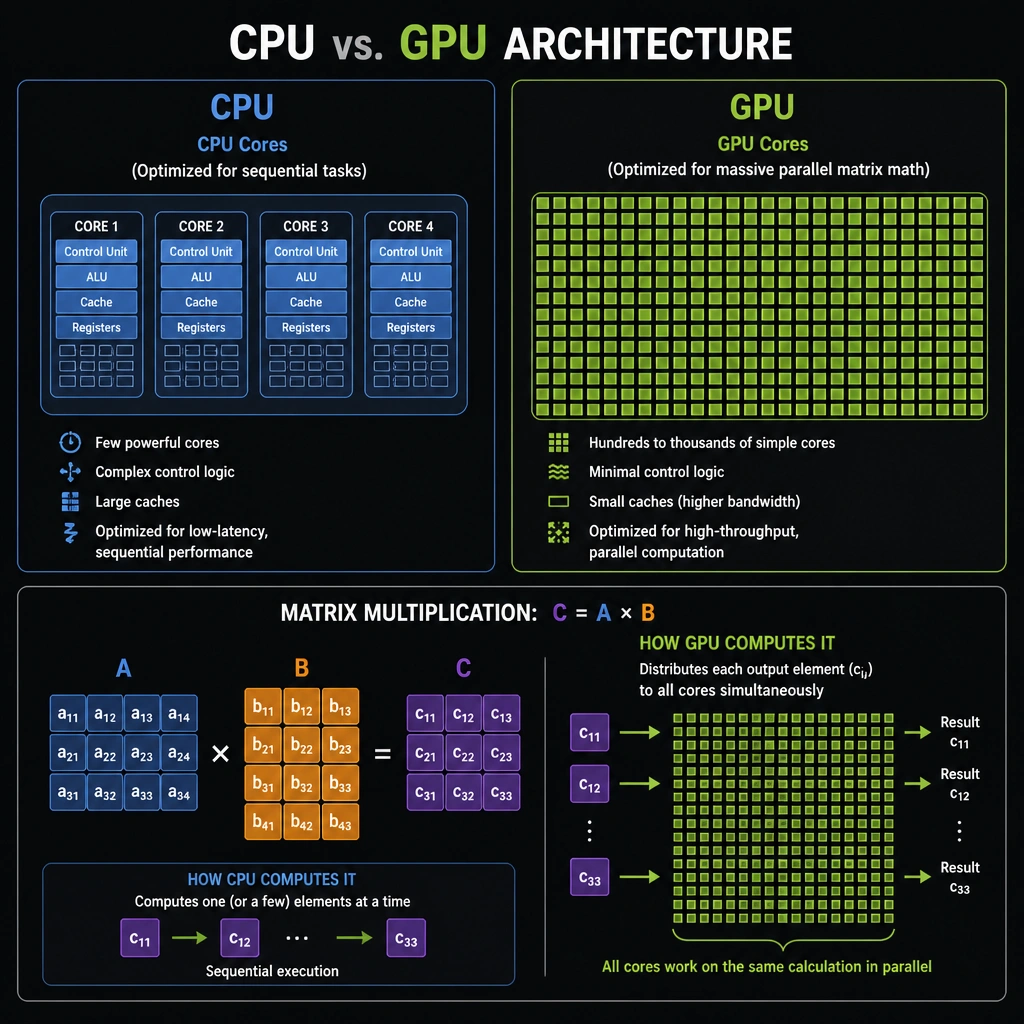
Check this out: deep learning is basically just a giant pile of matrix math. We're talking about multiplying and adding millions or billions of numbers over and over again. Now, think of a CPU as a team of a few super-genius engineers. They can solve incredibly complex math problems one by one, very fast. But if you give them a billion simple addition problems, they're going to get bogged down because they have to do them sequentially. A GPU, on the other hand, is like having ten thousand elementary school kids. None of them can write a compiler, but if you give each of them one simple multiplication problem to solve at the exact same time—boom! The whole stack is done in a fraction of a second. That is massive parallel processing. Because neural networks are built on these massive matrix operations, the parallel architecture of a GPU absolutely crushes a CPU for training. Trust me, in the real world, trying to train a deep neural network on a CPU is like trying to clear a snowy highway with a teaspoon. You need that parallel firepower!
Full explanation below image
Full Explanation
Deep learning models, particularly deep neural networks, rely heavily on linear algebra operations, primarily matrix multiplications and vector additions, during both the forward and backward propagation passes. The hardware architecture of a Graphics Processing Unit (GPU) is uniquely suited to accelerate these specific computations compared to a Central Processing Unit (CPU).
The key differences between the two architectures lie in their core design goals: 1. CPU Architecture (Sequential Processing): CPUs are designed for general-purpose computing. They feature a small number of complex, highly optimized cores (typically 4 to 64) that excel at sequential processing, task switching, and executing complex, branching logic. They use large caches to minimize latency. 2. GPU Architecture (Parallel Processing): GPUs are designed for graphics rendering and scientific computing. They contain thousands of smaller, simpler cores designed to perform the same mathematical operation on multiple data points simultaneously (Single Instruction, Multiple Data, or SIMD).
Because matrix multiplication is embarrassingly parallelizable (each cell in the output matrix can be calculated independently of the others), a GPU can distribute these calculations across thousands of cores. This parallel processing capability reduces the time required to complete training iterations from days or weeks on a CPU to hours or minutes on a GPU.
Let's analyze the incorrect options: - Memory Capacity: Historically, system RAM (available to the CPU) is much larger and cheaper than the specialized High Bandwidth Memory (VRAM) found on GPUs. GPU memory capacity is actually a frequent bottleneck when training large models. - Simplifies Code: Using a GPU does not simplify the code structure; in fact, it requires additional software frameworks (like CUDA or ROCm) and libraries (like PyTorch or TensorFlow) to manage data transfer between system memory and GPU memory. - Cost: High-performance enterprise GPUs (such as NVIDIA's H100 or A100) are far more expensive than standard enterprise CPUs, both in acquisition cost and power consumption.