A computer vision engineer is developing a model for an autonomous vehicle. The model needs to process incoming camera frames, locate the positions of pedestrians and traffic signs using bounding boxes, and assign a class label to each detected item. To achieve real-time performance, the model divides the input image into a grid, where each grid cell predicts bounding boxes and class probabilities. Which computer vision task does this describe?
Select an answer to reveal the explanation.
Short Explanation and Infographic
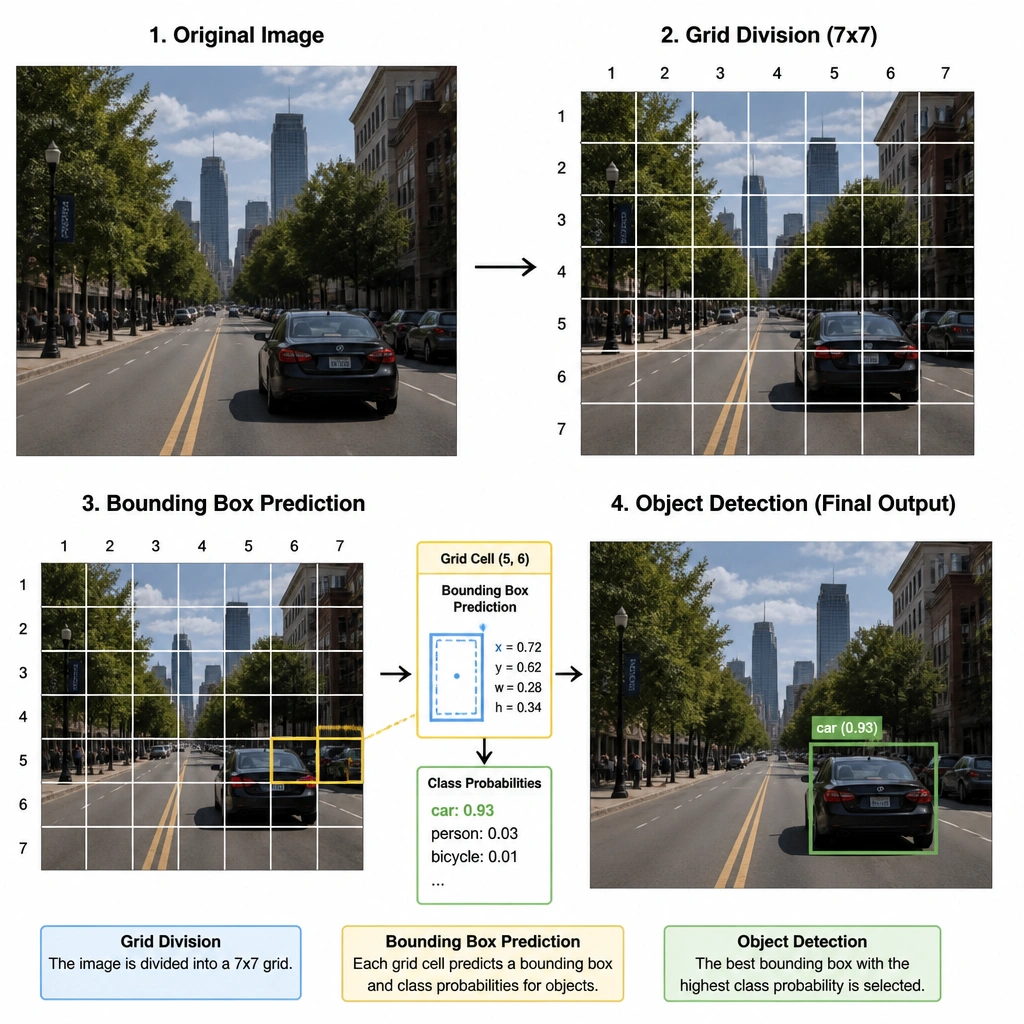
Here's the deal: computer vision has several levels of difficulty. If you just want to know, 'Is there a dog in this picture?'—that's standard image classification. Simple enough. But what if you need to know where the dog is, and maybe locate three cars and a pedestrian in the same frame? Now you're talking about object detection. The grid technique mentioned in the question is actually how the famous YOLO (You Only Look Once) algorithm works. It divides the image into a grid—say, 7x7—and asks each cell: 'Is there an object centered in you? If so, draw a bounding box around it and tell me the probability of what it is.' This allows the network to find and classify multiple objects in a single pass, which is absolutely vital for self-driving cars where you can't afford to run slow, multi-stage pipelines. Keep this straight for the exam: if you're drawing bounding boxes around things, it's always object detection!
Full explanation below image
Full Explanation
Computer vision tasks are categorized based on what information they extract from an image. The primary tasks include classification, detection, and segmentation.
The scenario describes Object Detection, which involves two simultaneous sub-tasks: 1. Localization: Finding where objects are located in an image and drawing rectangular boundaries (bounding boxes) around them, defined by coordinate points (center x, center y, width, height). 2. Classification: Determining the class label (e.g., pedestrian, car, traffic light) for each detected object.
The specific technique of dividing an image into a grid to predict bounding boxes and class probabilities is the core architecture of the YOLO (You Only Look Once) algorithm, a state-of-the-art, real-time object detection system. By dividing the image into an $S \times S$ grid, the model treats object detection as a single regression problem, passing the image through the network once to predict all bounding boxes and probabilities globally.
Let's evaluate the incorrect options: - Image Classification: This task predicts a single class label for the entire image (e.g., classifying a whole image as 'cat'). It does not locate objects or output spatial coordinates (bounding boxes). - Semantic Segmentation: This task involves classifying every individual pixel in the image into a category (e.g., labeling all road pixels as green and all sky pixels as blue). It does not output bounding boxes; instead, it provides a pixel-level map of the scene. - Image Generation: This is a generative task (using architectures like GANs or diffusion models) that creates new, synthetic images from scratch or from text prompts, rather than analyzing and extracting info from an existing image.