Imagine you are using a Term Frequency-Inverse Document Frequency (TF-IDF) vectorizer to analyze a collection of technical articles. If a specific word receives a high TF-IDF score within one particular document, what does this indicate about that word?
Select an answer to reveal the explanation.
Short Explanation and Infographic
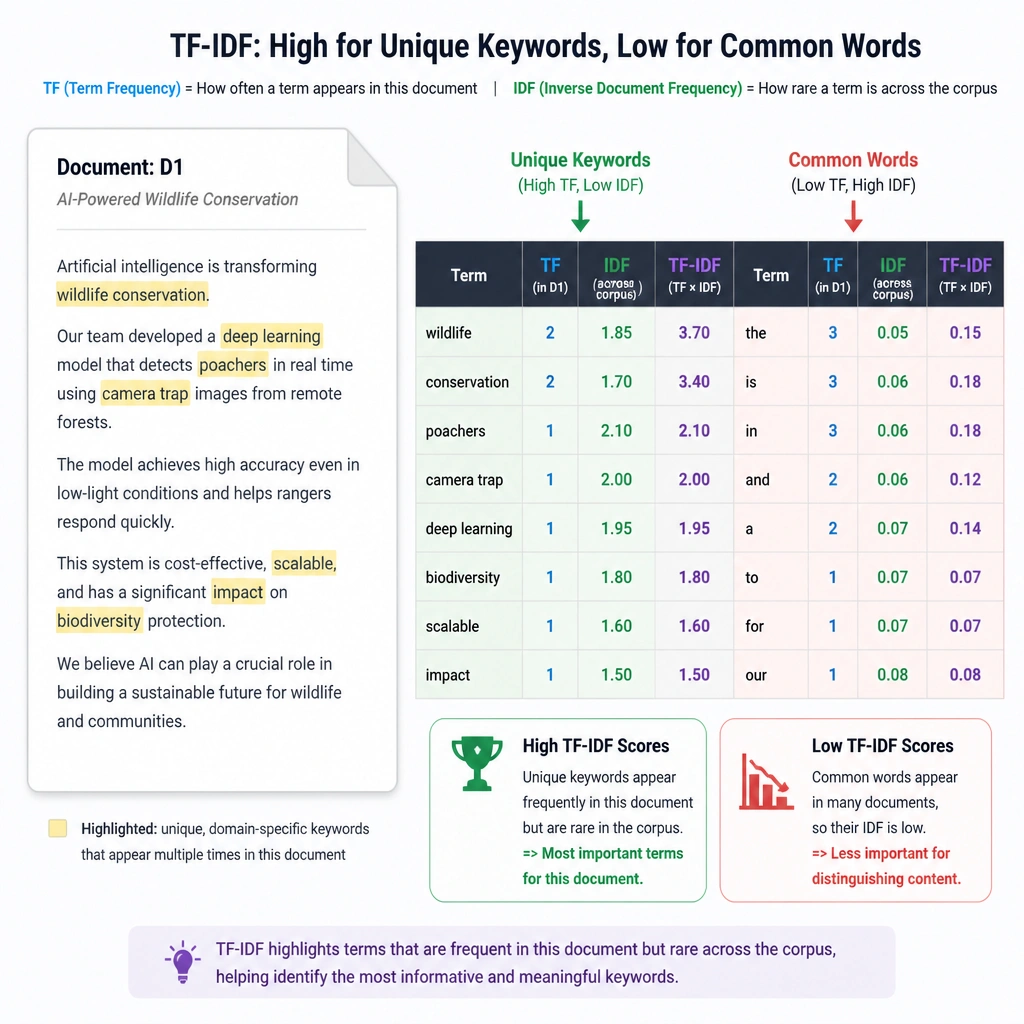
Think of it like this: if you walk into a crowded room of network engineers, the word "IP" or "router" is going to pop up constantly. It doesn't tell you much about what any individual person is working on because everyone uses those terms. But if one engineer keeps saying "BGP-EVPN" over and over, and nobody else in the room is saying it, that term is a massive clue about exactly what that person is doing. That's TF-IDF in a nutshell! The Term Frequency (TF) part measures how often a word shows up in a single document—showing how important it is there. The Inverse Document Frequency (IDF) part penalizes words that show up everywhere across your whole corpus. So, a high TF-IDF score means the word is super frequent in that one document but rare everywhere else. That makes it a fantastic indicator of the document's unique topic. Got it? Sweet. Let's keep rolling.
Full explanation below image
Full Explanation
Term Frequency-Inverse Document Frequency (TF-IDF) is a statistical measure used to evaluate how important a word is to a document in a collection or corpus. The importance increases proportionally to the number of times a word appears in the document but is offset by the frequency of the word in the corpus. - Option A is correct. A high TF-IDF score is achieved when a term has a high term frequency (TF) in a specific document but a low document frequency (DF) across the overall corpus, meaning it is a strong indicator of that document's unique content. - Option B is incorrect. Common stop words (like "the", "is") appear across almost all documents, which gives them a very low IDF score, resulting in a low TF-IDF score. - Option C is incorrect. While typos might be rare in the corpus, a typo would only receive a high TF-IDF score if it were repeated frequently within a single document. However, TF-IDF is not designed to identify typos, but rather to evaluate term importance. - Option D is incorrect. If a word is common across the entire corpus, its document frequency is high, which drives the IDF component toward zero, resulting in a very low TF-IDF score.