Within an MLOps architecture, what is the primary role of a model registry?
Select an answer to reveal the explanation.
Short Explanation and Infographic
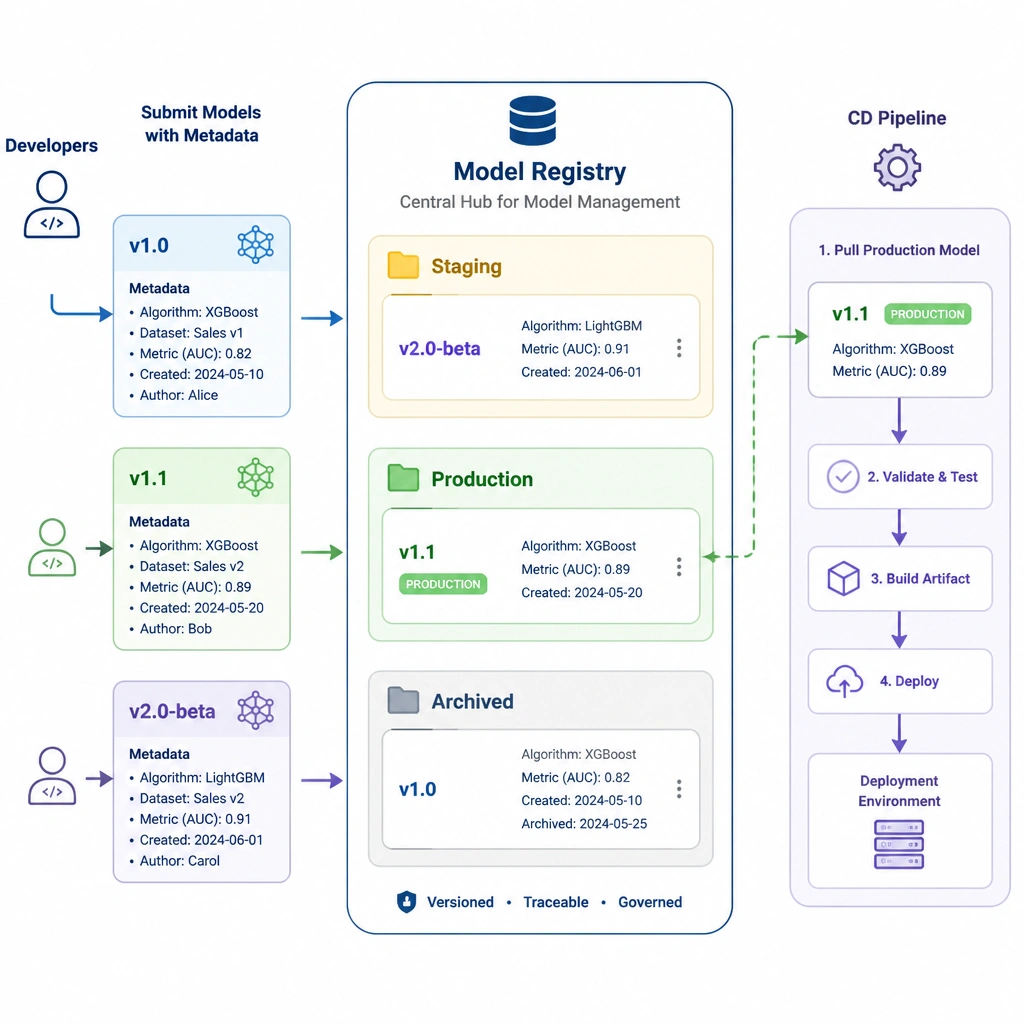
Here's the deal: when you're training models, you don't just train one and call it a day. You might train dozens of versions, tuning parameters and testing new data. If you're saving these on your desktop as 'model_v2_final_final.pkl', you're asking for trouble! A model registry is like Git, but specifically designed for your trained model files. It stores the actual models, keeps track of version numbers, and marks which one is in staging, which one is live in production, and which one is retired. It's your single source of truth for all your model versions. Got it? Sweet.
Full explanation below image
Full Explanation
In Machine Learning Operations (MLOps), a model registry is a centralized, database-backed repository designed to manage the lifecycle of machine learning models. During the development phase, data scientists train numerous models using different algorithms, features, and hyperparameters. Once a model is deemed suitable for potential deployment, it is registered in the model registry.
The model registry performs several critical functions: 1. Model Versioning: It automatically tracks versions of model artifacts, allowing teams to roll back to a previous version if a deployment fails or degrades. 2. Metadata Cataloging: It stores metadata associated with each model version, such as training parameters, evaluation metrics (e.g., accuracy, ROC-AUC), training datasets used, and who trained it. 3. Stage Management: It facilitates lifecycle transitions by labeling models with stages (e.g., 'Candidate', 'Staging', 'Production', 'Archived'). This allows CI/CD deployment pipelines to programmatically fetch the correct version (e.g., pull the latest model labeled 'Production').
Let's evaluate the incorrect options: - Option B refers to model serving or inference hosting, which is the system that executes the model to handle predictions (e.g., Triton Inference Server, TF Serving). The registry stores the model but does not serve it as an active API. - Option C describes data version control (DVC) or a feature store, which is designed for raw training data and feature vectors, not the trained model artifacts themselves. - Option D describes model monitoring and observability, which tracks metrics in production after deployment, whereas the registry is focused on asset management and versioning.