An MLOps engineer needs to build a multi-step machine learning workflow that includes data preprocessing, model training, evaluation, and deployment. They want this workflow to run on a Kubernetes cluster, allowing each step to run in its own containerized environment and ensuring the entire process is automated, scalable, and reproducible. Which tool is specifically designed to meet these requirements?
Select an answer to reveal the explanation.
Short Explanation and Infographic
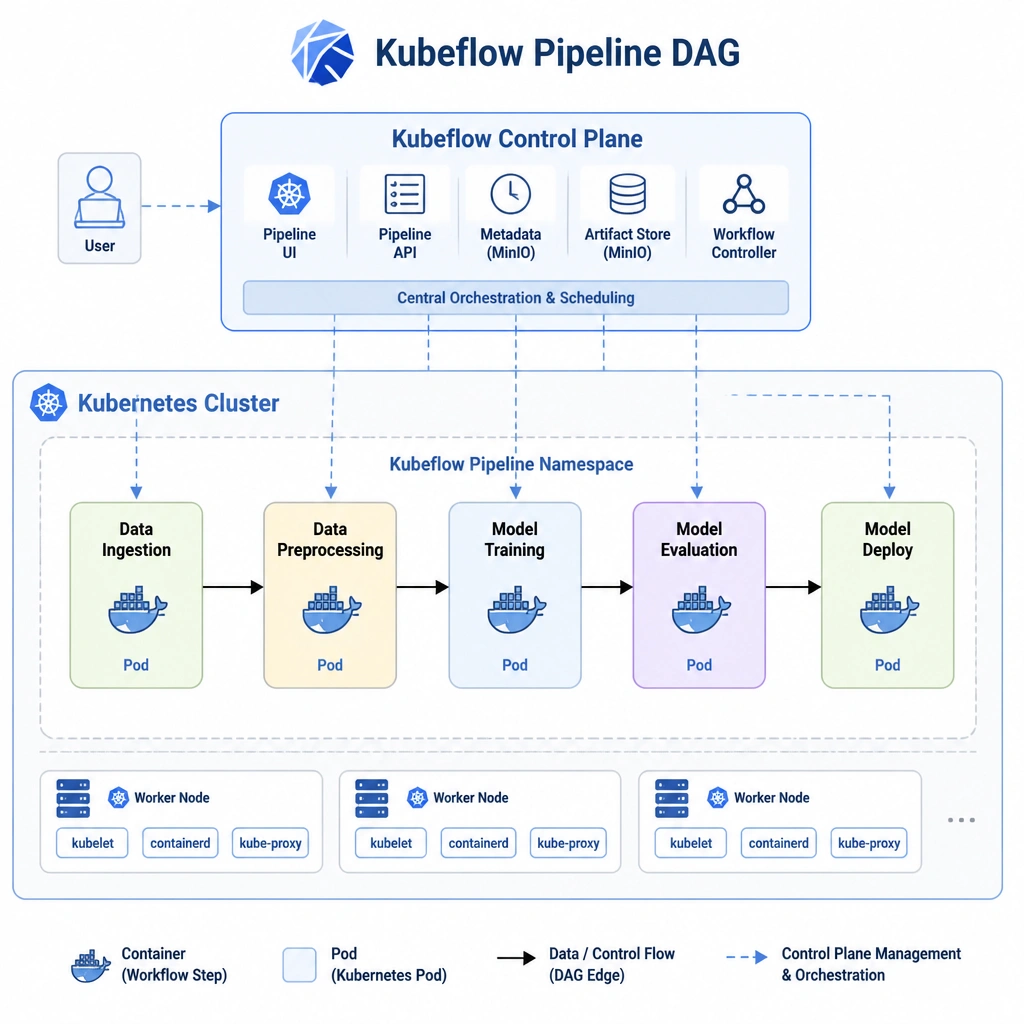
Let's face it: manual steps in machine learning are a recipe for disaster. If you're manually cleaning data, then running a training script, and then manually exporting the model to a server, you're doing it wrong! What happens when you need to retrain that model next week? That's where Kubeflow Pipelines comes to the rescue. Think of it as a supercharger for your ML workflow, built right on top of Kubernetes. It lets you package up every single step of your workflow—from data prep to training to deployment—into containerized blocks. You can stitch them together, automate the whole run, and scale it up across a cluster. It's repeatable, it's scalable, and it saves you from doing boring manual tasks. Got it? Sweet.
Full explanation below image
Full Explanation
Kubeflow Pipelines (KFP) is an open-source platform designed to build, deploy, and manage end-to-end machine learning workflows on Kubernetes. The primary objective of Kubeflow Pipelines is to enable automation, reproducibility, and scalability of ML workflows. In a typical ML lifecycle, workflow stages—such as data ingestion, preprocessing, training, validation, and deployment—depend on each other. Managing these steps manually can introduce errors and inconsistencies.
Kubeflow Pipelines solves this by: 1. Containerization: Each component or step in a pipeline runs in its own isolated container. This ensures that different steps can use different packages and libraries without dependency conflicts (e.g., one step runs Python 3.8 for preprocessing while another runs Python 3.10 for PyTorch training). 2. Orchestration: KFP orchestrates the execution of these steps, passing data between them and executing steps in parallel where possible. 3. Tracking and Metadata: It logs pipeline runs, parameters, execution metrics, and generated artifacts (such as model weights or evaluation charts), allowing developers to compare different runs and ensure experiment reproducibility. 4. Integration with Kubernetes: By leveraging Kubernetes, KFP can scale container resources up or down dynamically based on the workload requirements of each step.
Kubeflow Pipelines does not replace version control tools (like Git) or single-model deployment engines, but rather acts as the orchestrator that coordinates all these distinct tools into a unified, repeatable process.