An AI practitioner is designing a training strategy for a computer vision model. Labeling images is expensive and time-consuming, so the team decides to combine a small dataset of human-verified labeled images with a much larger pool of unlabeled images during training. How does this training approach differ from standard supervised learning?
Select an answer to reveal the explanation.
Short Explanation and Infographic
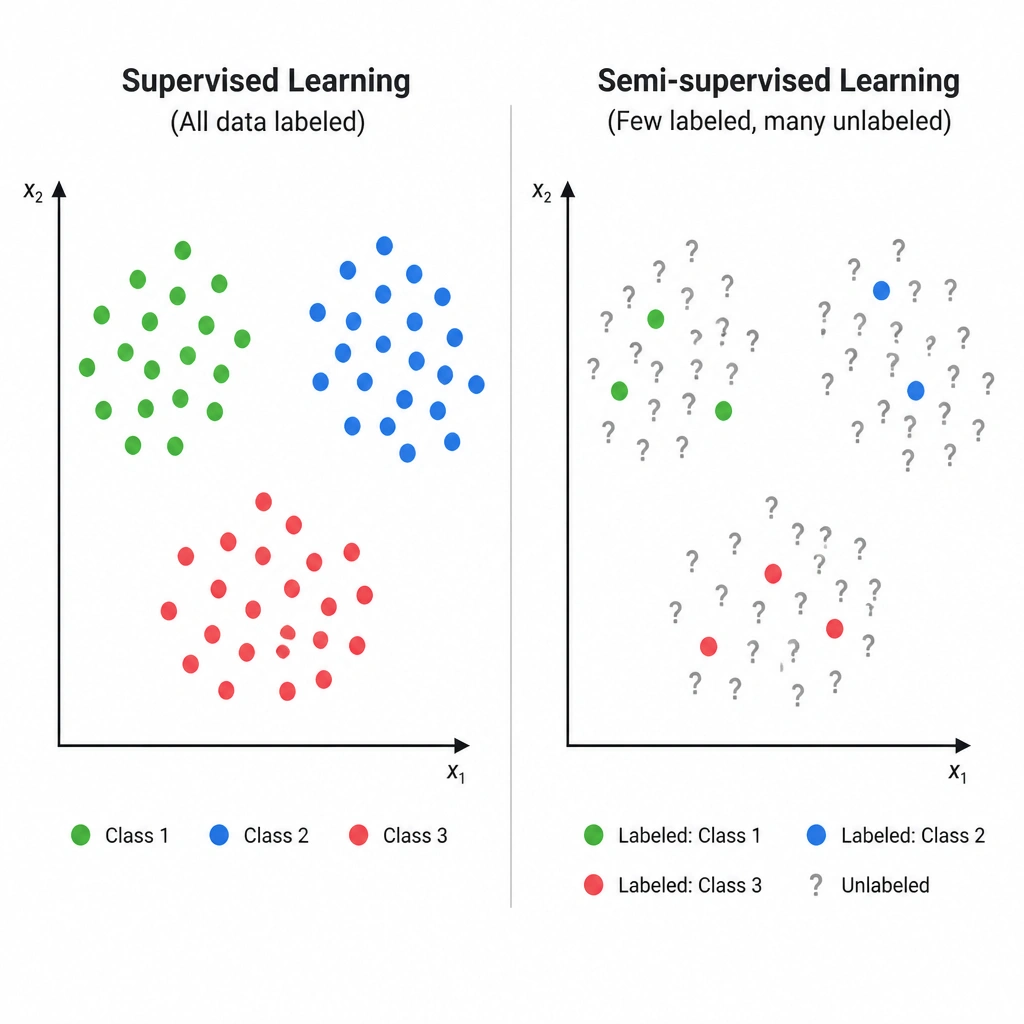
Think of supervised learning like having a personal tutor who grades every single homework question you answer. Every data point has a label (the right answer). It's great, but man, labeling data is incredibly expensive and slow! Now, think of semi-supervised learning. It's like having the tutor grade just ten questions, and then you use those ten answers to help figure out the patterns in a hundred other ungraded questions on your own. You're combining a tiny bit of labeled data with a giant pile of unlabeled data. It saves massive amounts of time and money because you don't need humans to label everything. So, remember: supervised is labels-only, while semi-supervised uses a smart mix of both!
Full explanation below image
Full Explanation
The key distinction between supervised and semi-supervised learning lies in the composition of the training data. Supervised learning requires that every training sample is paired with a corresponding target label or ground truth (e.g., $(X, y)$ pairs). The model learns to map features directly to these labels. However, obtaining high-quality labeled data often requires expensive human domain expertise.
Semi-supervised learning addresses this bottleneck by training on a small amount of labeled data alongside a large amount of unlabeled data (e.g., a mix of $(X, y)$ and $(X)$). The model leverages the small labeled dataset to learn basic class boundaries, and then uses the larger unlabeled dataset to understand the underlying data distribution and structure in the feature space. This is often implemented using techniques like: 1. Self-Training: The model is trained on labeled data, then predicts labels for unlabeled data (pseudo-labels). The highest-confidence predictions are added to the training set, and the model is retrained. 2. Generative Models: Modeling the probability distribution of the input features to help classification boundaries align with regions of low data density. 3. Graph-based methods: Propagating labels from labeled nodes to unlabeled nodes based on similarity.
Unsupervised learning, by contrast, uses only unlabeled data to identify clusters or patterns (such as grouping), while semi-supervised learning maintains a target output objective but utilizes unlabeled data to improve the model's generalization capabilities.