An MLOps engineer is tasked with making a deep learning training pipeline completely reproducible, ensuring that running the pipeline multiple times yields the exact same model weights. Which combination of practices is essential to achieve this?
Select an answer to reveal the explanation.
Short Explanation and Infographic
Trust me on this: there is nothing more frustrating than training a model, getting awesome results, and then running the exact same script the next day only to get a model that performs worse! Machine learning algorithms use random numbers for things like initializing weights and splitting data. If you don't control that randomness, you'll get different results every single time. The secret to repeatability is simple: you have to set a fixed random seed. But that's only half the battle. You also have to version control everything—the exact code version, the exact dataset, and the model artifacts. If you don't track what went in, you won't get the same thing out. Keep it locked down!
Full explanation below image
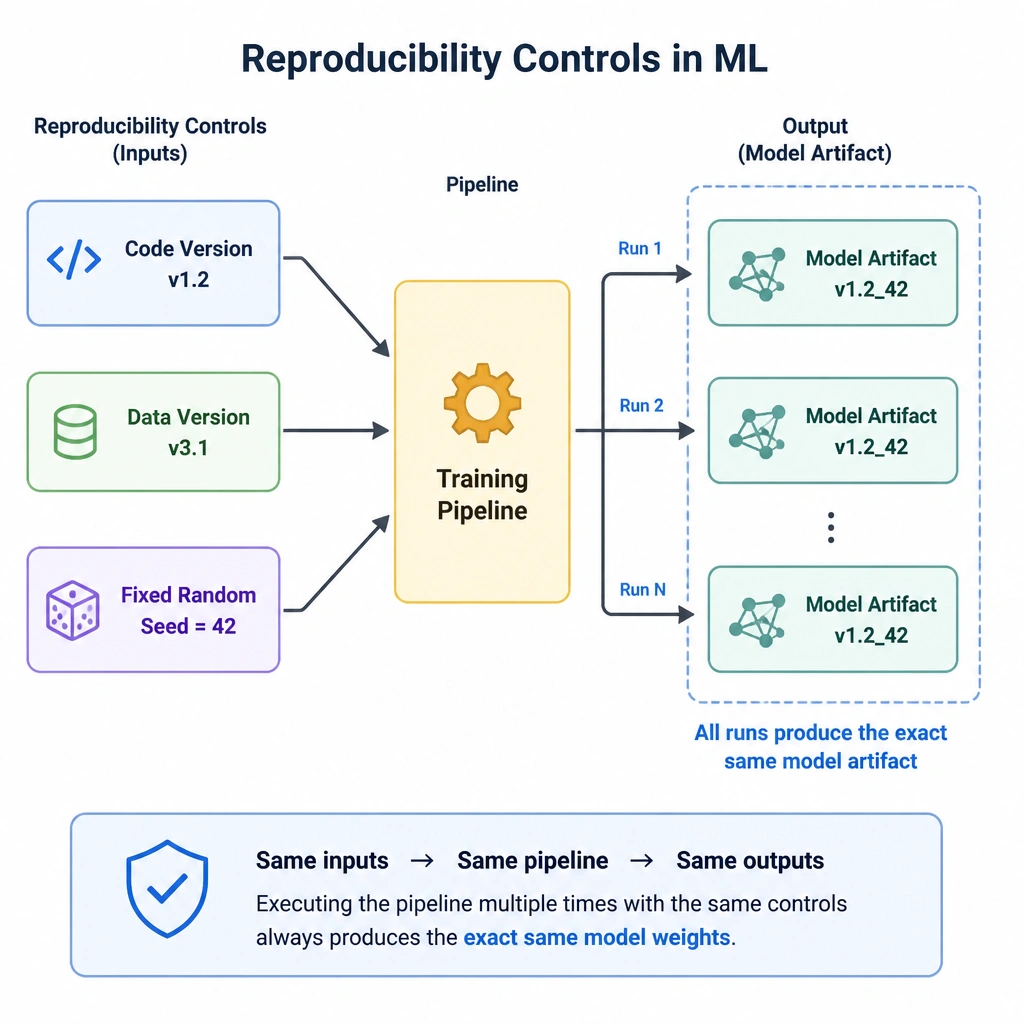
Full Explanation
Reproducibility and repeatability are fundamental pillars of MLOps. Because machine learning model training involves various stochastic processes (such as random weight initialization, data shuffling, and dropout layers), running the same training script twice on the same dataset can produce different results.
To ensure repeatability, two primary requirements must be met: 1. Deterministic Randomness: By setting a fixed random seed (e.g., using numpy.random.seed() or torch.manual_seed()), the pseudo-random number generator starts at the same point, ensuring that initialization, data splits, and other random elements are identical across runs. Note that when training on GPUs, additional parameters (like setting PyTorch to deterministic mode) may be required because parallel operations on CUDA can introduce minor numerical variations. 2. Comprehensive Versioning: - Code Versioning (e.g., Git): Captures the exact code state used to build the model. - Data Versioning (e.g., DVC, LakeFS): Ensures the model is trained on the exact same slice of data, preventing data leakage or variation from altering the output. - Model Registry (e.g., MLflow): Logs and tracks the resulting model artifacts, hyperparameter configurations, and evaluation metrics.
Simply training the model multiple times or switching machines without these controls will not guarantee reproducibility; in fact, different hardware architectures or driver versions can introduce further discrepancies.