During the development of an image classification system, the data science team partitions their dataset into training, validation, and test sets. What is the specific and primary role of the test set in this workflow?
Select an answer to reveal the explanation.
Short Explanation and Infographic
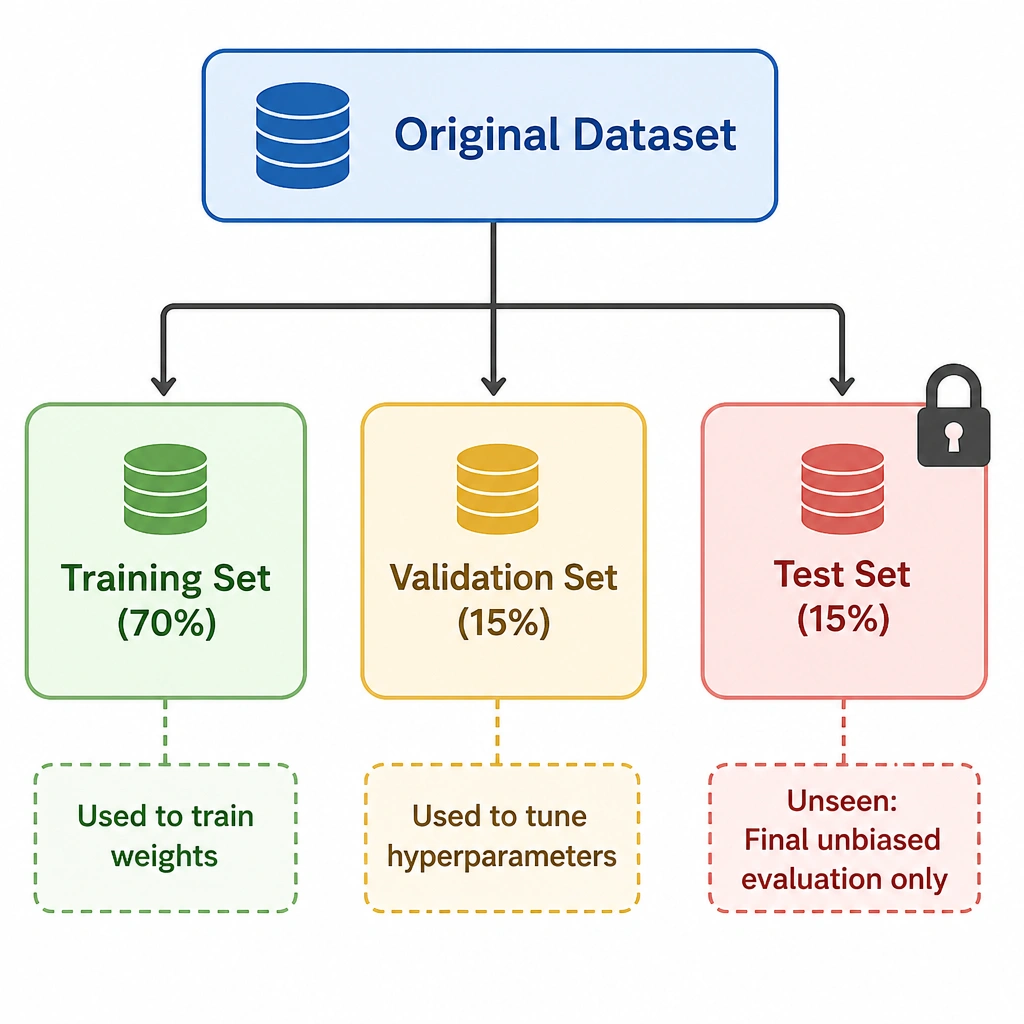
Think of this like studying for a big exam. The training set is your textbook—you read it over and over to learn the material. The validation set is your practice quizzes. You use them to see how well you're doing, and you adjust your study habits (your hyperparameters, like learning rate or model architecture) based on your scores. But the test set? That's the actual final exam. It's locked in a vault until the very end, and you don't get to look at it while you study. Why? Because if you saw the questions beforehand, your score wouldn't be an honest, unbiased reflection of what you actually know! The test set tells you how your model will perform in the real world on data it has never seen before. If you touch it during training, you're cheating!
Full explanation below image
Full Explanation
In machine learning, partitioning data into training, validation, and test sets is crucial for preventing overfitting and obtaining an accurate estimation of how the model will generalize to new, unseen data.
Each split has a distinct role: 1. Training Set: The subset of data used by the learning algorithm to adjust the model's weights and parameters (e.g., optimizing loss). 2. Validation Set: Used during the training phase to evaluate the model's performance periodically. Based on these validation results, developers adjust hyperparameters (such as learning rate, depth of trees, or regularization strength) and make choices like early stopping. Because the developer uses the validation set to make tuning decisions, the model indirectly 'leaks' information from this set, making it biased. 3. Test Set: This dataset must remain completely untouched during the entire development, training, and tuning phase. It is only introduced at the very end of the project to evaluate the finalized model. Because the model has never seen this data, and no decisions were made based on its performance, the test set provides a clean, unbiased assessment of how the model will perform in production.
Using the test set to adjust hyperparameters or train the model defeats its purpose, leading to optimistic performance estimates that fail to hold up in a live production environment.