When designing a neural network for natural language processing, a developer wants to capture long-term dependencies in sequential text data. They want to avoid the vanishing gradient problem common in standard Recurrent Neural Networks (RNNs) but prefer an architecture with fewer parameters and faster training times than a standard Long Short-Term Memory (LSTM) network. Which architecture should they choose?
Select an answer to reveal the explanation.
Short Explanation and Infographic
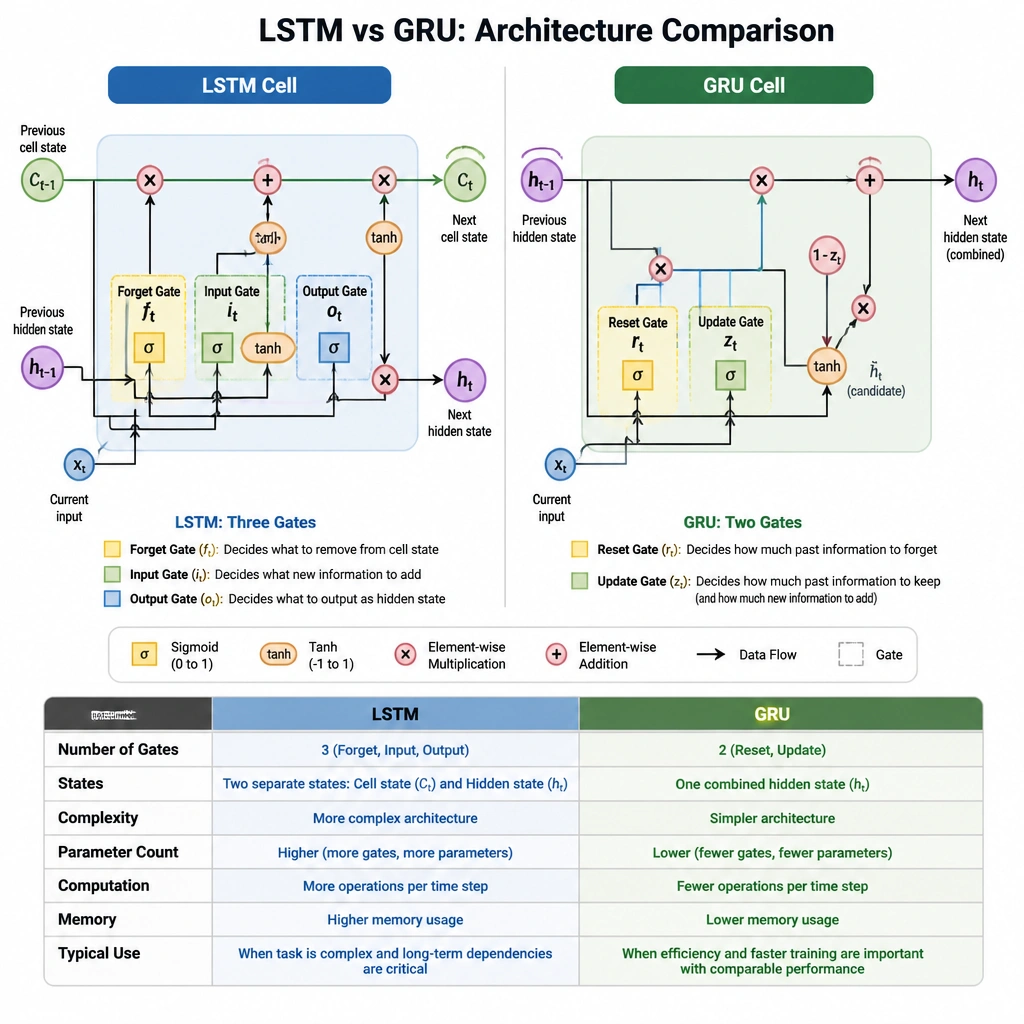
Standard Recurrent Neural Networks (RNNs) are great for sequence data, but they have a massive flaw: they suffer from the vanishing gradient problem. As sequences get longer, the network basically forgets the beginning of the sentence. Now, Long Short-Term Memory (LSTM) networks solved this by adding complex gates to remember long-term info, but they are heavy, slow, and have a ton of parameters. Enter the Gated Recurrent Unit, or GRU. Think of the GRU as a streamlined, stripped-down version of the LSTM. It merges the cell state and hidden state, and only uses two gates instead of three. You get the same benefits of fighting off the vanishing gradient, but with fewer parameters, faster training, and less overhead. It's clean, efficient, and perfect when you need speed. Got it? Sweet.
Full explanation below image
Full Explanation
Gated Recurrent Units (GRUs) are a variation of Recurrent Neural Networks (RNNs) designed to model sequential data and capture long-term dependencies. Standard RNNs suffer from the vanishing gradient problem, where gradients decay exponentially as they backpropagate through time, making it difficult for the model to learn relationships between distant steps in a sequence.
To resolve this, gated architectures like LSTMs and GRUs were introduced. A GRU achieves this with a simpler architecture than a standard LSTM: 1. Fewer Gates: A GRU uses only two gates: an update gate (which determines how much of the past information to keep) and a reset gate (which decides how much of the past information to forget). In contrast, an LSTM uses three gates: input, forget, and output gates. 2. Simplified State: A GRU merges the cell state ($c_t$) and the hidden state ($h_t$) into a single hidden state, reducing the complexity of the cell architecture. 3. Computational Efficiency: Because of fewer parameters and gates, GRUs require less memory and are computationally faster to train than LSTMs, while often achieving comparable performance on small to medium-sized sequential datasets.
Other options are incorrect: - PCA is a linear dimensionality reduction technique, not a sequential neural network. - CNNs are primarily designed for spatial grid data (like images) using convolutional filters, though they can be adapted for sequences (1D CNNs). - Autoencoders are unsupervised networks designed for representation learning and reconstruction, not specifically for resolving sequential vanishing gradients.