An organization is implementing an end-to-end MLOps pipeline and needs a centralized platform to manage trained machine learning models. This component must track model versions, record performance metrics from validation runs, and manage stage transitions (such as staging to production). Which MLOps component is specifically designed to meet these requirements?
Select an answer to reveal the explanation.
Short Explanation and Infographic
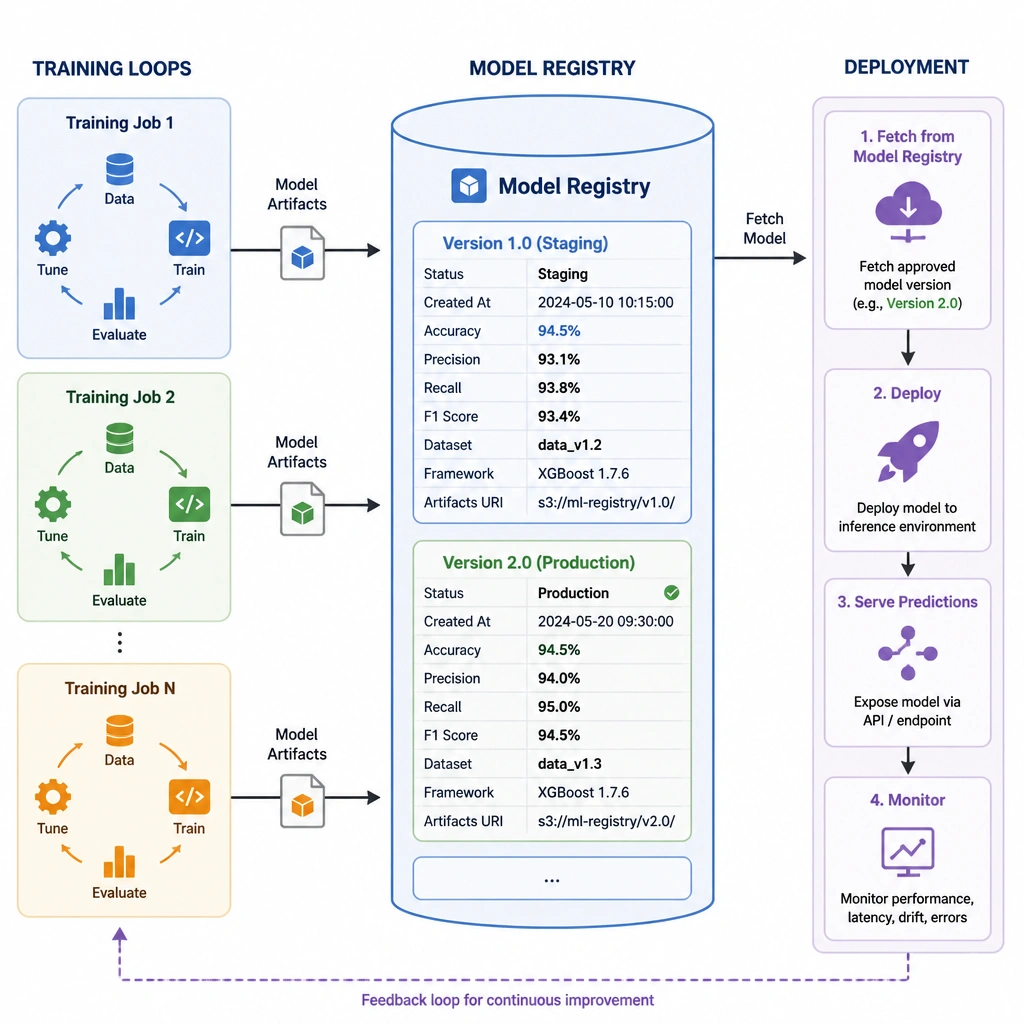
Think of it like this: you've got your source code tucked away in Git, which is great. But when your data science team starts churning out massive, multi-gigabyte neural network models, Git is going to choke. Plus, Git doesn't know which model is currently running in production, or which one had the best accuracy during last night's validation run. That's where a model registry comes in. Think of it as a specialized warehouse and tracking log specifically built for your models. It records the model's performance, keeps track of versions, and controls when a model moves from staging to production. Trust me, trying to manage models without a model registry is a recipe for absolute chaos in production. Option A is the way to go!
Full explanation below image
Full Explanation
In MLOps (Machine Learning Operations), a model registry serves as a centralized hub for managing the lifecycle of machine learning models. Once a model is trained and evaluated, its artifacts (such as weights, parameters, and configuration files) along with its metadata (such as training hyperparameters, evaluation metrics, and dataset version) are registered. The model registry allows teams to version models, track their performance over time, and manage their lifecycle status (e.g., "Candidate", "Staging", "Production", or "Archived"). This ensures reproducibility and governance, allowing automated deployment pipelines (CI/CD) to safely fetch the correct model version.
Let's check the other options to see why they don't fit: - Option B (a container registry, such as Docker Hub or Amazon ECR) stores container images, which package the runtime environment, but is not designed to track model versions, evaluation metrics, or lifecycle metadata. - Option C (a feature store) is a repository for storing and serving curated features for training and inference, ensuring consistency between training and serving data, but it does not store or manage trained models. - Option D (a Git repository) is designed for source code version control. It is inefficient at handling large binary files (model weights) and lacks built-in capability for model lifecycle stage management or recording complex validation metrics.
For the exam, remember that a model registry is the specific MLOps component dedicated to cataloging, versioning, and managing trained model files and metadata.