Your engineering team has completed training a machine learning model and needs to integrate it into a microservices-based enterprise application. You decide to expose the model's inference capabilities via a RESTful API. Which characteristic of REST makes it highly suitable for scaling model deployment in this production environment?
Select an answer to reveal the explanation.
Short Explanation and Infographic
Let me show you how this works in the real world. Once you have a killer machine learning model, you can't just leave it sitting in your Jupyter Notebook. You've got to share it with other applications. Exposing your model via a RESTful API is the industry standard for a very good reason: it's completely stateless. Think of it like a drive-thru window—the worker doesn't need to know what you ordered yesterday to hand you your burger today. Every single request stands on its own. This is huge for scalability because if your traffic spikes, your boss can just spin up five more server instances behind a load balancer, and they'll handle the incoming requests perfectly without needing to sync user session data. Plus, it uses standard HTTP, meaning whether your frontend is written in Python, JavaScript, or Go, they can all talk to your model without a hitch. Sweet, right?
Full explanation below image
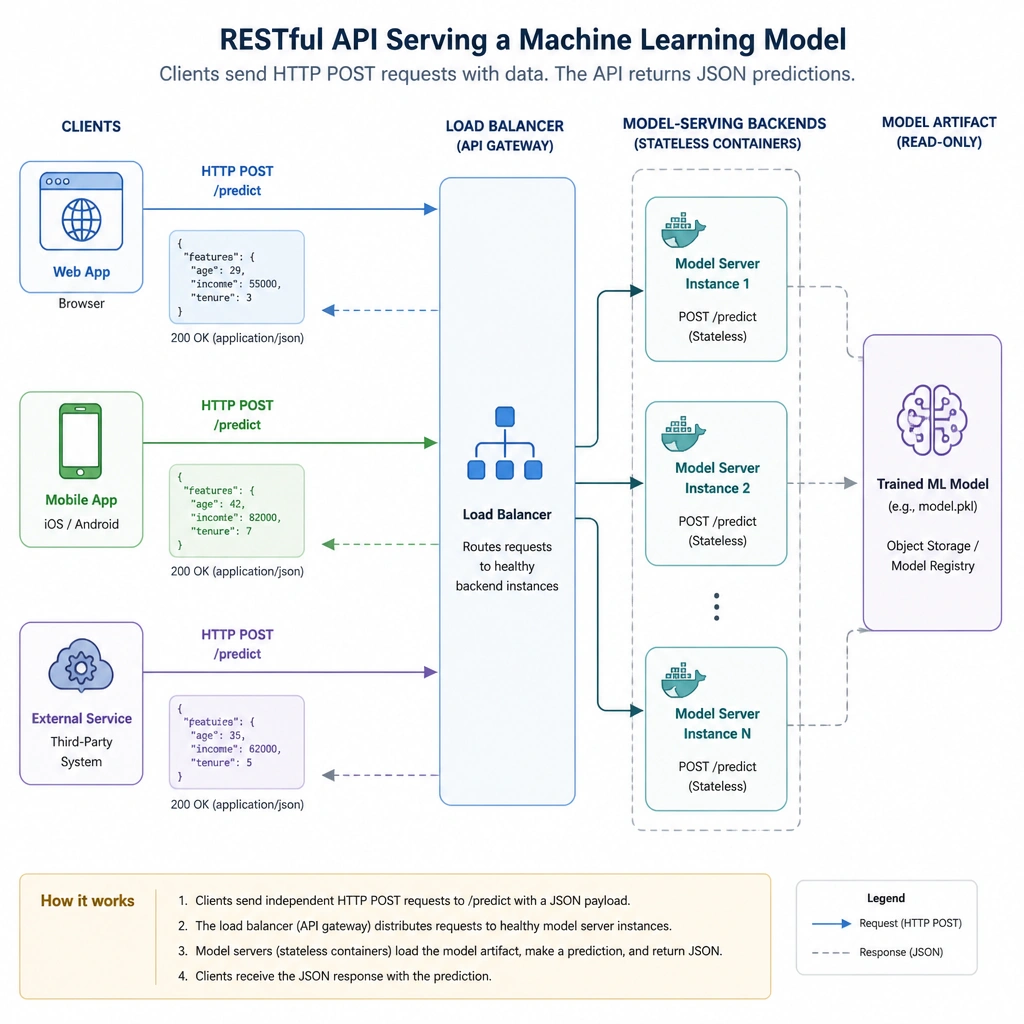
Full Explanation
Representational State Transfer (REST) is an architectural style commonly used for developing web services. When deploying machine learning models to production, wrapping the model in a RESTful API offers several critical operational advantages, primarily stemming from its statelessness. In a RESTful architecture, the server does not store any client context or session state between requests. Every API call from a client contains all the information necessary for the server to understand and process the request (e.g., the input features for inference). This stateless design simplifies server implementation and drastically improves horizontal scalability. Because any server instance can handle any incoming request, developers can easily distribute the incoming traffic across multiple instances using a load balancer. If traffic increases, additional model-serving containers can be spun up dynamically without worrying about session state replication. Furthermore, RESTful APIs are language-agnostic and rely on standard HTTP methods (such as POST for sending prediction payloads) and data formats (like JSON). This decoupled architecture ensures that different parts of a system can evolve independently; for instance, a Python-based model service can seamlessly communicate with a web application written in JavaScript or mobile apps built on Swift or Kotlin. Tightly coupling clients and servers, or maintaining stateful connections, increases complexity and degrades scaling performance. REST is also not a database or a local file; rather, it is a communication protocol style for network services.