You've finished training a state-of-the-art machine learning model, and now your boss wants it integrated into a web-based client application. You decide to expose the model's inference capabilities using a RESTful API. What is the primary operational advantage of using this architectural style to serve your model?
Select an answer to reveal the explanation.
Short Explanation and Infographic
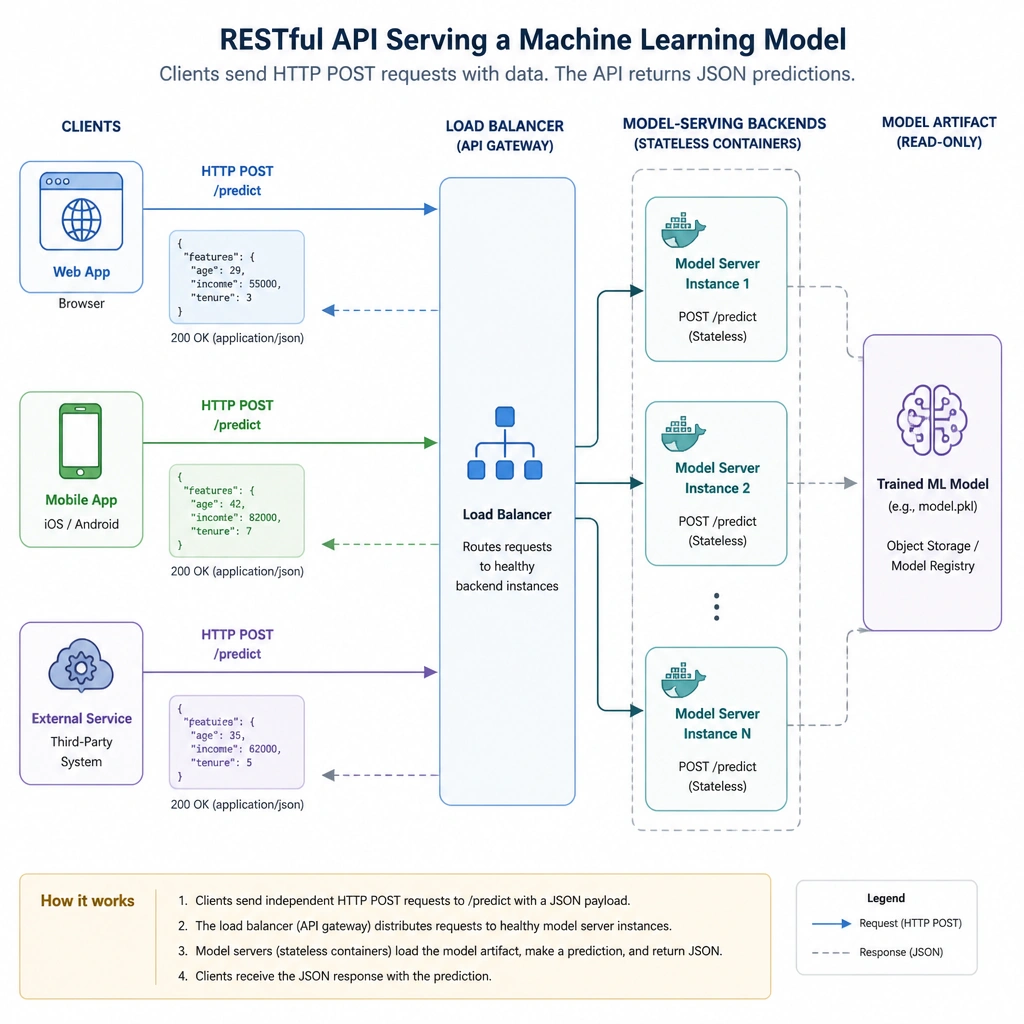
Here's the deal — once your model is trained, you have to get it out there so applications can actually use it. If you wrap your model in a RESTful API, you're using standard HTTP. The cool thing is that REST is stateless. This means every request from a client is a self-contained package. The server doesn't have to remember who you are from one second to the next. If your traffic spikes, you just spin up more containers running the model behind a load balancer and keep rolling. Plus, since it's just standard HTTP, a Python app, a Java backend, or a mobile app can all call it without any hassle. Simple, clean, and scalable.
Full explanation below image
Full Explanation
Representational State Transfer (REST) is an architectural style commonly used for developing web services. When serving a machine learning model, exposing it via a RESTful API means client applications can request predictions by sending standard HTTP methods (such as POST or GET) with payload data (like JSON).
The key operational benefit of REST is statelessness. Each request from a client contains all the information needed to process it. Because the server does not store any session state about the client, the backend architecture is highly decoupled. This allows system administrators to easily scale the inference service horizontally by running multiple instances of the API behind a load balancer. If one instance fails or if traffic increases, requests can be dynamically routed to other instances without session synchronization issues.
Additionally, RESTful APIs are language-agnostic. Since they rely on standard HTTP and common data serialization formats like JSON, any client application—regardless of whether it is written in JavaScript, Python, C#, or Swift—can communicate with the model server.
Let's break down the distractors: Option A is incorrect because REST is stateless, not stateful. Stateful designs make horizontal scaling much more complex. Option C is wrong because REST is a communication protocol/style, not a database. Option D is incorrect because REST does not compile models into client-side JS files; the model runs on the server, and the client just receives the prediction results.