Your team is deciding on an enterprise cloud platform for hosting machine learning workloads. You are evaluating AWS SageMaker, Google Vertex AI, and Azure Machine Learning. Which factor should be the primary driver for this decision?
Select an answer to reveal the explanation.
Short Explanation and Infographic
Okay, let's dive in. If your company is already running all their storage, databases, and servers on AWS, it makes zero sense to build your new machine learning pipeline on Google Cloud or Azure just because you like their logo or dashboard. Think of it like this: you wouldn't buy a diesel engine for a hybrid car. You want to choose the platform that integrates seamlessly with your existing cloud footprint, your current data warehouses, and security controls. Plus, you've got to look at your actual project needs—like cost, support for specific libraries, and whether you need managed training or simple endpoint deployment. Trust me on this, aligning with your current infrastructure will save you massive headaches and security review delays down the road. Got it? Sweet. Let's keep rolling.
Full explanation below image
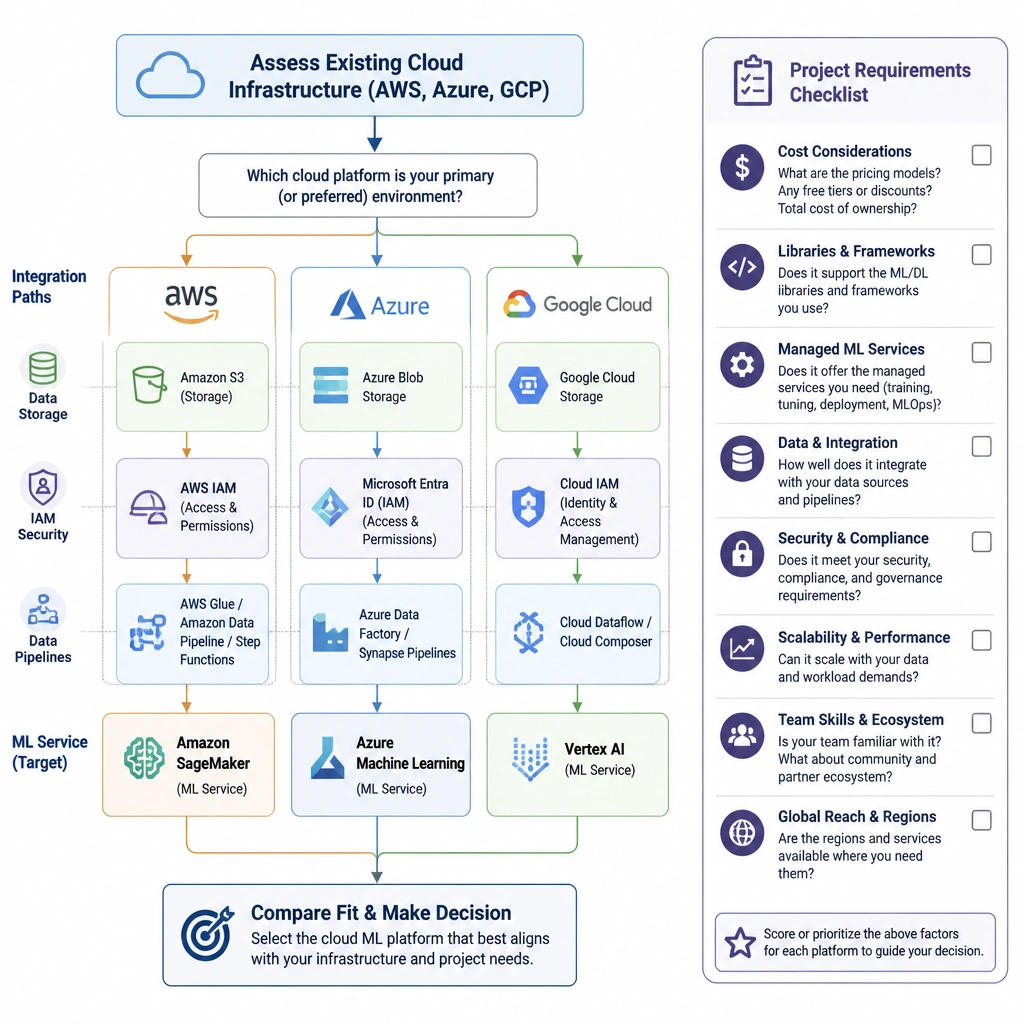
Full Explanation
When selecting an enterprise Machine Learning platform, such as AWS SageMaker, Google Vertex AI, or Azure Machine Learning, the decision must be guided by architecture, integration, and operational efficiency rather than superficial interface characteristics. The primary factor is the organization's existing cloud infrastructure. Modern ML pipelines do not operate in a vacuum; they require seamless access to data storage services (like AWS S3, Google Cloud Storage, or Azure Blob Storage), data warehouses (like Snowflake or BigQuery), and identity and access management (IAM) security policies. Deploying a platform within the organization's current cloud ecosystem minimizes data egress costs, reduces latency, and simplifies security compliance, as the team can leverage existing roles and networking infrastructure. Beyond infrastructure alignment, teams must evaluate the specific functional requirements of their project. This includes looking at the pricing models of managed services (e.g., spot instances for training vs. serverless inference endpoints), compatibility with required deep learning libraries or frameworks (such as specific PyTorch or TensorFlow versions), and the availability of pre-built algorithms or AutoML capabilities. Conversely, factors like developer preference, interface colors, or logo branding have no bearing on performance, scalability, or cost-efficiency. In summary, selecting the right ML platform requires balancing the technical constraints of the project with the financial and security benefits of integrating into the company's existing cloud ecosystem.