When transitioning a machine learning system from development to a live production environment, which factor is most critical to the project's long-term operational success, beyond just achieving high model validation accuracy?
Select an answer to reveal the explanation.
Short Explanation and Infographic
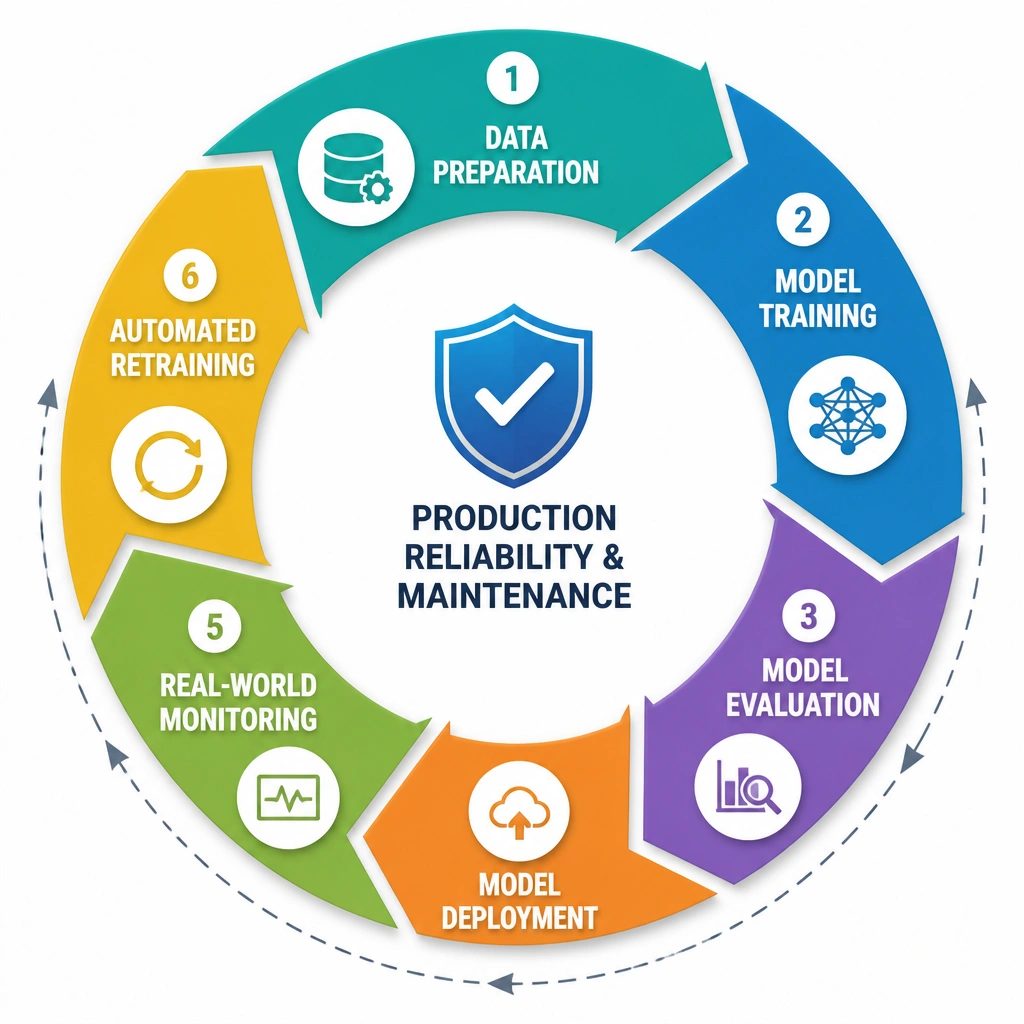
Here's the deal: getting a model to hit 95% accuracy in a clean Jupyter Notebook is a great start, but it's only about 10% of the battle. The real challenge starts when that model hits production. Imagine your boss walks in and says customers are getting weird predictions because the real-world data changed overnight. If you don't have a solid MLOps pipeline to deploy, monitor, and retrain that model, you're in for a rough time. Think of MLOps like the plumbing and maintenance of your AI system. It keeps track of model performance, flags when the data starts to drift, and lets you push out updates without taking the system down. Relying on a massive, messy script or just throwing a hyper-complex model at the problem is a recipe for disaster. Trust me on this, a production-grade ML system needs a robust, reliable lifecycle support system, or it will fail in the wild. Let's keep rolling!
Full explanation below image
Full Explanation
While building a model with high accuracy on a static validation dataset is an important milestone in the machine learning process, it does not guarantee success in a production environment. The real-world performance of a deployed model is subject to continuous change due to concepts like data drift (changes in input data distribution) and concept drift (changes in the relationship between input features and target variables). Therefore, the most critical factor for the long-term success of an enterprise ML project is the implementation of a robust Machine Learning Operations (MLOps) lifecycle. MLOps provides the tools and practices needed to manage the deployment, monitoring, and maintenance of models at scale. It automates testing, integration, and delivery pipelines (CI/CD for ML), enabling rapid and reliable updates. Monitoring tools track performance metrics (like latency and throughput) alongside data quality, alerting engineers when the model begins to degrade. This allows for automated retraining and safe redeployment. In contrast, alternative approaches introduce substantial risk. Relying on a single monolithic script makes collaboration, testing, and debugging extremely difficult. Using the most complex model available often increases computational latency, inference costs, and the risk of overfitting without offering actual benefits. Simply gathering the largest dataset without validating its quality can introduce noise and bias. Thus, establishing an end-to-end MLOps framework is essential to transform a static algorithm into a resilient, scalable, and value-generating business system.