Your team is moving a custom machine learning model from a local development sandbox into a production environment on Google Cloud. You decide to deploy the model using Google Cloud's managed AI Platform (now part of Vertex AI). What is the primary operational advantage of choosing this managed service over running the model on a self-managed virtual machine?
Select an answer to reveal the explanation.
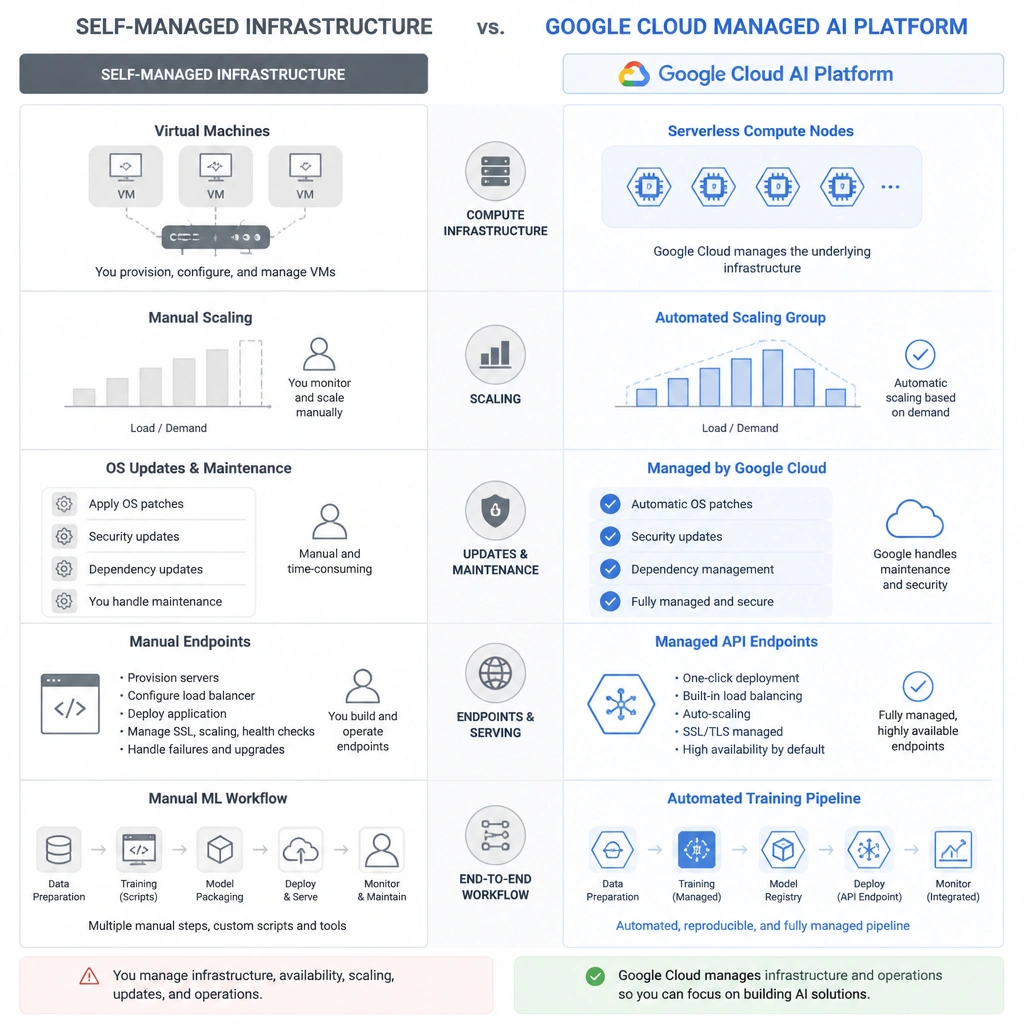
Short Explanation and Infographic
Here's the deal: in the real world, managing hardware is a huge pain. If you build a great model on your laptop, how do you scale it when thousands of users start hitting it? If you deploy on raw virtual machines, you're stuck patching OS versions, configuring load balancers, and worrying about physical hardware. Nobody has time for that! By deploying your model on a managed service like Google Cloud's AI Platform or Vertex AI, you let Google handle the heavy lifting. They manage the servers, scale the GPUs, and host your model endpoints. It's like renting a fully staffed kitchen instead of building a restaurant from scratch. Trust me on this, managed services let you focus on your code and your data, not on keeping the lights on in the data center.
Full explanation below image
Full Explanation
Managed machine learning platforms, such as Google Cloud's AI Platform (integrated into Vertex AI), are designed to streamline the machine learning lifecycle by abstracting away infrastructure management. The key benefit of these platform-as-a-service (PaaS) offerings is that they provide a fully managed environment for both training and serving machine learning models. During the training phase, the service automatically provisions compute resources (including high-performance CPUs, GPUs, or TPUs), executes the training job, and deprovisions the resources when finished, optimizing costs. For deployment (serving), it hosts the model behind a secure, auto-scaling API endpoint, managing load balancing and infrastructure availability automatically. Managed cloud services are not free; they operate on a pay-as-you-go model based on the compute type and storage duration used. These platforms support a wide variety of hardware accelerators, including GPUs and Tensor Processing Units (TPUs), rather than restricting training to CPUs. Finally, it is not a local text editor; it is a suite of cloud-based services and APIs for orchestrating machine learning workflows. Therefore, the core benefit is the automated management of infrastructure for training and serving models.