Your team has built a machine learning model using a specific combination of Python libraries, system packages, and GPU drivers. To prepare for production deployment, you decide to package the model inside a Docker container. What is the main advantage of using containerization for this deployment?
Select an answer to reveal the explanation.
Short Explanation and Infographic
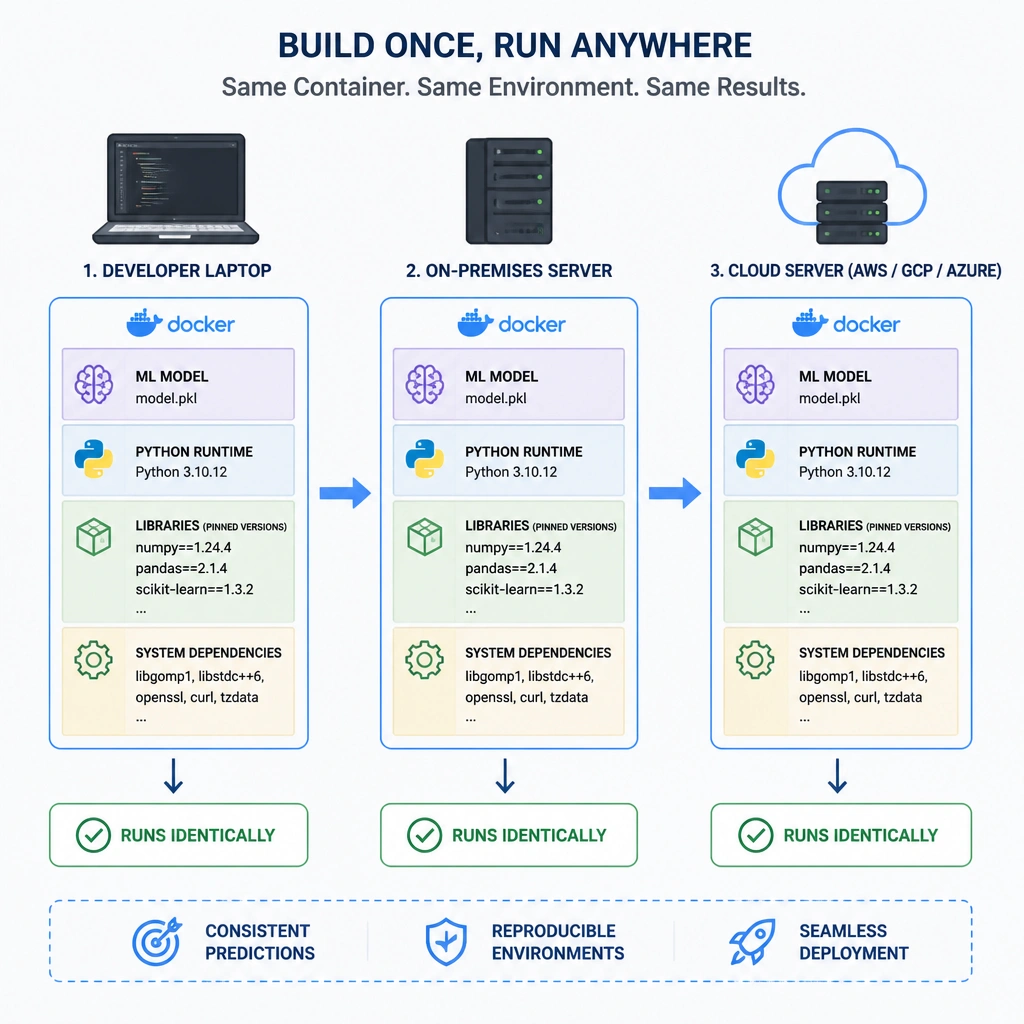
Pay close attention here, because this one bites people in production all the time. Have you ever written code that worked perfectly on your machine, but the moment you pushed it to the test server, it blew up? We've all been there. It's usually because of mismatched library versions or missing environment variables. Docker completely solves this headache by letting you wrap your model, your specific Python version, and all your library dependencies into a neat little package called a container. Think of it like a shipping container: it doesn't matter if it's on a cargo ship, a train, or a truck; the cargo inside stays exactly the same. That container will run the exact same way on your laptop, your company's server, or a cloud cluster. Got it? Sweet.
Full explanation below image
Full Explanation
Docker is an open-source containerization platform that allows developers to package applications and all their dependencies into a standardized unit called a container. In machine learning engineering, this is incredibly valuable because ML models are highly sensitive to their runtime environments. A minor version mismatch in libraries like NumPy, PyTorch, or TensorFlow, or differences in system-level dependencies (such as CUDA drivers), can lead to unexpected model errors or subtle changes in predictions. By using Docker, developers create a container image that isolates the application and its environment from the host operating system. This ensures portability and consistency, allowing the exact same model container to run reliably on a developer's workstation, a staging server, or a production cluster. A Docker container is not a simple plain text file running natively in a web browser; it is an isolated user-space image running on top of a container engine. Containerization is designed for broad deployment and portability across any host server running Docker, not to restrict execution to a single physical machine. Additionally, containerization introduces a minor layer of virtualization overhead; while highly efficient, they do not guarantee faster training speeds than raw bare-metal hardware. Therefore, the primary advantage of Docker is environment isolation and consistent deployment across different servers.